Key Points
- For those with serious water quality concerns, the Waterdrop A1’s 7-stage filtration system is more comprehensive than the A2’s 5-stage system.
- While both models filter 100 gallons of water per day, the A2 achieves approximately 75% efficiency (3:1 pure-to-drain ratio) vs. A1’s approximately 67% efficiency (2:1 pure-to-drain ratio), wasting less water during the filtration process.
- The A1 is heavier and takes up more counter space, while the A2 is more compact and better suited for smaller kitchens.
- The A2 is a more affordable option for those on a budget, without significantly compromising on core filtration performance.
Waterdrop A1 vs A2: Which Filter Will Change Your Water?
Finding the right water filtration system can make a big difference to the quality of water in your home. The Waterdrop A1 and Waterdrop A2 are two of the most advanced countertop reverse osmosis systems available today, but deciding between them means understanding what each one does best.
The A1 and A2 models both employ reverse osmosis technology, which is seen as the best in the business for home water filtration.
This technology works by pushing water through a semipermeable membrane, which removes contaminants down to 0.0001 microns. This is small enough to filter out bacteria, viruses, and dissolved solids that conventional filters fail to catch. The difference between the two models is in how they implement this technology and the extra filtration stages they include.
Whether you’re dealing with municipal water loaded with chlorine or well water containing sediment and minerals, the right Waterdrop system can transform your drinking experience. Let’s dive deep into what separates these two powerful filtration systems and help you determine which deserves a place on your countertop.
Key Differences
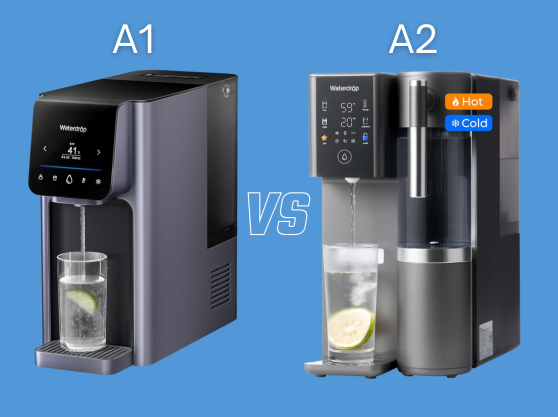
Before we dive into the details, it’s important to note the main differences between the Waterdrop A1 and A2. The biggest difference is the filtration process – the A1 uses a thorough 7-stage filtration system, while the A2 uses a simpler 5-stage system. This directly affects their ability to purify water and the kinds of contaminants they can remove effectively.
Another key difference between the two is their size and weight.
The A1 is heavier and larger than the A2, which means it takes up more space on the countertop. This could be a problem in homes where space is limited.
The A2, on the other hand, has a more compact design, making it easier to fit into smaller kitchens without taking up too much counter space.
The A2 is also more water-efficient, achieving approximately 75% efficiency with a 3:1 pure-to-drain ratio compared to the A1’s approximately 67% efficiency with a 2:1 pure-to-drain ratio. This essentially means that the A2 wastes less water during the filtration process. This is a significant factor for those who are environmentally conscious or have high water bills.
In short:
- A1 features 7-stage filtration with dual UV sterilization; A2 offers 5-stage filtration with UV sterilization
- A2 is more compact and lighter than the A1
- A2 achieves approximately 75% efficiency (3:1 ratio) vs. A1’s approximately 67% efficiency (2:1 ratio)
- Both filter 100 gallons of water daily
- A2 typically costs less initially and has lower operational costs
See Price of the Waterdrop WD-A1 on Amazon | See Price of the Waterdrop WD-A2 on Amazon
Why These Systems Matter For Your Home
In an era where water quality concerns are mounting, investing in a high-performance filtration system isn’t just a luxury – it’s increasingly becoming a necessity. Municipal water supplies, while generally safe by regulatory standards, often contain chlorine, chloramines, and trace pharmaceuticals that affect taste and potentially long-term health.
Private well users face different challenges, including sediment, heavy metals, and bacterial contamination. Both the Waterdrop A1 and A2 target these issues, removing up to 99% of harmful contaminants while preserving beneficial minerals that cheaper filters often strip away.
Waterdrop A1 vs A2: Design and Build Quality
Both Waterdrop models are designed to impress right from the first glance. They have a sleek and modern look that fits perfectly into any contemporary kitchen, and they also show off their high-tech capabilities.
Both models are made with high-quality, food-safe plastics and have clear sections so you can see the filtration process in action. This not only looks cool, but it also gives you peace of mind that your system is working properly.
Many users appreciate the A1’s larger form factor, which makes it feel more durable and advanced. Despite its smaller size, the A2 doesn’t feel any less substantial – Waterdrop has managed to make it more space-efficient without sacrificing its robustness.
Both models have leak-proof connections and stable bases that won’t tip over, even when their water reservoirs are filled to the brim.
Counter Space
The amount of counter space a filtration system takes up is a crucial factor for many, as kitchen counter space is often limited. The Waterdrop A1 is a bit larger and needs more counter space. This is due to the additional filtration stages and UV sterilization component it contains, which are worth the extra space they take up.
The Waterdrop A2 is a standout when it comes to saving space, thanks to its more compact size. This makes it perfect for apartments, smaller kitchens, or homes where countertop space is at a premium. Despite its smaller size, the A2 doesn’t skimp on the amount of water it can filter – both models can provide 100 gallons of filtered water per day, which is more than enough for even larger families.
Build Quality and Longevity
Upon assessing the build quality of both models, it is clear that Waterdrop does not compromise on the quality of their products.
Both the A1 and A2 are made from BPA-free, food-grade materials that are designed to withstand years of everyday use.
The A1’s slightly higher quality materials attribute to its heavier weight but also increase its durability when used consistently. The filtration chambers in both models are made from high-quality, clear plastic that does not become cloudy even after years of use – enabling you to visually check the water flow and the condition of the system.
Both models are reinforced at stress points, with the A1 having extra structural support around its more complex filtration system.
The A2 is lighter and easier to move than the A1. Like many countertop dispensers, it may arrive with a small amount of residual water because it is water tested before leaving the factory.
Control Panel and User Interface
The A1 and A2 models differ slightly in the user experience they offer.
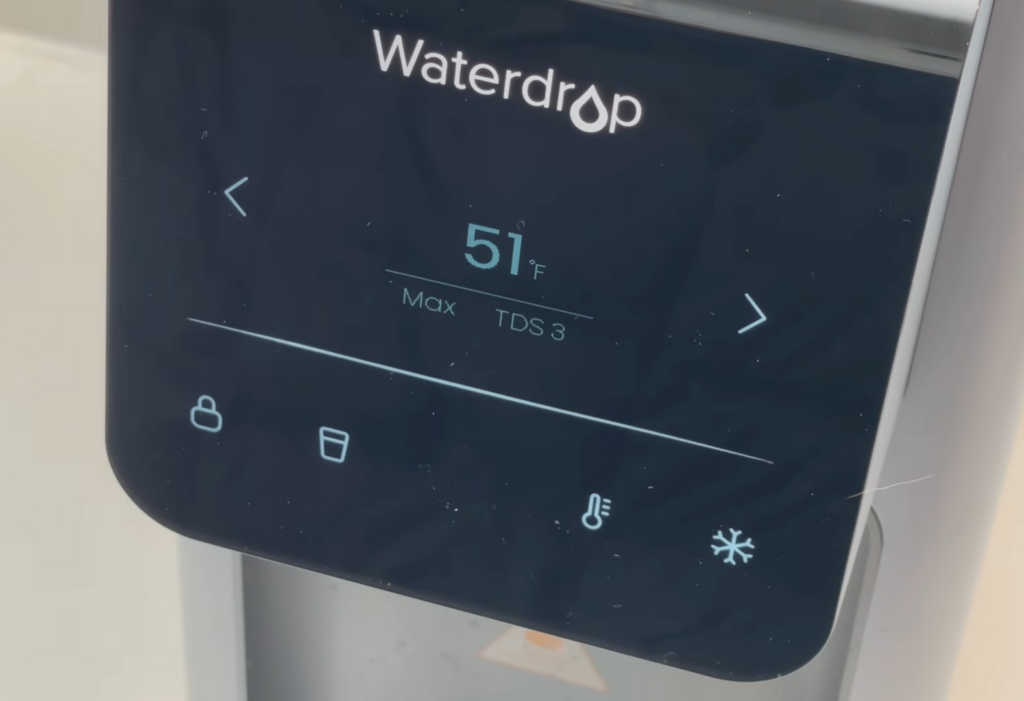
The A1 features a more detailed digital control panel that provides real-time filtration status, filter life indicators, and UV sterilization monitoring.
This user-friendly interface removes any guesswork about the system’s performance and maintenance needs. Several indicator lights provide visual cues about the system’s operation, with color changes alerting you when it’s time to replace the filters.
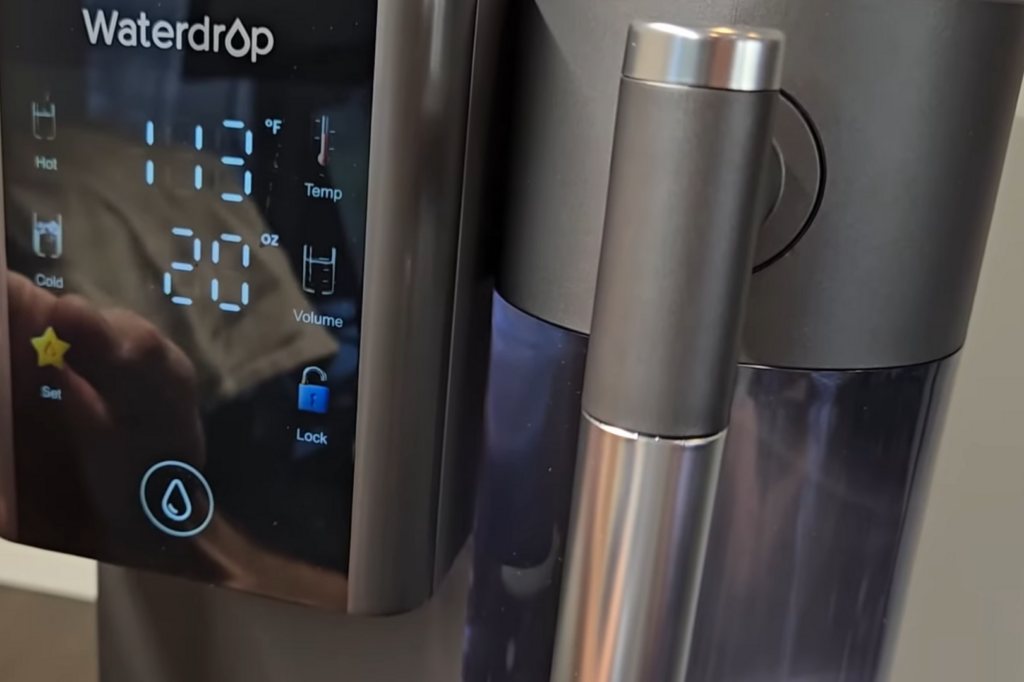
On the other hand, the A2 has a more streamlined interface with a simplified control panel that still provides essential information about the filtration status and filter life. The more minimalist design aligns with the A2’s space-saving philosophy while ensuring users still have access to critical system information.
Both control panels are responsive to touch and remain functional even with wet fingers – a thoughtful design consideration for a kitchen appliance.
Waterdrop A1 vs A2: Comparing Filtration Technologies
The most crucial element of any water filtration system is its purification technology. This is where we see the most significant differences between the Waterdrop A1 and A2. Both use reverse osmosis as their main filtration method. However, the way they implement this method and the supporting technologies they use create unique performance characteristics.
Knowing these differences is key to figuring out which system is best suited to your particular water quality issues and household requirements.
7-Stage A1 vs 5-Stage A2 System
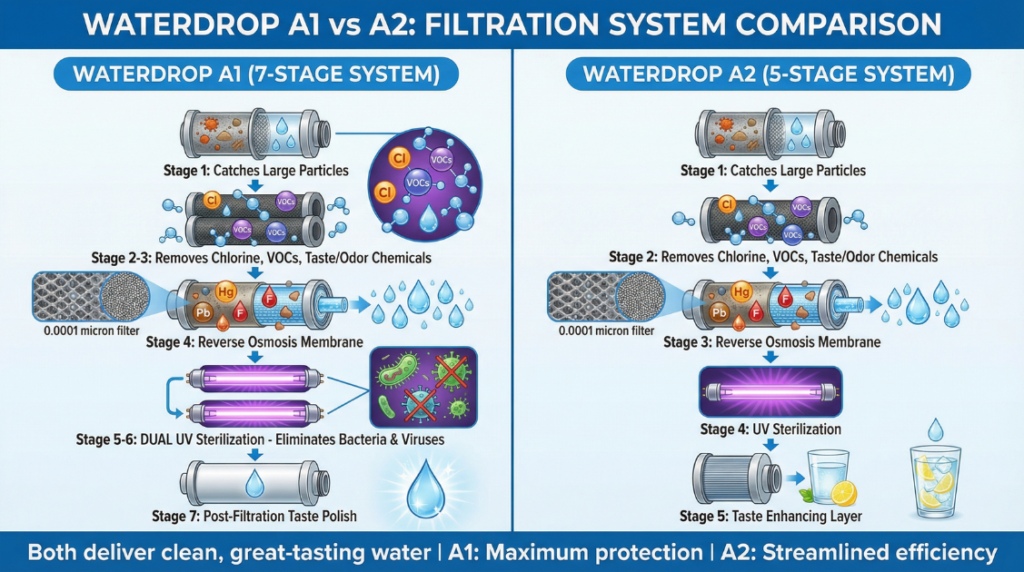
The Waterdrop A1’s 7-stage filtration system is more comprehensive due to its additional sediment pre-filtration layers and dual carbon stages. This not only protects the following stages but also prolongs the life of the more specialized filters downstream.
Breaking down the stages:
- The A1 starts with two mechanical filtration layers that catch larger particles like rust, sand, and debris
- It then features two separate carbon filtration stages—one for activated carbon granule and one for carbon block—which target chlorine, volatile organic compounds (VOCs), and chemicals affecting taste and odor.
- The fourth stage is the core 0.0001 micron reverse osmosis membrane, which removes dissolved solids, heavy metals, and fluoride.
- The final stages include dual UV sterilization for internal tank protection, followed by post-filtration that polishes the water’s taste before dispensing.
In contrast, the A2’s 5-stage system is more streamlined in that it combines its initial filtration into a single pre-filtration stage, followed by one multi-layer activated carbon block (rather than two separate carbon stages), then the same 0.0001 micron RO membrane.
The A2 includes a taste-enhancing post-filtration stage and single UV sterilization. The key difference is the A1’s redundancy—two mechanical layers, two carbon stages, and dual UV—versus the A2’s consolidated approach with combined filter cartridges.
Both systems include UV sterilization. Ultraviolet light is used to help reduce microorganisms that may remain after filtration. This can be especially useful for households concerned about biological contamination or those using well water sources.
If you’re interested in exploring other water filtration options, consider checking out our guide on the best countertop water filters for well water.
How Often You’ll Need to Change the Filters
Knowing how often you’ll need to change the filters on each system can help you figure out which one is the best value in the long run. The A1 has a more complicated filtration system, so you’ll need to change the filters at different times.
The pre-filters usually need to be changed every 6 months, depending on how much you use them. The RO membrane can last for approximately 12 months, but it depends on the quality of your water and how much you use it. The post-filters typically need to be changed every 12 months to keep the water tasting good and to keep the minerals in it.
The A2’s sleeker design means less maintenance, with fewer filter parts to keep an eye on and change. The combined A2RF filter cartridge lasts approximately 12 months. Verify RO membrane lifespan with official Waterdrop documentation for your region.
Waterdrop A1 vs A2: Performance and Quality of Water
Both the Waterdrop A1 and A2 produce excellent results when it comes to real-world performance. However, there are some differences that may sway your decision one way or the other.
Below we look at key factors including flow rate, daily output capacity, and most importantly, the quality of the water they produce. Both systems noticeably improve the taste and clarity of the water, but there are some subtle differences that are worth noting.
Both models have been shown in lab tests to reduce Total Dissolved Solids (TDS) by over 90%, turning even the most contaminated water into crystal clear, delicious drinking water.
Both systems almost completely remove chlorine, which can affect the taste and smell of water, eliminating the chemical taste that makes many tap waters unpleasant to drink. This level of performance is more effective than what you’ll find in pitcher filters or faucet attachments.
How Fast They Produce Filtered Water and Their Daily Capacity
One of the most important features of a water filtration system is how quickly it can filter water – no one wants to wait around for a glass of water.
The Waterdrop A1 has a flow rate of 0.07 GPM (approximately 264 ml per minute), which means a standard 8-ounce glass takes approximately 54 seconds to fill. The A2 is just as fast, even though it has a more compact design and a different filtration system.
The A1 and A2 both have a daily capacity of 100 gallons, which is more than enough for most households, even those with large families. This means you won’t have to worry about your filtration system not being able to keep up with your water needs.
Even during high usage times, like when you’re cooking dinner or in the morning when everyone is getting ready for the day, both the A1 and A2 perform consistently.
Water Efficiency Ratings
Water efficiency is a key differentiator between these two models.
The A2 achieves approximately 75% efficiency with a 3:1 pure-to-drain ratio, meaning 3 gallons of pure water for every 1 gallon wasted. The A1 operates at approximately 67% efficiency with a 2:1 pure-to-drain ratio, producing 2 gallons of pure water for every 1 gallon wasted.
The difference in efficiency can have significant environmental and financial effects, particularly in areas where water is scarce or utility costs are high.
Over a year of normal use, the A2 could save thousands of gallons of water compared to the A1. For those who are environmentally conscious or wish to reduce their utility bills, this increased efficiency may be enough to sway them towards the A2, despite the A1’s superior filtration capabilities.
Measuring TDS Reduction
Total Dissolved Solids (TDS) provide a clear measurement of how effectively a reverse osmosis system works. Unlike pitcher filters or basic carbon filters, RO technology removes dissolved minerals and contaminants at the molecular level—a process that can be quantified through laboratory testing and third-party certifications.
Independent Lab Testing Results
The Waterdrop A1 has undergone independent laboratory analysis by multiple testing organizations. According to Water Filter Guru’s comprehensive lab report, the A1 achieved a 95.65% TDS reduction, lowering water from 138 ppm down to 6 ppm.
This exceeds the NSF/ANSI 58 certification requirement of at least 75% TDS reduction. According to BOS Water’s independent laboratory testing, the Waterdrop A1 achieved 98% TDS reduction.
NSF/ANSI 58 Certification Standards
The A1 is certified to NSF/ANSI 58 (performance) and NSF/ANSI 372 (materials), with lab-tested TDS reduction of 94-98%, significantly exceeding the 75% certification standard.
The A2 is certified to NSF/ANSI 372 only and does not have NSF/ANSI 58 performance certification.
Which Model Is Right For Your Home?
After closely studying the technical specifications, performance metrics, and practical considerations of both models, the choice ultimately depends on your specific household needs and priorities.
Perfect for Small Households
The Waterdrop A2 is the ideal choice for apartments, condos, or homes with limited counter space due to its compact footprint and simplified maintenance requirements.
Its 75% water efficiency ratio minimizes waste, which is particularly important in multi-unit buildings where water costs may be higher or usage more carefully monitored.
The A2’s lower initial cost and reduced operational expenses are well suited to smaller household budgets while still providing the core benefits of reverse osmosis filtration. With 100 GPD capacity, even modest households will have ample filtered water for daily needs.
Perfect for Large Families and Heavy Usage
Both systems have sufficient daily capacity (100 gallons) to meet the needs of a large family. However, the choice depends on water quality priorities:
Choose the A1 if:
- You have well water with concerns about biological contamination, sediment, or high mineral content
- Your household prioritizes maximum contaminant reduction over water conservation
- You want NSF/ANSI 58 performance certification
- You prefer dual UV sterilization for added microbial protection in unregulated water sources
Choose the A2 if:
- You have municipal water (which is already treated and regulated)
- Your family is environmentally conscious and wants to minimize water waste
- You prioritize water efficiency and cost savings
- You want comparable water quality with better resource efficiency
The A1’s more advanced filtration system is designed to address challenges specific to well water in rural areas with less regulated water sources. Well water has no EPA-mandated disinfection and commonly contains bacteria (E. coli, iron bacteria), sediment, and heavy metals.
For municipal water supplies—which are already disinfected with chlorine or chloramine at regulated levels (maximum 4 mg/L by EPA standards)—the additional filtration stages and dual UV sterilization may provide minimal practical advantage over the A2’s single UV system.
For well water users, however, UV sterilization offers real value by effectively eliminating microorganisms that chlorine-based treatment alone cannot address.
Frequently Asked Questions
Is Waterdrop A2 worth it?
Waterdrop A2 is worth it if you prioritize water efficiency, compact size, and cost savings. It includes UV sterilization and reduces common contaminants like TDS, chlorine, and dissolved minerals using reverse osmosis technology. However, note that the A2 is certified to NSF/ANSI 372 (lead-free materials) but does not have NSF/ANSI 58 performance certification like the A1.
Does Waterdrop A2 have remineralization?
No, the standard Waterdrop A2 does not include a built-in remineralization stage. However, you have options if you want mineralized water:
- Use Other RO Models – Waterdrop’s X-series and other models offer built-in remineralization as alternatives to the A2.
- Upgrade to A2G Model – Waterdrop offers an A2G variant with 6-stage filtration that includes remineralization built-in to improve taste and provide mineral content.
- Add a Separate Remineralization Filter – You can purchase Waterdrop’s MNR35 remineralization filter as an add-on accessory on Amazon. This cartridge connects to the A2’s outlet and uses “PCC technology” to restore minerals like calcium, magnesium, sodium, and potassium. The filter has universal 1/4″ quick-connect compatibility and lasts approximately 9-12 months.
Which Waterdrop under sink filter is best?
The Waterdrop G3P800 is often the best pick if you want under sink reverse osmosis with high capacity and NSF/ANSI certifications.
Is Waterdrop A1 NSF certified?
Yes, Waterdrop A1 is certified to NSF/ANSI 58 (performance certification for TDS reduction) and NSF/ANSI 372 (materials certification for lead-free components). The NSF/ANSI 58 certification validates the A1’s ability to reduce TDS by at least 75%, while NSF/ANSI 372 confirms lead-safe materials.
Does a Waterdrop filter remove calcium?
Yes, Waterdrop reverse osmosis systems can reduce calcium because RO removes dissolved minerals like calcium and magnesium that cause hardness. Standard carbon filters are mainly for chlorine, taste, and odor and may not significantly reduce calcium.
The Bottom Line
Choosing between the Waterdrop A1 vs A2 ultimately comes down to your water source and household priorities.
If you have well water or serious contamination concerns, the A1’s NSF/ANSI 58 certification, dual UV sterilization, and 7-stage filtration may justify the investment despite lower water efficiency. Check the current Waterdrop A1 price on Amazon here.
For municipal water users, the A2 delivers excellent reverse osmosis performance with 75% water efficiency, making it the smarter choice for environmentally conscious households and smaller spaces. Check current pricing of the Waterdrop A2 on Amazon here.
Both countertop systems provide 100 gallons daily capacity with comparable TDS reduction, meaning either will dramatically improve your water quality. Consider your budget, available counter space, and whether you’re filtering regulated municipal water or untreated well water to make the right decision for your home.
Disclaimer: This content is for informational purposes only. Product specifications, certifications, and features may change. Always verify current details with the manufacturer and test your water quality. As an Amazon Associate I earn on qualifying purchases at no extra cost to you.