
If you’re looking for the best countertop reverse osmosis system with remineralization, you’re likely trying to solve two problems at once without taking on an under-sink install.
These countertop water purifiers use an RO membrane to reduce contaminants such as lead, fluoride, and, in certified systems, certain PFAS, while a remineralization stage adds minerals like calcium and magnesium back in to improve taste.
The picks here include a highly certified standout, a larger-capacity option for families, a feature-packed model with hot and cold dispensing, a glass-carafe system with UV treatment, and hot-water-friendly options that make daily use easier. Since none require plumbing changes, they suit both renters and homeowners.
Top 6 Picks
Best Overall
AquaTru Carafe Alkaline
Best for: NSF certification
Check price on Amazon
Jump to review ↓
Best for Families
AquaTru Classic Smart Alkaline
Best for: Larger tank and lower cost per gallon for high-volume households
Check price on Amazon
Jump to review ↓
Best Tech Features
RKIN U1-W
Best for: Hot and cold water, hydrogen infusion, and the lowest cost per gallon
Check price on Amazon
Jump to review ↓
Best UV + Glass Carafe
Bluevua ROPOT(UV)
Best for: UV sterilization, glass carafe, and real-time TDS display
Check price on Amazon
Jump to review ↓
Best Mid-Range
BLACK+DECKER Countertop RO+UV
Best for: NSF/ANSI 58 certified, remineralization, UV, and hot water from a name brand
Check price on Amazon
Jump to review ↓
Best for Hot Water
SpiroPure SP-RO500
Best for: On-demand hot water at four temperature settings with six-stage filtration
Check price on Amazon
Jump to review ↓
Best Overall: AquaTru Carafe Alkaline
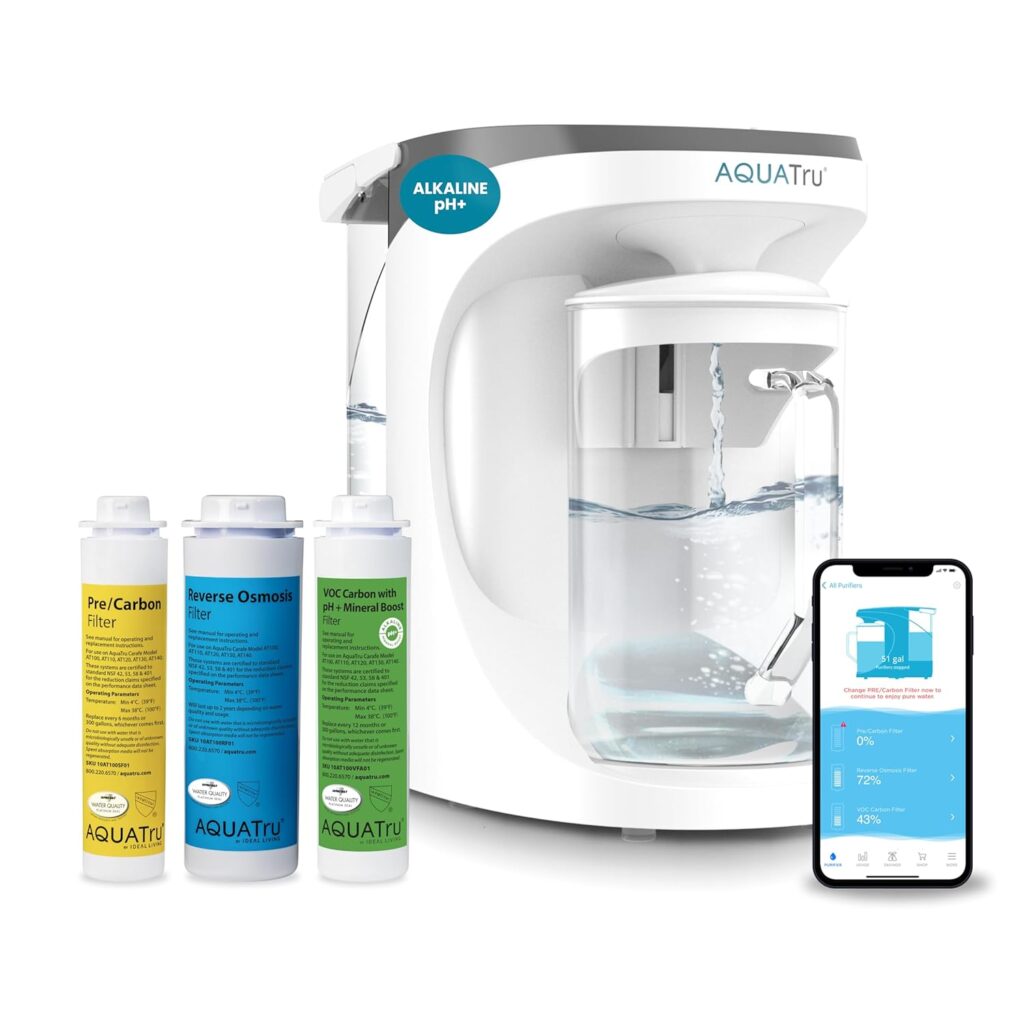
If your water report shows PFAS, lead, or fluoride and you want clear proof that a filter is taking them out, the AquaTru Carafe Alkaline is one of the easiest options to verify, marketed as tested and certified by IAPMO to NSF/ANSI 42, 53, 58, and 401, with reduction claims covering up to 84 contaminants.
Additionally, the filtered water collects in a borosilicate glass carafe, so the water stays out of contact with plastic from the membrane to the pour.
What Hits the Mark
- IAPMO certified to NSF/ANSI 42, 53, 58, and 401, covering PFAS, lead, fluoride, chromium-6, and emerging compounds
- Alkaline VOC filter adds calcium and magnesium back into the water and is designed to improve taste.
- Borosilicate glass carafe eliminates plastic taste and leaching risk in the filtered water vessel
- Covers 84 contaminants in certified testing including lead, chromium-6, fluoride, and PFAS
- Plug-and-play setup with no tools or plumbing; fully operational in under 10 minutes
What to Know First
- Filtered water collects in the glass carafe; households of more than two people will refill frequently
- Independent lab data shows magnesium restoration is more pronounced than calcium after RO filtration
- Hard source water above the manufacturer’s stated operating range can reduce membrane lifespan
Specs snapshot
Filtration type: 4-stage RO with alkaline VOC remineralization filter
Certifications: IAPMO certified to NSF/ANSI 42, 53, 58, 401
Dimensions: 14″L x 7.5″W x 13″H
Approx annual filter cost: $0.19 per gallon
Maintenance notes: Run three full priming cycles before first use and discard that water. Replace the alkaline VOC cartridge and pre-filter when the indicator signals. The glass carafe can be stored in the refrigerator between fills.
Best for Families: AquaTru Classic Smart Alkaline
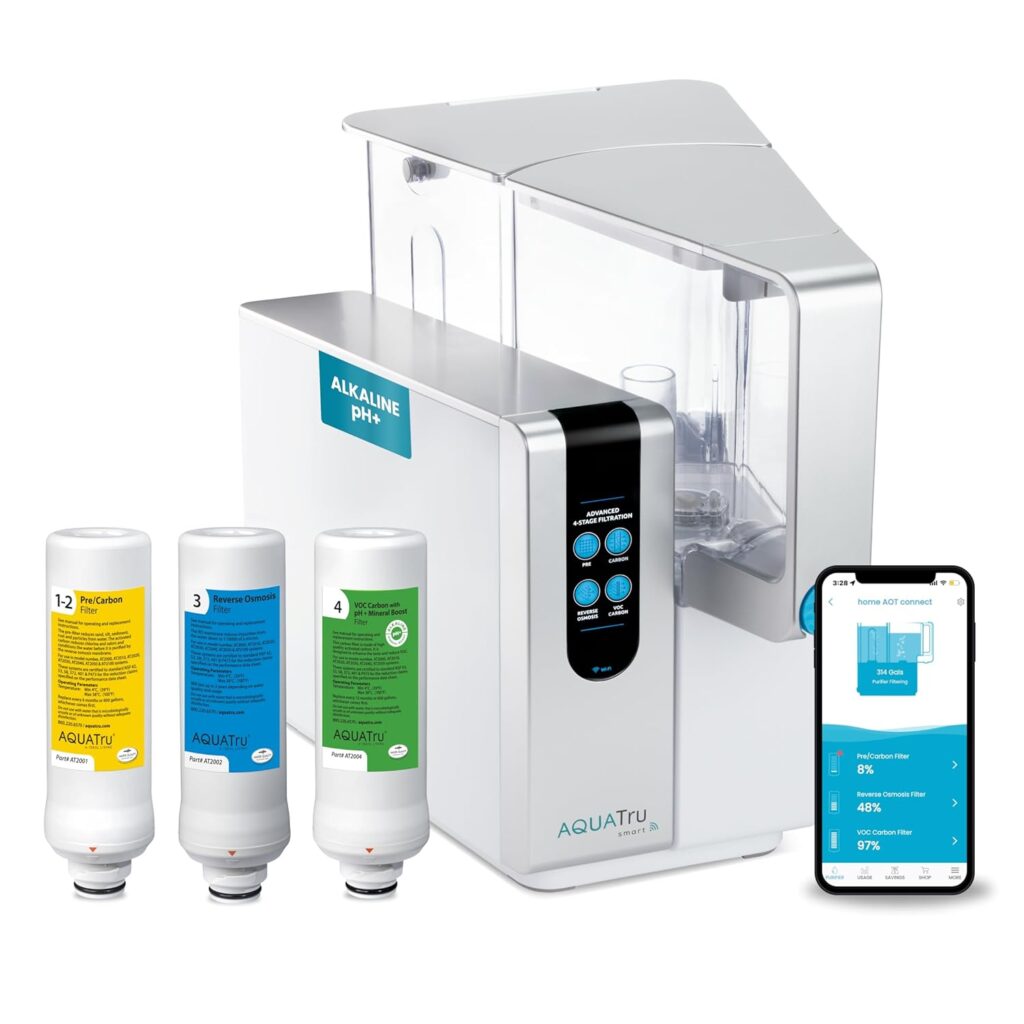
A household that drinks, cooks, and refills filtered water throughout the day needs more output than a small-carafe RO system can provide. The AquaTru Classic Smart Alkaline brings the same IAPMO certification suite as the Carafe Alkaline into a larger chassis with a 0.75 gallon clean water tank, Wi-Fi app monitoring, and a lower ongoing cost per gallon. It’s the certified drinking water purifier built for households that require extra volume.
What Hits the Mark
- Same IAPMO certification to NSF/ANSI 42, 53, 58, and 401 as the Carafe Alkaline
- 0.75 gallon (2.8 liters) clean water tank with filter capacity up to 1,200 gallons per set
- Wi-Fi app tracks filter life, water quality, and replacement alerts in real time (check model and region)
- Approximately $0.11 per gallon ongoing cost, lower than most certified countertop RO systems
- BPA and BPS-free Tritan construction; supports source water TDS up to 2,000 ppm
What to Know First
- Larger footprint at 14″L x 12″W x 14″H and approximately 22 lbs; measure counter space before ordering
- Manual refill reservoir; plan ahead on high-volume days
- Same hard water sensitivity as the Carafe Alkaline; check source water hardness against manufacturer specs
Specs snapshot
Filtration type: 4-stage RO with alkaline VOC remineralization filter
Certifications: IAPMO certified to NSF/ANSI 42, 53, 58, 401; 84 contaminants
Capacity (clean water tank): 0.75 gallon (2.8 liters)
Dimensions: 14″L x 12″W x 14″H
Filter life: 6 months to 2 years depending on stage
Approx annual filter cost: Approximately $0.11 per gallon
Maintenance notes: Run two clean cycles before first use. The app and indicator light signal per-stage replacements. Filters use a twist-and-lock design for tool-free swaps.
Best Tech Features: RKIN U1-W
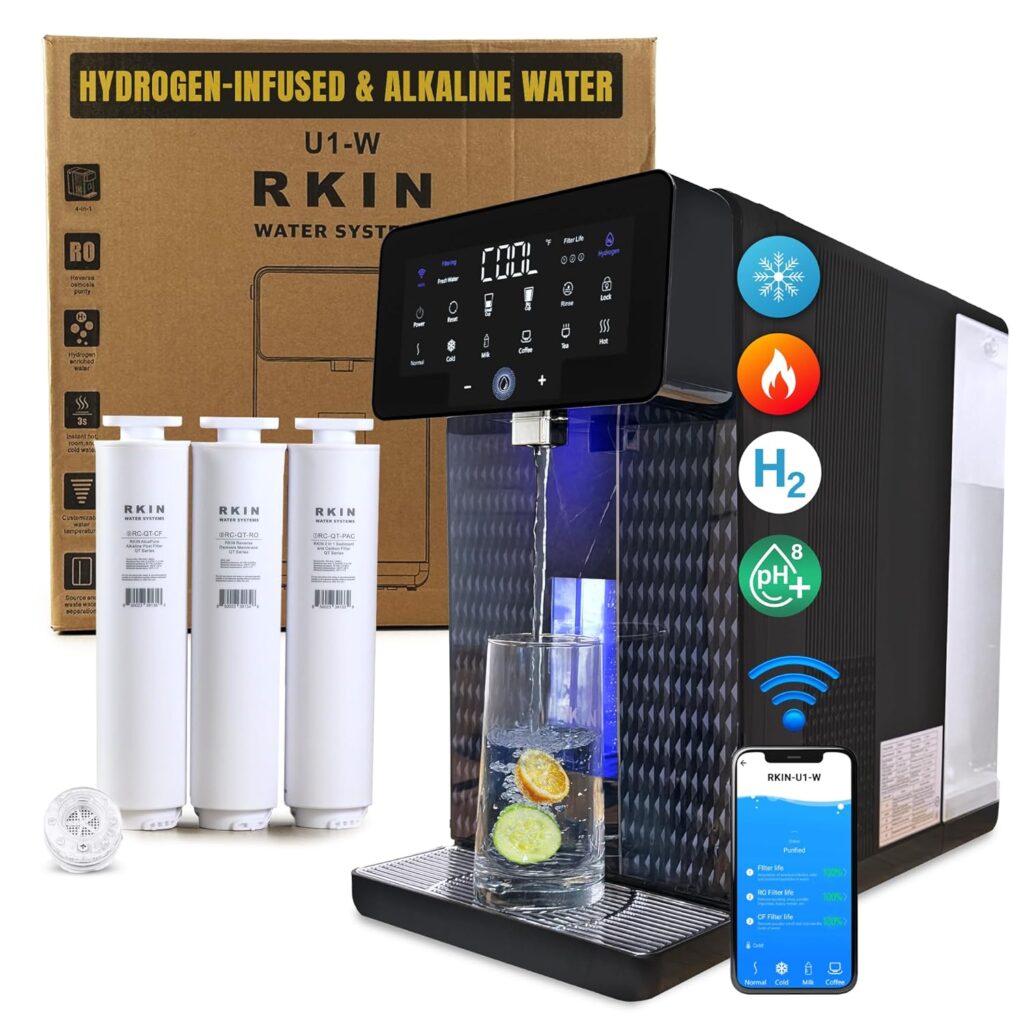
The RKIN U1-W is for buyers who want more from their water system than straightforward filtration.
It combines five-stage RO with alkaline remineralization, hydrogen infusion for negative ORP water, and hot and cold dispensing at customizable temperatures, all in one countertop unit. An app monitors filter life and water quality in real time, and the built-in TDS meter gives you an ongoing read on output quality.
What Hits the Mark
- Combines RO purification, alkaline remineralization, hydrogen infusion, and hot and cold dispensing in one countertop unit
- Built-in TDS meter and app monitoring track water quality and per-stage filter life in real time
- Customizable hot water temperature and dispensing volume settings
- U1’s five-stage system is marketed as third-party tested for fluoride and lead reduction, along with other contaminants
- Supports source water TDS up to 800 ppm; no installation required
What to Know First
- 0.5 gallon tank is smaller than most countertop RO systems; best suited for one to two people
- Larger footprint at 19″L x 9.5″W x 17″H and 24 lbs
- Verify third-party certification details independently before purchasing
Specs snapshot
Filtration type: 5-stage RO with alkaline remineralization and hydrogen infusion
Capacity: 0.5 gallons
Dimensions: 19″L x 9.5″W x 17″H
Weight: 24 lbs
Filter life: 6 to 24 months depending on stage and usage
Maintenance notes: The app sends per-stage filter alerts so you replace only what needs replacing. Follow the manufacturer’s schedule by stage to maintain membrane performance over time.
Best UV + Glass Carafe: Bluevua ROPOT(UV)
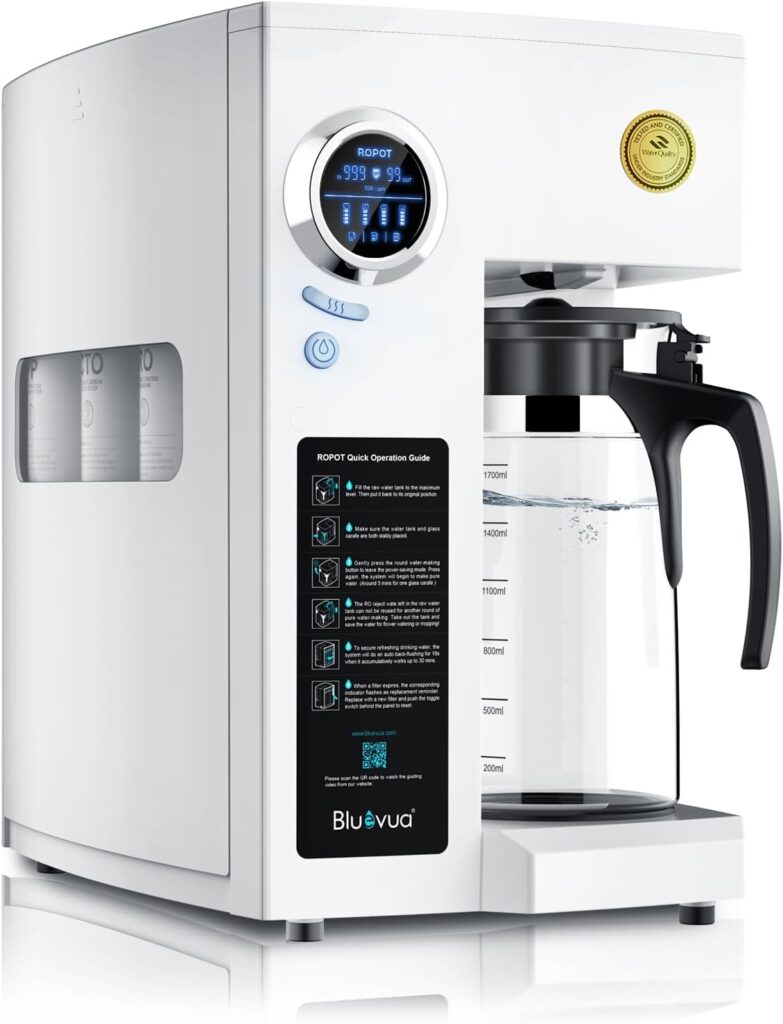
The Bluevua ROPOT(UV) delivers six-stage purification including UV sterilization and remineralization in a borosilicate glass output carafe, with a live TDS display showing input and output readings side by side. It pairs UV treatment with a borosilicate glass carafe, which is still uncommon in countertop RO systems.
What Hits the Mark
- Six-stage purification: sediment, carbon block, RO membrane, post-carbon polish, remineralization, and UV sterilization in the storage tank
- Borosilicate glass carafe reduces plastic contact in the filtered-water container
- Pre- and post-filter TDS display shows input and output water quality simultaneously
- 2:1 pure-to-drain wastewater ratio and self-cleaning function reduce waste and maintenance
- No installation required; fully portable for renters, apartments, and RV use
What to Know First
- Bluevua says the system is certified by WQA against NSF/ANSI/CAN 372 for lead-free materials and tested by SGS for contaminant reduction claims
- Output carafe holds 1,700 mL (approximately 0.45 gallons); source water TDS should stay at or below 500 ppm
- Maximum flow rate is listed as 0.26 liters per minute, and customer reports on the listing suggest a full carafe generally takes under 10 minutes
Specs snapshot
Filtration type: 6-stage RO with UV sterilization and remineralization
Certifications: WQA certified to NSF/ANSI/CAN 372 for lead-free materials; contaminant reduction claims are described as SGS tested
Output capacity: 1,700 mL (approximately 0.45 gallons)
Dimensions: 10.9″L x 15.4″W x 14.3″H
Maximum flow rate: 0.26 L/min
Filter life: 12 to 24 months
Wastewater ratio: 2:1
Maintenance notes: The system includes a self-cleaning function, which can help reduce manual maintenance. Replace filter cartridges based on the indicator or when post-filter TDS starts trending upward. The glass carafe can be removed for cleaning separately.
Best Mid-Range: BLACK+DECKER Countertop RO+UV
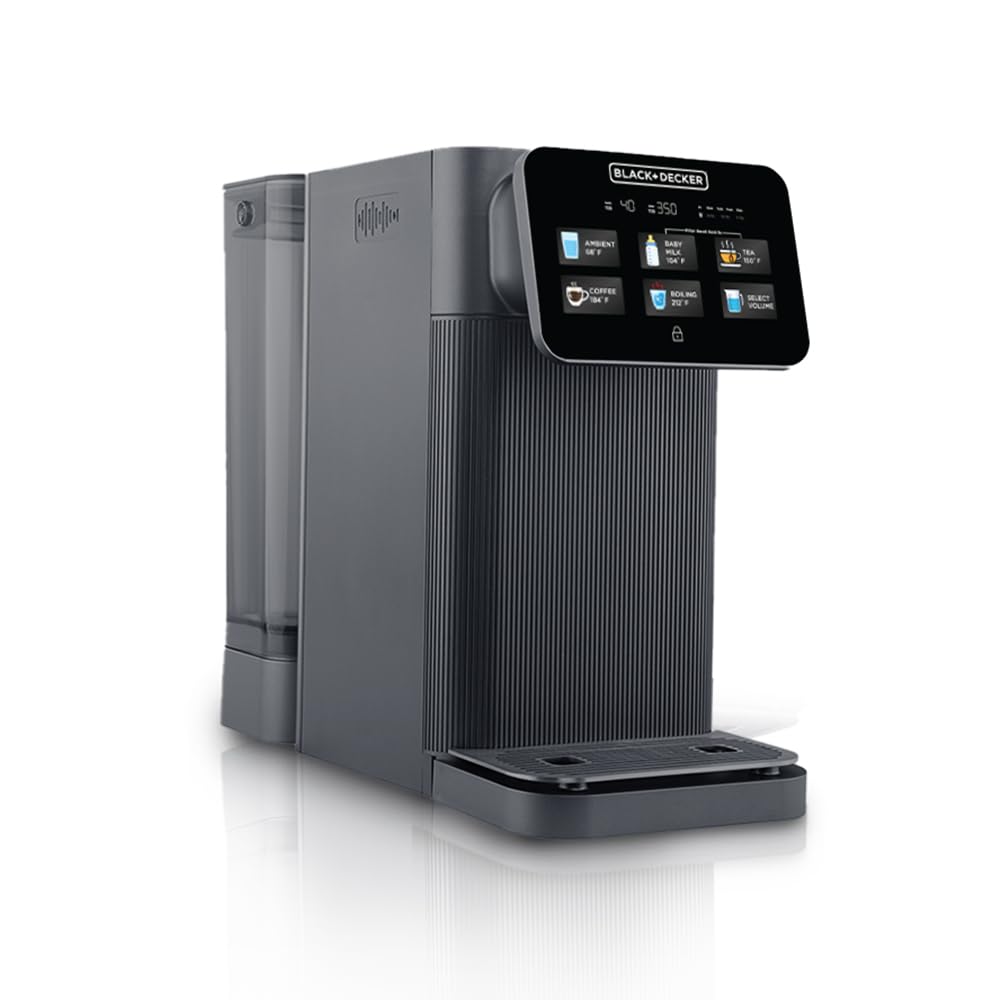
Not every household needs a four-standard certification suite to get clean, remineralized drinking water. The BLACK+DECKER Countertop RO+UV is listed as NSF/ANSI 58 certified via IAPMO and backed by a manufacturer with established quality controls and a warranty program.
It adds UV sterilization, a remineralization stage, and hot water dispensing in a plug-and-play design that needs no installation or plumbing.
What Hits the Mark
- NSF/ANSI 58 certified via IAPMO
- Five-stage system includes RO membrane, UV sterilization in the storage tank, and a remineralization stage
- Hot water at five temperature presets (ambient, tea, coffee, boiling, baby milk) with three dispensing volume options
- 2:1 pure-to-drain wastewater ratio; filter life up to 12 months
- LED display shows real-time TDS and filter life; 1-year warranty with lifetime technical support
What to Know First
- Hot and ambient dispensing only; no cold water option (lowest temperature rating at 54 degrees F)
- Plug-and-play countertop setup; no tools, drilling, or plumbing connections required
Specs snapshot
Filtration type: 5-stage RO with UV and remineralization
Certifications: NSF/ANSI 58 certified via IAPMO
Filter life: up to 12 months
Wastewater ratio: 2:1
Warranty: 1 year manufacturer
Maintenance notes: The LED display signals when filter replacement is due. Run several priming cycles before first use to clear the carbon media fully. Replace the cartridge at the indicator prompt or when output TDS rises noticeably.
Best for Hot Water: SpiroPure SP-RO500
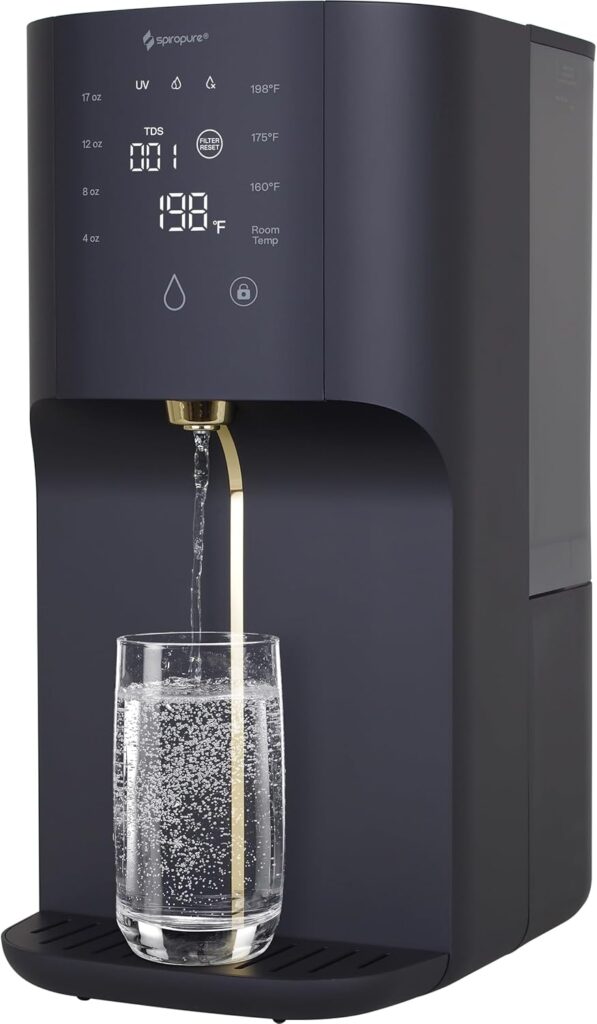
Tea drinkers, pour-over coffee enthusiasts, and parents making formula know how much a kettle can slow down a morning. The SpiroPure SP-RO500 cuts out that extra step by combining six stage reverse osmosis filtration with instant hot water at the push of a button.
At 11.7 pounds with a 7.9-inch width, it is one of the lightest and most compact countertop RO systems available, and its 4:1 pure-to-drain ratio keeps water waste low.
What Hits the Mark
- Instant hot water at four temperature presets up to near boiling, with no separate kettle needed
- Six-stage filtration: sediment, activated carbon, polypropylene pad, RO membrane, MineralPlus alkaline remineralization, and UV sterilization
- Single SP-RO525 replacement cartridge covers five of the six stages and swaps in about one minute
- Among the lightest countertop RO systems available at 11.7 lbs; compact 7.9-inch width fits tight counters
- 4:1 pure-to-drain ratio keeps wastewater low relative to filtered output
What to Know First
- Slow flow rate at 0.03 GPM; not ideal for households that need high-volume output quickly
- One-gallon tank may require multiple refills daily in active households
Specs snapshot
Filtration type: 6-stage RO with MineralPlus remineralization and UV
Certifications: None listed by manufacturer
Dimensions: 11.7″D x 7.9″W x 15.7″H
Weight: 11.7 lbs
Filter life: approximately 12 months per cartridge
Wastewater ratio: 4:1
Maintenance notes: Setup takes about 15 minutes. The removable magnetic drip tray accommodates mugs, travel cups, and larger vessels. The SP-RO525 cartridge is the main annual maintenance item.
How to Choose the Right Countertop RO System with Remineralization
Why Certifications Are the First Thing to Verify Before Anything Else
The phrase ‘tested to NSF standards’ does not mean the same thing as ‘NSF certified.’ Actual certification should be verifiable through the certifier’s public database or the brand’s certification listing.
For a countertop reverse osmosis system:
- NSF/ANSI 58 is the core standard. Specific contaminant reductions depend on the claims the product is actually certified for.
- NSF/ANSI 401 covers certain emerging contaminants. For PFAS, look for NSF/ANSI 53 or 58 with a PFAS reduction claim.
- NSF/ANSI 53 covers lead and health-related contaminants.
- NSF/ANSI 42 covers taste and odor.
Note that NSF/ANSI 372 covers lead-free materials only and says nothing about contaminant removal performance. The AquaTru Carafe Alkaline and Classic Smart Alkaline both carry IAPMO certification across all four relevant standards.
Remineralization and Real Mineral Restoration vs pH Adjustment
RO filtration removes calcium, magnesium, and most dissolved minerals along with contaminants. Without a remineralization stage, RO water can taste flatter because most dissolved minerals have been removed.
A remineralization cartridge adds back minerals and raises pH, but the degree varies between systems. The AquaTru alkaline filter is designed to add minerals back in and create pH-balanced alkaline water. If matching natural spring water mineral content is the goal, look for published post-filter TDS and mineral data.
Tank Size, Flow Rate, and Daily Water Volume
Most countertop water purifiers hold well under one gallon of filtered water at a time. For a household of two, one daily refill is generally manageable. For three or more people, or anyone using filtered water heavily for cooking, look for a larger clean water tank or faster flow rate.
| System | Clean Water Capacity | Flow Rate | Best For |
| AquaTru Carafe Alkaline | Glass carafe (under 1 gal) | Slow | Singles and couples; glass carafe preferred |
| AquaTru Classic Smart Alkaline | 96 fl oz | Slow | Families needing certified higher volume |
| RKIN U1-W | 0.5 gallons | Moderate | Hot and cold users; one to two people |
| Bluevua ROPOT(UV) | 1,700 mL (0.45 gal) | 0.069 GPM | Portable use; UV and glass carafe priority |
| BLACK+DECKER RO+UV | 75-gallon filter capacity | Moderate | Budget buyers who need NSF certification and hot water |
| SpiroPure SP-RO500 | Approximately 1 gallon | Slow | Hot water and cooking use; one to two people |
Hard Water and Membrane Longevity
Countertop RO membranes can be sensitive to high source water hardness. Levels above the system’s stated operating range can scale the membrane over time and reduce filtration performance.
If your water tests above 10 to 15 grains per gallon (GPG), check the manufacturer’s operating range before buying. A sediment pre-filter or portable water softener placed upstream can extend membrane life considerably.
Wastewater Ratio: How Much Water Do RO Systems Use?
Every reverse osmosis system produces wastewater as a byproduct of pushing water through the membrane. Advertised ratios show how much filtered water you get relative to wastewater produced.
The SpiroPure SP-RO500 advertises a 4:1 filtered-to-waste ratio. The Bluevua ROPOT(UV) and BLACK+DECKER both claim 2:1. If water conservation is a priority, look for a published ratio and cross-reference against user reports for real-world confirmation.
What Contaminants Can a Countertop RO System with Remineralization Reduce
Reverse osmosis is one of the most thorough home drinking water filtration methods available. The semi-permeable RO membrane blocks particles based on size and charge, addressing contaminants that activated carbon filters cannot touch.
| Contaminant | RO Effective | Notes |
| PFAS (forever chemicals) | Yes | Look for a product that clearly lists PFAS reduction claims or shows certification backing for that claim. |
| Lead | Yes | NSF/ANSI 53 or 58 certification covers lead reduction |
| Fluoride | Yes | Significant reduction; NSF/ANSI 58 verifies where certified |
| Arsenic | Yes | Confirmed under NSF/ANSI 58 testing |
| Nitrates | Yes | Effective; important for well water users |
| Chromium-6 | Yes | AquaTru independently tested for this |
| Chlorine and chloramines | Yes | Carbon pre-filter stage handles most of this |
| Bacteria and viruses | Partial | Built-in UV sterilization adds extra protection |
| Hardness minerals | Yes | RO removes calcium and magnesium; remineralization adds back partial amounts |
RO alone does not reliably eliminate bacteria and viruses, though it reduces many by size exclusion. For microbiological risk, UV sterilization is the more dependable solution.
The Bluevua ROPOT(UV), BLACK+DECKER Countertop RO+UV, and SpiroPure SP-RO500 all include UV sterilization built into the filtered water storage tank.
Testing Your Water Before Buying a Countertop RO System
A water test tells you exactly which contaminants are present at what levels, so you can match the right NSF certifications to your actual situation rather than guessing.
If you are on city water, your utility publishes an annual Consumer Confidence Report. The EWG Tap Water Database also shows utility-level data by ZIP code and is worth checking for PFAS and lead specifically.
For well water, a mail-in test from a state-certified lab gives you specific readings on nitrates, arsenic, bacteria, hardness, and TDS. A TDS meter is also useful after installation to confirm the system is performing as expected and to track output quality over time.
When a Countertop RO System Is Not Enough
A countertop water purifier addresses drinking and cooking water. It does not treat water at every tap in your home.
If iron staining is appearing on fixtures, sulfur odor is coming through showers, or sediment is clogging multiple outlets, the problem is upstream. Those situations require a whole-house water filtration system.
For well water with confirmed bacterial contamination, a point-of-entry UV system provides more complete protection than a countertop UV stage alone. In very hard water regions, pairing a water softener with a dedicated RO drinking water filter is a more sustainable long-term approach.
FAQ About the Best Countertop Reverse Osmosis System with Remineralization
What is the best countertop reverse osmosis system with remineralization?
The AquaTru Carafe with the remineralization upgrade is the strongest certified option in the category, carrying NSF/ANSI 42, 53, 58, and 401. For families who need more daily volume, the AquaTru Classic offers the same certifications at a lower cost per gallon.
Does a countertop RO system with remineralization actually remove PFAS?
Yes, reverse osmosis is one of the most effective methods for removing PFAS from drinking water, with typical reduction rates above 95 percent. For verified PFAS claims, look for NSF/ANSI 53 or 58 with a PFAS reduction claim. Check the NSF or IAPMO public databases to confirm certification status before purchasing.
Does remineralization improve RO water taste?
For most people, yes. Standard RO water tests between pH 5.0 and 6.5 after filtration and has near-zero mineral content, producing a flat or slightly sour taste. A remineralization filter raises pH and restores calcium and magnesium. The degree of mineral restoration varies by system, so check published post-filter pH data where available.
How often do you replace filters in a countertop reverse osmosis system?
Pre-filter and carbon stages typically need replacement every 6 to 12 months. RO membranes last 1 to 2 years. Remineralization cartridges have their own schedules. All six systems in this guide include filter life indicators or app alerts. Higher TDS or harder source water accelerates filter wear.
Countertop RO vs under-sink RO for remineralization: which is better?
Under-sink RO systems offer larger output and more consistent flow but require drilling, drain connections, and plumbing experience. Countertop reverse osmosis systems are fully portable and require no installation, making them the only practical RO option for renters. Certified countertop systems like AquaTru match many under-sink models for drinking water filtration performance.
| Option | Best For | Tradeoffs |
| Countertop RO with remineralization | Renters, portable use, no installation | Manual refill, smaller daily output |
| Under-sink RO with remineralization | Homeowners, high daily volume | Requires installation, higher setup cost |
What NSF certifications should a countertop RO system have?
NSF/ANSI 58 is the core standard for reverse osmosis systems and verifies actual contaminant reduction, not just materials safety. NSF/ANSI 401 covers certain emerging contaminants. PFAS claims should be checked on the product’s actual certification or performance listing. NSF/ANSI 53 addresses lead and health contaminants. NSF/ANSI 42 covers taste and odor. Avoid systems that list only NSF/ANSI 372, which covers lead-free construction only and says nothing about what the filter removes.
Can a countertop RO system handle well water?
Many countertop RO systems can handle well water. RO handles nitrates, arsenic, and dissolved metals effectively. High sediment loads clog pre-filters faster, so a sediment pre-filter upstream helps protect the membrane. For bacterial risk, a unit with built-in UV sterilization adds meaningful protection. Testing the well water first is the most reliable way to select the right system for your specific contaminants.
Conclusion
If you’re trying to find the best countertop reverse osmosis system with remineralization, the goal is not just cleaner water. It’s cleaner water that also tastes good enough to drink every day.
A reverse osmosis water filter can reduce contaminants like lead, fluoride, and in certified systems, certain PFAS, while the remineralization stage puts minerals like calcium and magnesium back into the water, which can help improve taste and make the water less flat.
The tradeoff is usually slower flow and regular refills. For many people, that is still an easy swap for purified water, better tasting drinking water, and a countertop water purifier that does not need any plumbing changes.