Shower filters can be helpful, but not always in the way that people assume.
It’s easy to get confused about what a shower filter can do. If you walk into any home improvement store, you’ll see packaging that promises softer skin, healthier hair, and cleaner water. What those packages don’t always make clear is that filtering water and softening water are two different things. This confusion often leads to disappointed customers who installed a filter and still saw limescale on their showerhead a month later.
Shower filters can be a great addition to your home, but it’s important to understand what they can and can’t do. While they may not solve all of your hard water problems, they can still provide a number of benefits.
Key Takeaways
- Shower filters do a great job of reducing chlorine, sediment, and heavy metals, but they’re not built to soften hard water.
- Hard water is the result of dissolved calcium and magnesium minerals. The most common and practical whole-home solution is ion-exchange softening, not regular filtration.
- While a shower filter may not be able to soften hard water, it can still significantly enhance the health of your skin and hair by minimizing exposure to chemicals.
- 90% of homes in the United States have hard water, and cities like Las Vegas, Phoenix, and San Antonio have some of the hardest water in the nation.
- Continue reading to learn what shower filters actually do, where they fall short, and what actually works for hard water.
Understanding the Cause of Hard Water
Hard water isn’t a result of pollution, but rather it’s a natural occurrence. When rainwater travels through the earth, it absorbs minerals from rocks and soil, mostly calcium and magnesium. These minerals are carried all the way to your pipes, and are not removed by your city’s treatment plant because they are not harmful to consume.
Calcium and Magnesium: The Main Culprits
Water hardness is measured by scientists in milligrams per liter (mg/L) as calcium carbonate. The higher the number, the harder the water. Here’s how the hardness scale breaks down:
| Category | Level of Hardness (mg/L as CaCO₃) |
|---|---|
| Soft | 0 – 60 |
| Moderately Hard | 61 – 120 |
| Hard | 121 – 180 |
| Very Hard | 180+ |
Calcium and magnesium ions have a strong affinity for soap, which reduces its ability to lather effectively. These ions also deposit themselves on every surface that water touches, including your skin, your hair, and your showerhead. That white, crusty buildup you see on your fixtures is calcium carbonate, a clear sign that your water is not working in your favor.
How Hard Water Gets to Your Shower
The water in most cities comes from groundwater aquifers or surface water that has flowed through rocks and soil rich in minerals. Water treatment plants check for bacteria, pH levels, and pollutants such as lead or nitrates, but they are not required to lower the mineral content. Therefore, the water reaches your home already hard, flows through your pipes, and exits your showerhead with all its minerals.
Identifying Hard Water in Your Home
Before you even conduct a test, your home will usually show you signs:
Here are a few signs that you may have hard water:
- Scale buildup around faucets, showerheads, and drains that is white or yellowish
- Soap that does not lather well and leaves a filmy residue on your skin
- Hair that feels dry, brittle, or dull even after you condition it
- Skin that feels itchy or tight after you shower
- Spots on your glassware and dishes after you wash them
- A shortened lifespan for your water heaters and washing machines
If several of these sound familiar, you probably have hard water. You can confirm your water’s hardness level and get a mg/L reading to work with by using a simple at-home test strip kit.
How Shower Filters Work
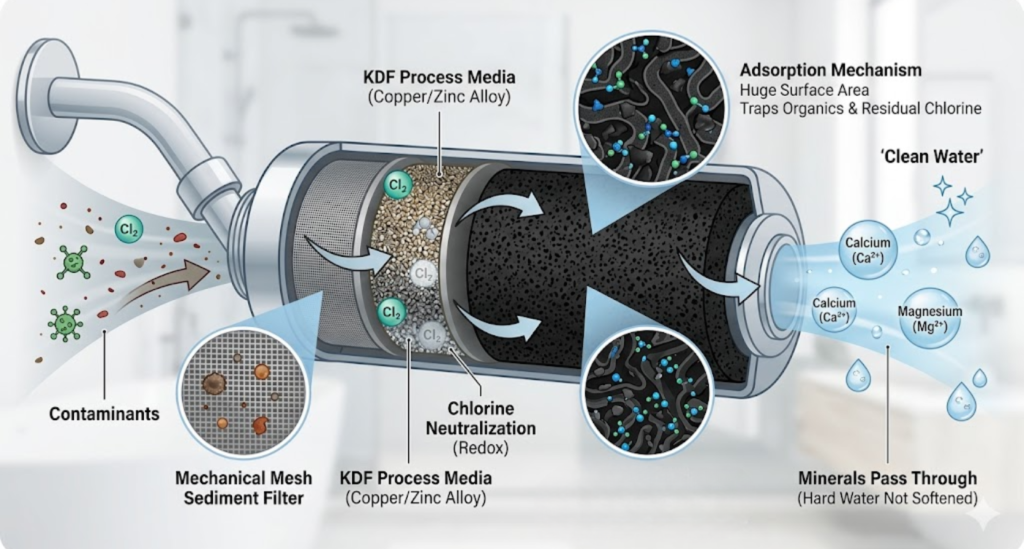
Shower filters are designed to remove certain impurities from the water before it reaches your skin. The best shower filters use a variety of filtration media, which are arranged in layers inside the filter casing. As the water flows through each layer, various contaminants are trapped or neutralized through physical and chemical reactions.
It’s crucial to realize that filtration operates by capturing or altering particles and chemicals, but it isn’t intended to extract dissolved mineral ions such as calcium and magnesium from water. This difference is key to why shower filters and hard water are frequently confused.
Catching Sediment and Particles with Mechanical Filtration
Most shower filters use a mechanical layer, often a fine mesh or ceramic media, as the first line of defense.
This layer physically traps sediment, rust particles, and suspended solids, which is particularly helpful in older homes with aging pipes that can allow rust and debris to enter the water supply. While this layer doesn’t impact water hardness, it does significantly improve the overall quality of the water and shields your skin from abrasive particles.
How Activated Carbon Filters Work
Activated carbon is one of the most common and effective filtration materials. It uses a process called adsorption to attract and hold chlorine molecules and organic compounds.
This is possible because of the enormous surface area of the carbon. One gram of activated carbon can have a surface area of over 500 square meters. This is why a small shower filter can filter thousands of gallons before it needs to be replaced.
Removing chlorine is more important than many people realize. Chlorine is added to city water to disinfect it, but it is also a known skin and hair irritant, stripping the natural oils from your skin every time you shower.
Can Shower Filters Eliminate Hard Water Minerals?
This is the main question, and the honest answer is no. Standard shower filters do not effectively remove calcium and magnesium from hard water.
What Makes Filtering Calcium and Magnesium So Challenging?
Calcium and magnesium, the two minerals that make water “hard,” are found in water as dissolved ions. This means they’re fully incorporated into the water on a molecular level. They aren’t particles that can be caught by a mesh, nor are they chemicals that can be adsorbed by carbon. These positively charged ions can move freely through almost all filtration mediums used in traditional shower filters.
Removing these minerals requires a process that can draw in and replace these ions with something else. This process is known as ion exchange. Ion exchange involves a resin bed where sodium or potassium ions take the place of calcium and magnesium ions as the water flows through. This is the technology used in water softeners. However, it requires a much larger system than what can fit inside a showerhead filter housing.
There are shower filters on the market that claim to help with hard water and do contain a bit of KDF-55 media. This media uses a redox reaction to lessen certain heavy metals and prevent bacteria. However, KDF does not remove calcium or magnesium. While it is a good filtration component, it is not a solution for softening water, and any products that claim to be are exaggerating their abilities.
Understanding the Difference Between Filtration and Softening
Before you can fully understand the relationship between shower filters and hard water, you need to know that filtration and softening are two separate processes that address two separate issues.
Filters work by trapping or chemically neutralizing suspended particles, chemicals, and some heavy metals as water passes through a filter medium. Softeners use ion exchange to replace dissolved mineral ions, such as calcium and magnesium, with sodium or potassium ions. While one process purifies the water, the other completely alters its mineral composition.
Let’s put it this way: a coffee filter takes out the coffee grounds from your drink, but it doesn’t alter the mineral content of the water you started with. This is how a shower filter works. It can catch chlorine, sediment, and some metals, but the calcium and magnesium ions pass right through it unchanged and hit your skin and hair just as they would from a tap without a filter.
It’s important to note this because a lot of people buy shower filters hoping to alleviate hard water problems, but then they’re disappointed when they still have dry skin, lifeless hair, and a showerhead that’s covered in limescale a few weeks later. The filter isn’t broken — it’s just not meant to do that.
Here is a quick comparison of what shower filters and water softeners do:
- What shower filters target: Chlorine, chloramines, sediment, rust, heavy metals like lead and mercury, bacteria (in some systems), and organic compounds
- What water softeners target: Dissolved calcium and magnesium ions that cause scale buildup, soap scum, dry skin, and brittle hair
- What both improve: The overall quality of your water and your shower experience — just in different ways
- What neither can do alone: Solve every water quality issue in your home
What Shower Filters Can and Can’t Do
Shower filters can effectively reduce your exposure to chlorine, filter out sediment and rust, remove certain heavy metals, and improve the smell and feel of chemically treated municipal water. But they can’t meaningfully reduce water hardness, prevent limescale buildup on fixtures, stop soap scum formation caused by mineral content, or replace the function of a whole-house water softener.
The Impact of Hard Water on Your Skin and Hair

Hard water can have a gradual impact on your body, so much so that many people never attribute their symptoms to the actual cause. If you’ve been dealing with chronically dry skin, hair that never looks quite right no matter how much you spend on products, or a tight, itchy feeling after every shower, it’s possible that your water is causing more harm than your skincare routine can fix.
Hard water is packed with minerals that are not always friendly to our bodies. When the calcium and magnesium in hard water meet soap and shampoo, they create insoluble compounds. This is basically a thin layer of soap scum that gets rinsed off onto your skin and scalp instead of washing away cleanly. This residue, over time, can clog pores, mess with the skin’s natural barrier function, and leave a film on hair that makes it look dull and feel rough.
Studies in the fields of health and dermatology have continually emphasized the link between exposure to hard water and aggravated skin conditions. Hard water is full of minerals and other impurities that can make conditions like eczema, dandruff, and dermatitis worse — issues that many people try to treat for years without ever considering the quality of the water in their shower.
How Hard Water Dehydrates Your Skin
The skin depends on a thin layer of natural oils known as the acid mantle to remain moisturized and to protect against environmental pollutants. Calcium and magnesium ions interfere with this layer by attaching to the skin’s fatty acids, reducing the effectiveness of the protective barrier and leaving the skin more susceptible to moisture loss. Each hard water shower effectively removes a bit more of that protection.
The end product is skin that feels tight, itchy, or flaky — especially in winter when humidity is lower and the skin barrier is already under stress. Moisturizers help temporarily, but they’re treating the symptom rather than the cause. As long as hard water continues hitting your skin daily, you’re fighting an uphill battle against mineral-driven dryness.
How Hard Water Affects Your Hair in the Long Run
- Calcium deposits roughen the hair cuticle, causing visible dullness and frizz
- Mineral buildup prevents moisture from penetrating the hair shaft, resulting in chronic dryness even with deep conditioning treatments
- Hard water increases the pH of hair, causing the cuticle to swell and leading to increased breakage and tangling
- Shampoos and conditioners are much less effective in hard water because minerals interfere with their active ingredients
- Color-treated hair fades faster in hard water because mineral deposits speed up color degradation
Many people find it frustrating that no amount of high-quality hair products can fully compensate for daily exposure to hard water. You can use the most expensive conditioner on the market, but if calcium is coating every strand of your hair in the shower, your hair will still look and feel damaged.
Over time, hard water can cause the kind of hair damage people usually link to heat or chemical treatments. That can mean brittle ends, less elasticity, and a rough, straw-like texture. It’s only when water quality improves that the difference becomes noticeable and hair can start to regain its natural texture and shine.
How Hard Water Aggravates Skin Conditions
If you have sensitive skin or a skin condition, hard water is not just annoying. It can have a real effect on your skin. Hard water has been linked in some studies with a higher risk of atopic eczema or worse eczema symptoms, especially in children.
The minerals in hard water can weaken the skin barrier, trigger inflammation, and make flare-ups happen more often and hit harder.
Hard water can also play a part in dandruff and seborrheic dermatitis. The minerals in the water can disrupt the scalp’s natural oil balance, which may create conditions that help dandruff-related yeast grow.
That is why some people do not get lasting relief from dandruff even after trying a lot of shampoos. The shampoos may help with symptoms, but they do not deal with the water itself.
Why You Should Still Use a Shower Filter
While a shower filter may not fix your hard water issues, it’s still worthwhile. The simple act of removing chlorine can greatly improve the way your skin and hair feel after each shower.
How Cutting Down on Chlorine Can Improve Your Health
Our tap water is treated with chlorine or chloramines to kill off any harmful bacteria and make it safe for us to drink. While that’s certainly a good thing, it doesn’t mean that chlorine stops being an irritant.
Hot showers can increase exposure to volatile chlorination byproducts released from treated tap water. Plus, the hot water opens up your pores, making it easier for chlorine to get into your skin than it would be with cold water. This daily exposure can strip your skin of its natural oils, make dry skin even worse, and irritate your respiratory system over time.
An effective activated carbon shower filter is designed to successfully eliminate most of the free chlorine from your shower water. This results in softer skin, reduced scalp irritation, and improved hair texture for many people. This is not because the water hardness has been altered, but because the chemical stripping effect has been minimized. It’s not a total solution for hard water, but it’s an improvement that many people notice within the first week of use.
Who Will Benefit the Most from a Shower Filter?
There are specific groups of people who will see the most significant benefit from a shower filter, especially in areas with hard water.
If you fall into one of these categories, a shower filter is a worthwhile investment even if your primary water problem is hardness. It won’t eliminate the mineral issue, but it removes a secondary layer of damage that compounds the problem.
- People with sensitive skin or skin conditions like eczema or rosacea who are aggravated by chlorine and chemical exposure
- Those with color-treated or chemically processed hair where chlorine accelerates fade and increases damage
- Households on heavily chlorinated municipal water where chemical smell and taste are noticeable in the shower
- Allergy and asthma sufferers who may benefit from reducing chloramine vapor inhalation during showers
- Renters who can’t install a whole-house water softener and need a practical point-of-use solution
It’s important to manage your expectations. A shower filter can improve your shower experience, but it’s not the solution to hard water problems. However, if you combine it with the right water softening solution, it can effectively solve both issues.
The Perfect Answer to Hard Water Issues
If hard water is your main issue, the only answer that truly works is one that directly targets calcium and magnesium at the root of the problem, and that involves an ion exchange water softening system.
Understanding the Functionality of Ion Exchange Water Softeners
The ion exchange process is responsible for eliminating calcium and magnesium from water. When hard water flows through a tank that contains resin beads with a negative charge, the calcium and magnesium ions, which have a positive charge, are attracted to the resin and attach to it.
Sodium or potassium ions that were previously attached to the resin are then released into the water. This results in water in which the hardness minerals have been replaced with sodium or potassium. These ions do not cause scale, do not interfere with soap, and do not harm the skin or hair.
Over time, the resin bed becomes filled with calcium and magnesium and needs to be recharged. This is done through a process called regeneration, where a concentrated salt solution flushes the resin and reloads it with fresh sodium ions. This is why water softeners require periodic salt top-ups — the salt isn’t going directly into your water supply in meaningful amounts, it’s regenerating the resin so the system can keep working.
Point-of-Use Filters or Whole-House Softeners?
Whole-house water softeners are installed at the point where your main water line enters your home. This means that every single drop of water is treated before it reaches any of your fixtures, including showers, faucets, dishwashers, and washing machines. This is the most comprehensive solution, and it’s the one that will prevent hard water damage throughout your entire home.
On the other hand, point-of-use filters, including shower filters, only treat the water at the specific outlet where they’re installed. This leaves the rest of your plumbing untreated, and your pipes, appliances, and other fixtures are still exposed to full mineral content.
If you’re renting or can’t put in a whole-house system, a two-pronged approach is a good idea. Use a shower filter to cut down on chlorine and chemical exposure, and understand that the mineral problem will need a bigger solution when you’re able to do so. It’s not a complete solution, but it’s a significant step that enhances your daily shower in the ways a point-of-use filter can.
U.S. Cities with the Hardest Water
Approximately 90% of homes in the United States are affected by hard water. However, some cities have a much higher concentration of minerals in their water than others. Las Vegas, Nevada is consistently ranked as one of the cities with the hardest water in the country. This is because it draws a large amount of water from the Colorado River via Lake Mead, which has a very high mineral content. Phoenix and Tucson in Arizona, San Antonio in Texas, and Indianapolis in Indiana are also frequently mentioned as cities with very hard water. If you live in one of these cities and have not addressed the quality of your water, it is likely that your skin, hair, and household appliances are all being affected.
Why a Shower Filter Alone Isn’t Enough to Fix Hard Water
While a shower filter can improve your water quality by reducing chlorine, sediment and in some cases certain metals, which may help water feel gentler on skin and hair, it doesn’t truly soften hard water.
If hard water is causing your skin to be dry, your hair to be brittle, your scalp to have issues, and your fixtures to be covered in mineral scale, a standard shower filter usually will not solve that problem. The calcium and magnesium that cause hardness are not removed by typical shower-filter media.
To actually soften hard water, you need a treatment method that removes hardness minerals, most commonly an ion-exchange water softener installed at the source. Use a shower filter for chlorine and sediment reduction, but rely on a proper softening system if hardness is the main issue.
Commonly Asked Questions
Can Shower Filters Soften Water?
A few shower filters are marketed with scale-reducing media, but that is not the same as true water softening. Media such as TAC or other salt-free conditioning approaches may help reduce how readily hardness minerals form scale, but they do not remove the calcium and magnesium that make water hard.
Real softening is typically done through cation exchange, which removes calcium and magnesium and requires a resin bed that must be periodically regenerated with sodium or potassium salts. That is why true softening is usually handled by a larger whole-house or point-of-entry system rather than a small showerhead-mounted filter.
Be wary of any product that promises to both filter and completely soften your shower water in one small device. TAC media can lessen the adhesiveness of minerals on surfaces, which assists in preventing scale buildup, but it doesn’t provide the skin and hair advantages that come from water that has had its hardness minerals genuinely eliminated. For true softening effects, a whole-house system or at least a dedicated under-sink or point-of-entry ion exchange unit is what really works.
Can hard water cause keratosis pilaris?
Hard water is not a proven direct cause of keratosis pilaris. It can, however, make dry skin worse, which may make keratosis pilaris look or feel more noticeable.
Will a shower filter help with eczema?
A shower filter may help some people by reducing chlorine or other irritants, but it is not a proven treatment for eczema caused by hard water. Research has found that even full home water softeners did not clearly improve eczema symptoms beyond standard care.
Is hard water good for osteoporosis?
Hard drinking water can provide small amounts of calcium and magnesium, which may support overall bone health. It is not considered a treatment for osteoporosis and should not replace proper nutrition or medical care.