iSpring RCC7 Review
The iSpring RCC7 is a 5-stage under-sink reverse osmosis system aimed at big improvements in taste and contaminant reduction. It’s a strong pick if you can spare cabinet space and don’t mind typical RO wastewater.
Best for
- Homes wanting strong contaminant reduction, including heavy metals and fluoride.
- Families replacing bottled water with a dedicated drinking-water faucet.
- DIY-minded buyers who can handle a 2–3 hour under-sink install.
Skip if
- You have very limited under-sink cabinet space.
- Water waste is a deal-breaker for your household.
- Your water pressure is low and you don’t want to add a booster pump.
Clean, great-tasting water is a must-have, not a nice-to-have.
The iSpring RCC7 consistently comes out on top as a high-performing system that balances purification capability, ease of use, and cost.
This NSF-certified reverse osmosis system has become a popular choice for homeowners looking to improve their water quality without breaking the bank.
In this detailed review, I’ll dive into exactly what makes this system stand out in a crowded market of under-sink water filters.
Understanding the RCC7’s 5-Stage Filtration System
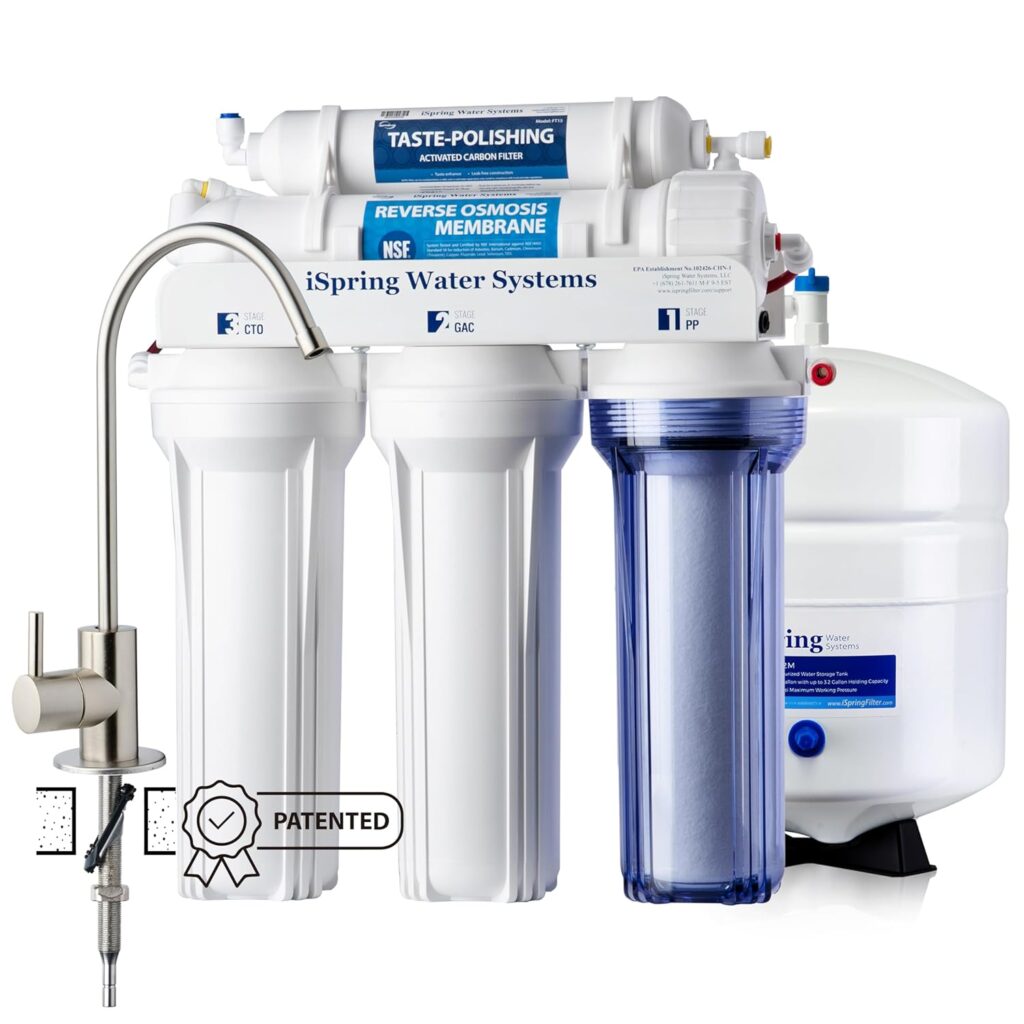
The iSpring RCC7’s strength lies in its thorough 5-stage filtration system that progressively eliminates contaminants of varying sizes and types.
Each stage has a unique role in the filtration process, working in harmony to produce exceptionally pure water.
Knowing how each part works gives insight into why this system continually outdoes many single-stage filters available today.
The Process of Each Filtration Stage Removing Various Contaminants
The filtration process starts with three pre-filters, each designed to remove particles of decreasing size.
The first stage features a polypropylene sediment filter that removes larger particles like dust, sand, and rust up to 5 microns in size. This first barrier protects the more delicate filters downstream.
The second stage uses a granular activated carbon (GAC) filter that absorbs chlorine, chloramines, and other chemicals that affect taste and odor.
The third stage uses a carbon block filter that traps smaller organic compounds, pesticides, and certain heavy metals that might have slipped through the previous stages.
These three pre-filters work together to tackle the majority of common water contaminants and greatly extend the life of the more expensive reverse osmosis membrane that follows.
The Reverse Osmosis Membrane: The System’s Main Component
Stage 4 houses the system’s most important component—a high-rejection reverse osmosis membrane that eliminates particles as tiny as 0.0001 microns.
This semi-permeable membrane is where the real work is done, pushing water molecules through tiny pores while discarding dissolved solids, including heavy metals, fluoride, arsenic, lead, and chromium.
The RCC7 employs a high-capacity membrane rated at 75 gallons per day, significantly more than many rival systems.
This membrane typically eliminates between 80-90% of total dissolved solids (TDS) according to iSpring’s specifications, though independent testing of similar iSpring systems has shown TDS reduction rates near 97-98% under controlled conditions.
The system’s NSF/ANSI 58 certification verifies its performance for TDS reduction, with certain RCC7 variants also certified for reduction of specific contaminants including lead, fluoride, asbestos, and other regulated substances.
Final Stage: How It Improves Taste
The fifth and final stage includes another carbon filter that is essential for improving water quality.
After passing through the reverse osmosis membrane, water can sometimes taste flat or slightly acidic due to the removal of minerals.
This post-filter uses coconut shell activated carbon to refine the water, removing any remaining tastes or odors that might have been introduced during storage in the tank.
The result is exceptionally fresh, crisp-tasting water that many users compare favorably to high-quality bottled water.
For those who prefer water with minerals, iSpring offers an upgraded model (the RCC7AK) that includes an additional alkaline remineralization stage, though many users find the standard RCC7’s water quality perfectly satisfying for daily drinking and cooking needs.
iSpring RCC7 RO System: Performance Outcomes
The RCC7 is designed primarily for municipal tap water and can also work well on tested well water when appropriate pre-treatment is in place for issues like heavy hardness, sediment, or iron.
iSpring’s installation guidance lists typical operating requirements: 45 to 80 psi feed water pressure and 40 to 100°F feed water temperature, and recommends a softener ahead of the system when hardness is very high.
For well water with bacterial concerns or unreliable sources, iSpring recommends UV-equipped variants like the RCC7AK-UV rather than the base RCC7.
The RCC7 has built a solid reputation through independent verification.
The NSF product listing for RCC7-BN and RCC7-BLK variants shows NSF/ANSI 58 certification for TDS reduction plus certified reduction claims for lead, fluoride, asbestos, barium, cadmium, chromium (trivalent), copper, and selenium.
Impressive Contaminant Removal Rates (99% of 1000+ Pollutants)
iSpring describes the RCC7 as a 5 stage system that can remove up to about 99 percent of more than 1,000 contaminants, including chlorine, fluoride, lead (up to 98%), arsenic, asbestos, calcium, and sodium.
If you want one independent data point to support real world expectations, TechGearLab’s third party lab results report that the RCC7 eradicated 100% of the chlorine from their test sample and left the lowest total contaminant levels of any filter they tested.
What Research Supports for Trace Organics
Reverse osmosis membranes are widely studied for reducing trace organics.
Research published in 2023 reported near complete removal of the pharmaceuticals tested with rejection rates above 99 percent using RO membranes under controlled conditions.
Additional peer-reviewed studies have shown high RO rejection rates for pesticides and other organic contaminants in drinking water applications.
This supports the broader reason people choose RO when they want a stronger barrier than carbon alone, even though results in a home still depend on water chemistry and membrane condition.
Taste: “Nearly Bottled‑Water‑Like”, Not Flat or Metallic
For many homes, taste is the quickest payoff. The carbon stages target chlorine and other compounds that cause harsh taste and odor, and the post carbon stage helps polish the water after it sits in the tank.
Independent reviews describe the RCC7’s output as having a “nearly bottled water-like taste” with a neutral, crisp profile and no strong chlorine taste or odor.
A simple way to keep that clean, neutral taste consistent is to stay on top of filter changes. When the carbon stages start getting tired, taste is usually the first thing people notice, even before flow drops.
If you want the matching replacement set for the RCC7, you can grab the iSpring replacement filter pack on Amazon here.
75 GPD Rating and Real‑World Household Use
The RCC7 is rated at up to 75 gallons per day under ideal conditions, with a 3.2‑gallon pressurized storage tank that helps maintain a steady supply of filtered water at the tap.
The 75 GPD rating is based on standard RO test conditions (around 60 psi and 77°F), so actual production will be lower at cooler temperatures or lower pressures.
In day-to-day use, the storage tank is what makes the system feel convenient, while refill speed varies mostly with pressure and temperature within the normal operating range.
It’s still more than enough to support drinking, cooking, and small appliance needs for most households.
How to Install the iSpring RCC7 Series RO System
The RCC7 is a standout due to its user-friendly design that allows you to install it yourself, rather than needing a professional.
The system comes with easy-to-follow instructions and nearly everything you need to get it up and running.
However, it’s important to install it correctly to avoid leaks and ensure it performs at its best. Paying attention during the setup process will help ensure the system is reliable.
What You Need for DIY Installation
For installation, the iSpring RCC7 package includes most of the necessary components, but you’ll need a few basic tools to complete the job.
You’ll need:
- An adjustable wrench
- Screwdriver
- Drill with 1/2″ bit
- Teflon tape
The kit comes with color-coded tubing, a feed water adapter, drain saddle, storage tank, faucet, and mounting brackets.
The faucet included is a brushed nickel model that looks surprisingly high-end compared to those included with other filtration systems.
If you don’t have plumbing experience, consider purchasing additional pipe fittings and a basic pipe cutter, as these can simplify installation depending on your under-sink configuration.
Setup Time: 2-3 Hours for Most Homeowners
Most homeowners with basic DIY skills can install the RCC7 in about 2-3 hours.
The most challenging aspects typically involve drilling the hole for the faucet (if your sink doesn’t have a pre-drilled accessory hole) and properly installing the drain saddle.
The color-coded tubing system simplifies connections, reducing the likelihood of incorrect installation.
After completing the physical installation, expect to run through two full tank cycles before drinking the water, as this removes any manufacturing residues and carbon dust.
First-time installers should set aside additional time for reviewing the instructions thoroughly and watching the manufacturer’s helpful installation videos before beginning the process.
Changing Filters and Expenses
The RCC7 has a simple routine for changing filters that balances performance with cost efficiency.
The system is designed to allow for quick filter changes without the need for special tools or plumbing knowledge.
The average annual maintenance cost is between $80-120, which is significantly less than the ongoing cost of bottled water or many competing systems.
Convenient filter replacement packages are available on Amazon or through the manufacturer and include all necessary components for a complete system refresh, although individual filters can also be purchased separately if needed.
1. Initial Three Phases: Replace Every Six to Twelve Months
The first three pre-filters need to be replaced the most often, usually every six to twelve months, depending on the quality of your water and how often you use it.
If your water supply has a lot of sediment or chlorine, you may need to change them more often, but if your source water is cleaner, you can wait longer between changes.
It’s important to replace them on time to protect the more expensive RO membrane that comes after them.
You can tell when it’s time to replace them by simply looking at them.
The first-stage sediment filter will be noticeably discolored when it needs to be changed, and if the water flow is reduced, it often means the carbon pre-filters are clogged and need to be replaced.
2. RO Membrane: Needs Replacement Every 2-3 Years
The reverse osmosis membrane is the most expensive part to maintain, but it also has the longest lifespan. Usually, this part lasts about 2-3 years before it needs to be replaced.
By replacing pre-filters when necessary, the life of the membrane can be extended because it prevents early fouling.
Indications that your RO membrane may need to be replaced include an increase in the TDS levels in your filtered water, a decrease in water production, or a change in taste.
To ensure optimal performance, use a simple TDS meter to periodically test your water, as this will provide objective data on membrane efficiency.
Adhering to the manufacturer’s suggestions for membrane replacement guarantees constant water quality and avoids system inefficiency that can result in higher water waste.
3. Carbon Post-Filter: Replace Once a Year
The fifth-stage carbon post-filter is an essential part of the final taste of your water and should be replaced once a year.
This component is relatively inexpensive (around $20) and provides the final touch that makes the water filtered by the RCC7 taste better than many other systems.
Changing this filter is very easy, it only takes a few minutes and doesn’t require any special tools.
There are reports from some users that they have been able to extend the life of this filter by rotating it 180 degrees after six months, although this is not officially recommended by iSpring.
For households that use less filtered water, it may be possible to extend the replacement intervals to 15-18 months without a significant degradation in taste.
You can easily find all the replacement filters for the RCC7 online. The filter sizes are standardized, so you can use third-party replacements that are compatible.
However, if you want the best performance and want to keep your warranty, you should use genuine iSpring filters.
How the RCC7 Stacks Up Against Other Under-Sink Filters
There are countless under-sink water filters on the market, from simple carbon filters to intricate multi-stage systems.
The iSpring RCC7 hits the mark by offering professional-level filtration at a reasonable price.
When stacked up against similar systems, the RCC7 excels in certain areas and falls behind in others. If you’re considering alternatives, you might want to check out the Aquasana AQ-5300 for a different approach to under-sink filtration.
Under sink reverse osmosis system comparison
| System | Type | Output rating | Certification listing |
|---|---|---|---|
| iSpring RCC7 BN 5 stage under sink RO with storage tank | Under sink reverse osmosis system with a separate drinking water faucet | Up to 75 gallons per day listed by iSpring | NSF/ANSI 58 listing includes TDS reduction plus reduction claims for lead and fluoride and other listed contaminants |
| APEC ROES 50 5 stage under sink RO with storage tank | Classic under sink RO layout with pre filters, RO membrane, and a polishing carbon stage | Up to 50 gallons per day listed by APEC | WQA Gold Seal certification is commonly shown for ROES 50 under NSF/ANSI 58 for TDS reduction |
| Home Master TMAFC RO system with remineralization stage | Under sink reverse osmosis system that adds minerals back for a more mineral tasting finish | 75 gallons per day listed for TMAFC | Uses NSF-certified components; check the exact listing you are buying since whole-system certification details can vary by model and seller |
| Express Water RO5DX 5 stage under sink RO with storage tank | Under sink reverse osmosis system with a separate drinking water faucet | Up to 50 gallons per day listed by Express Water | NSF/ANSI 58 listing shows TDS reduction for RO5DX |
Comparing the RCC7 to Other Reverse Osmosis Systems
When you compare under-sink reverse osmosis systems, most of them follow the same basic idea: pre-filters, an RO membrane, then a final carbon stage to polish taste.
So the practical differences usually come down to whether it’s tank or tankless, how much cabinet space it takes, and how simple filter changes are.
The iSpring RCC7 is rated up to 75 gallons per day, which is one reason it is often compared against higher priced products.
APEC’s ROES 50 is the same general style of under sink tank based RO system, but it is rated at up to 50 gallons per day. If you are comparing the two for a family kitchen, that output gap may be an important consideration.
If space is your main issue, the Waterdrop G3 line is built around a tankless design. That can free up room under the sink, and the filters are designed to twist off and swap without tools, but it does require power under the sink.
If you are looking at premium upgrades, Home Master’s TMAFC line is built around adding minerals back to the water for a less stripped taste, and the ERP versions add a permeate pump.
Those are feature upgrades, not a different category of filtration, and they are best for people who care about taste finish and efficiency as much as pure RO performance.
In summary, the biggest strengths of the RCC7 comes to its high-capacity output (75 GPD), quality of components, and ease of DIY maintenance.
Also, not many systems in this price range offer the clear first-stage housing that makes monitoring sediment build-up so easy.
Pros & Cons of the iSpring RCC7
What I Like About the RCC7
There are a few things about the RCC7 that I really like. The system’s filtration performance is consistently strong, with independent lab testing confirming very high contaminant reduction and water quality that matches or exceeds manufacturer claims.
The clear first-stage housing lets you see the filter so you know when it needs to be replaced.
The quality of the parts is much better than cheaper competitors, with solid construction, reliable fittings, and a faucet that looks good even in high-end kitchens.
The 75 GPD capacity is enough water for most households, and the installation kit has almost everything you need to set it up.
iSpring’s customer service is worth noting, as they offer quick responses and useful help with any problems you might have.
The system’s NSF/ANSI 58 certification provides reliable third-party verification of its TDS reduction performance, with certain variants certified for additional contaminant reduction.
There are also many positive reviews from users, which show that it’s reliable in real-world situations.
If you’re replacing bottled water with this system, it will usually pay for itself within 12-18 months. It also helps to reduce plastic waste.
Downsides
Every system has its drawbacks, and the RCC7 is no exception.
The most significant downside is its water efficiency.
Like most non-pumped residential RO systems, the RCC7 typically operates at around a 3:1 to 4:1 waste-to-product ratio under normal conditions, meaning it produces approximately three to four gallons of wastewater for each gallon of filtered water.
This ratio is typical for standard RO systems without pumps, but it might concern environmentally conscious users or those with water usage restrictions.
Space is the next consideration. The RCC7 uses a tank and a multi-stage filter assembly, so it takes up a decent amount of cabinet room, which can be tight in smaller kitchens.
Installation is also more involved than a countertop filter or a faucet mounted option. Most people with basic DIY skills can handle it, but if drilling a faucet hole or working under the sink sounds stressful, a portable or countertop water filter may feel easier.
If you want to reduce wastewater, look at RO systems that use a permeate pump or a built-in booster pump.
And if your water pressure is below about 45 psi, the RCC7 may not perform at its best without a booster, so the iSpring RCC7P-AK with its built in pump is typically the safer choice.
Finally, if your tap water is already good and you mainly want better taste, a simpler carbon based under sink filter can be more cost effective.
If the goal is mineral rich alkaline style water, consider the RCC7AK with its remineralization stage, or add minerals separately after filtration.
Is This the Best Water Filter for Your Home?
Deciding if the iSpring RCC7 is the right fit for your unique needs depends on a few different things including your water quality issues, how much space you have, your budget, and any environmental concerns you might have.
The system is a great deal for most homes that need thorough water filtration, but it might not be the best choice for everyone.
If your home has serious water quality issues—including high levels of dissolved solids, heavy metals, or chlorine—the RCC7 is a dependable, affordable solution that is hard to beat.
In the end, the choice comes down to weighing your filtration requirements against practical factors such as space limitations and water efficiency.
For the majority of suburban and city homes with sufficient under-sink space and standard city water sources, the RCC7 offers an unbeatable blend of performance, convenience, and value that’s hard to beat in the current market.
For families that are used to buying bottled water, the system will probably pay for itself in 12-18 months, and you’ll be reducing plastic waste at the same time. That’s a win for your wallet and for the environment.
Click Here to Check Current Price on Amazon
Frequently Asked Questions
What is the impact of the iSpring RCC7 on water pressure?
Compared to a regular kitchen faucet, the RCC7 delivers water at the dedicated drinking water faucet at a lower pressure than your main tap. This is a common occurrence with all reverse osmosis systems that use a storage tank.
The system provides water from the tank when it is full, with the pressure gradually decreasing as the tank empties. This pressure is adequate for drinking and cooking needs, but it is noticeably less than the pressure of a regular faucet.
If you need higher or more consistent pressure, consider the RCC7P-AK model, which has a built-in booster pump that maintains a more consistent flow regardless of the tank level.
How do the RCC7 and RCC7AK models differ?
The main difference between these two models is that the RCC7AK has an extra stage for alkaline remineralization.
This sixth stage adds back in beneficial minerals like calcium, magnesium, sodium, and potassium that are removed during the reverse osmosis process. The result is slightly alkaline water (pH 7-8) with a better taste that some people prefer over the pure RO water that the standard RCC7 produces.
The mineral cartridge contains calcite, red mineral stone, and other natural minerals that slowly dissolve as the water flows through.
Adding a remineralization stage will increase the initial system cost by about $50-60, and you’ll need to replace it about once a year, which will cost about $30 per cartridge.
Whether this upgrade is worth it or not depends on your taste preference and whether you think the potential health benefits of mineral-containing alkaline water are worth it.
Many users have reported that remineralized water tastes more like natural spring water, compared to the “flatter” taste of pure RO water.
Can this system filter well water?
The RCC7 is designed primarily for treated municipal tap water. While it can filter some well water sources, it typically requires additional pre-filtration and testing depending on the specific quality of your water.
If your well water has high levels of sediment, you will likely need to replace the first-stage filter more frequently. If your well water has extremely high levels of iron, hydrogen sulfide, hardness over 10 grains, or bacterial contamination, you may need specialized pre-treatment systems to prevent the RO membrane from getting fouled too quickly.
For wells with bacterial concerns or unreliable water sources, iSpring recommends UV-equipped systems like the RCC7AK-UV rather than the base RCC7. I would suggest getting a comprehensive water test before you install the system to identify any specific contaminants that might need additional steps for treatment.
What is the waste water ratio of the RCC7?
Similar to most standard reverse osmosis systems without pumps, the RCC7 typically produces approximately 3 to 4 gallons of waste water for every gallon of purified water under normal household conditions.
This ratio is a built-in feature of reverse osmosis technology, which needs a flow of water across the membrane to remove rejected contaminants.
The actual waste ratio can vary based on the incoming water pressure, temperature, and the condition of the membrane, with higher pressure and warmer water generally improving efficiency. The waste water is usually directed to the drain and contains concentrated minerals and contaminants removed from the purified water.
There are several options for those who are worried about water efficiency. The RCC7P model includes a permeate pump that can improve the waste ratio, potentially bringing it closer to 2:1 under favorable conditions. Some inventive homeowners sometimes redirect the wastewater to toilet tanks, plant watering, or other non-drinking uses to get the most out of it.
While water waste is a real environmental concern, it should be weighed against the plastic waste and energy use that comes with alternatives like bottled water.
The Bottom Line
For most households looking to improve their water quality, the iSpring RCC7 water filter is a fantastic option that offers a great balance of performance, convenience, and affordability.
It offers comprehensive filtration, requires reasonable maintenance, and has proven reliability, making it a leading option in the competitive under-sink filter market.
While it may not be perfect for every situation, its strengths consistently outweigh its limitations for most homeowners who are concerned about water quality.