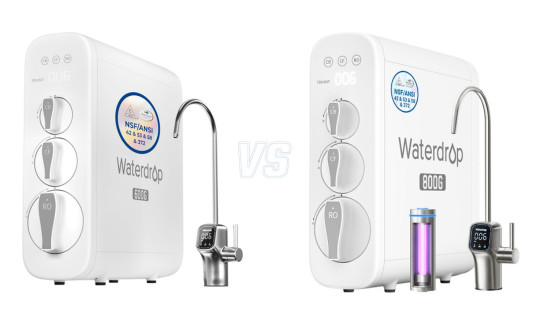
If you’re weighing the Waterdrop G3P600 against the G3P800, you’re looking at two solid under-sink reverse osmosis systems that share the same core technology. The main difference comes down to whether you want UV sterilization, a faster flow rate, and a slightly better wastewater ratio — and whether those things are worth the higher price tag for your household.
This guide walks through every meaningful difference between the two models, based on Waterdrop’s own specifications and certifications, so you can make a confident decision without the second guessing.
G3P600 vs G3P800 Side by Side Comparison
Key spec differences for filtration, speed, efficiency, monitoring, maintenance, and certifications.
| Feature |
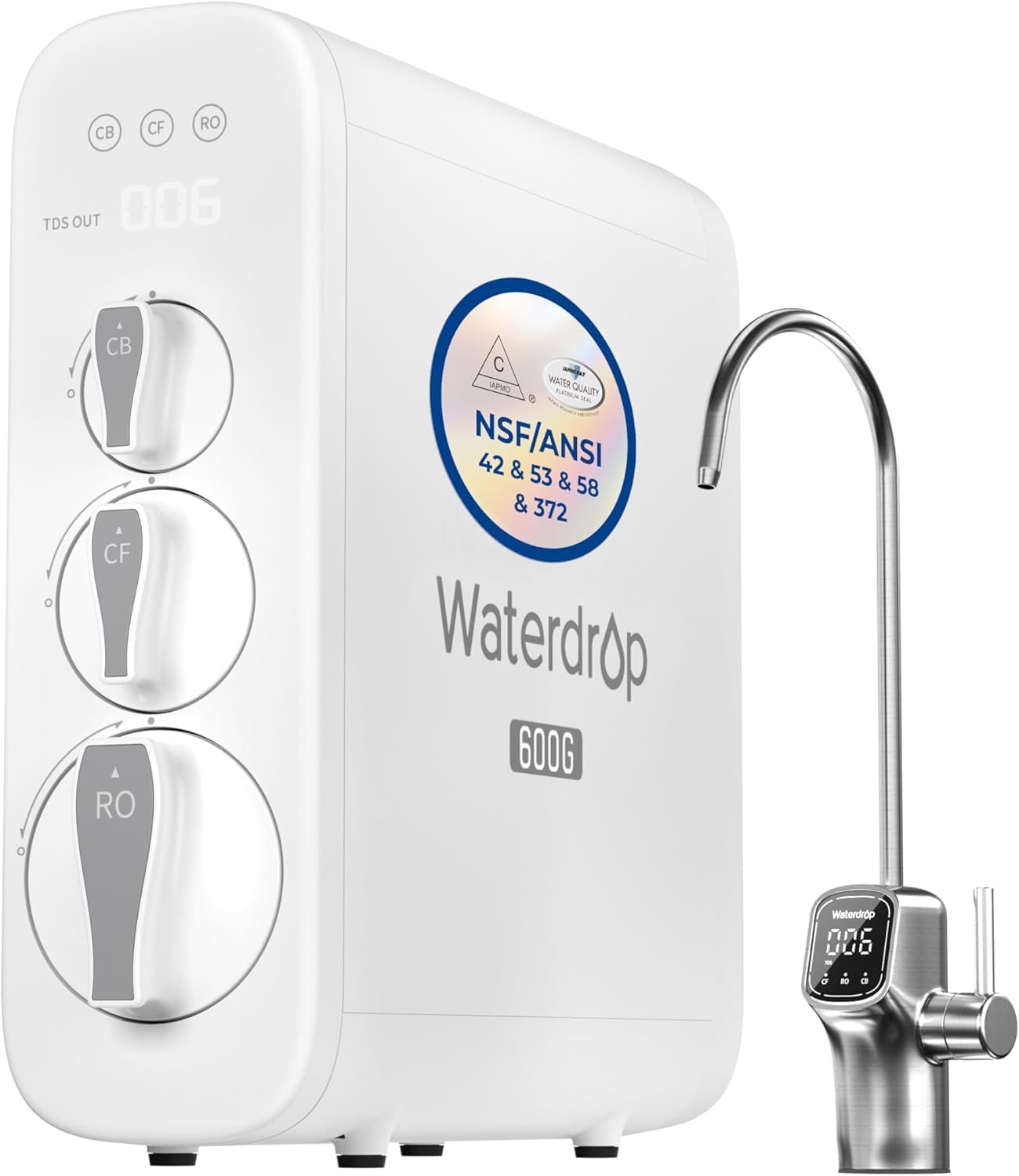
Waterdrop G3P600
|
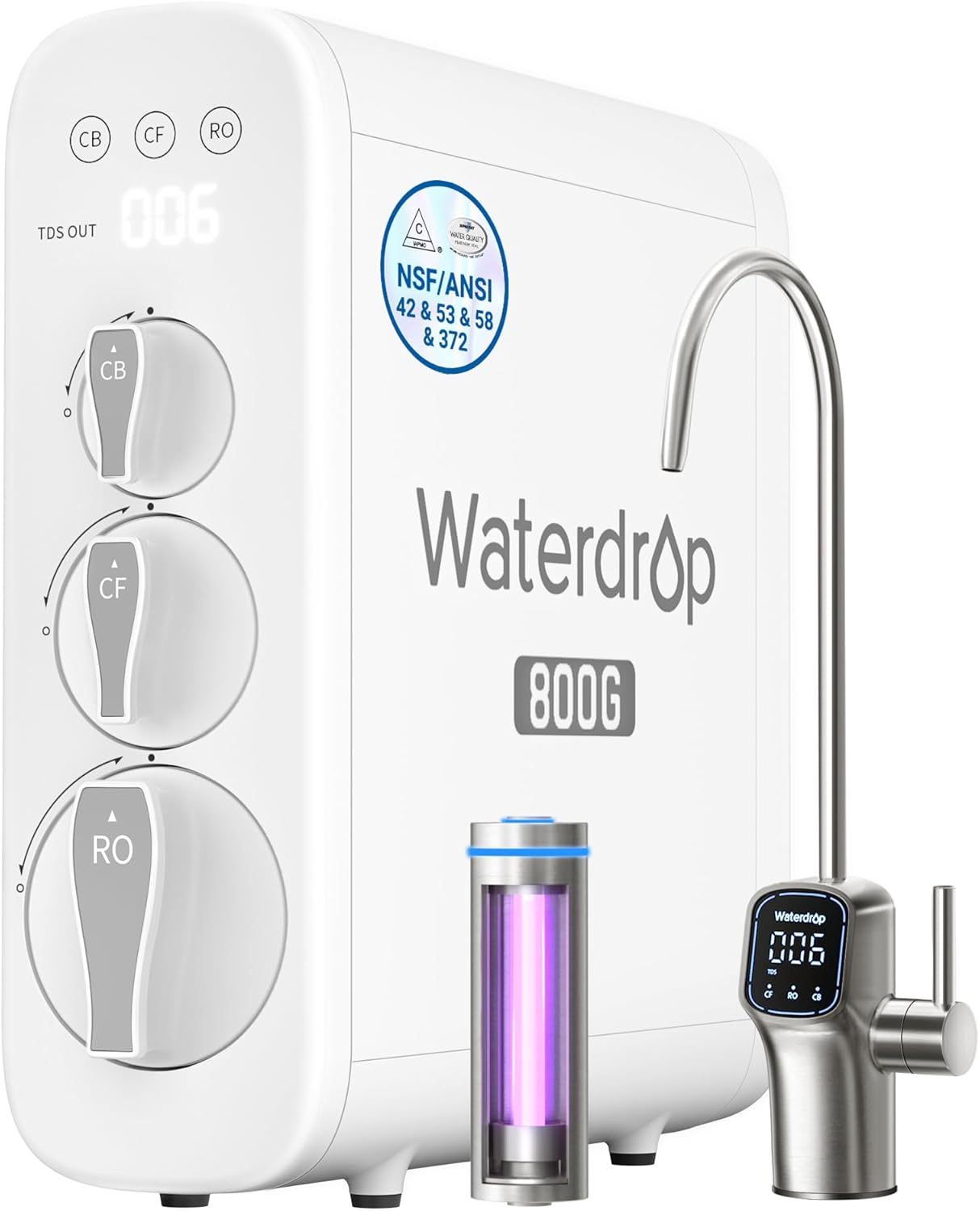
Waterdrop G3P800
|
|---|---|---|
| Filtration Stages | 8 stage 8 stage filtration system without UV. | 10 stage 10 stage filtration system with UV sterilization. |
| Daily Capacity | 600 GPD | 800 GPD |
| Flow Rate | 0.42 GPM | ~0.55 GPM Mid range estimate |
| Wastewater Ratio | 2:1 Pure to drain | 3:1 Pure to drain |
| TDS Monitoring | Yes smart faucet display | Yes smart faucet display |
| Filter Life CF | About 6 months | About 6 months |
| Filter Life CB | About 12 months | About 12 months |
| Filter Life RO | About 24 months or 2,200 gal | About 24 months or 2,200 gal |
| UV Sterilizer Life | Not included | About 2 years |
| Noise Level | Up to 65 dB lab conditions | Up to 65 dB lab conditions |
| Power Required | Yes outlet required | Yes outlet required |
| Fluoride Removal | Yes via RO membrane | Yes via RO membrane |
| Remineralization | Optional (add-on filter / specific bundle only) | Optional (add-on filter / specific bundle only) |
| NSF Certifications | NSF 42, 53, 58, 372 | NSF 42, 53, 58, 372 |
| Where To Buy | Check Price on Amazon | Check Price on Amazon |
*Wastewater ratios are manufacturer rated benchmarks. Real world results vary with water pressure, temperature, and installation conditions.
What’s the Difference between Waterdrop G3P600 and G3P800 Reverse Osmosis Systems?
While the Waterdrop G3P600 and G3P800 may appear identical at first, the differences between them go beyond their model numbers.
The G3P800 is Waterdrop’s top-of-the-line model, boasting a higher daily water production capacity (800 gallons per day compared to 600 GPD), an extra filtration stage, and advanced smart features.
The G3P600, on the other hand, is more affordable yet still packs a punch with its robust 8-stage filtration system and smart monitoring features. These differences clearly delineate the two models, with the G3P800 being better suited for larger households or those with specific water quality issues that require UV sterilization.
Filtration: 8-Step vs 10-Step Purification
Both RO systems use the same fundamental approach: sediment pre-filtration, carbon block filtration, and a reverse osmosis membrane. Both systems can also be paired with an optional remineralization filter, but remineralization isn’t included in every bundle.
The RO membrane does the heavy lifting in both models, reducing dissolved solids, heavy metals, fluoride, PFAS, chlorine, and hundreds of other contaminants. Both are certified to NSF/ANSI standards 42, 53, 58, and 372 through IAPMO R&T. For the specific reduction percentages on each certified contaminant, Waterdrop points to the official Performance Data Sheet for the exact model you’re purchasing.
The G3P800 also adds an extra step with an integrated sterilization stage (UV/LED depending on version) that activates when you dispense water. More on this down below.
Does the Waterdrop G3P600 Remove Fluoride?
Yes. Fluoride removal happens at the RO membrane stage, which both the G3P600 and G3P800 share. This is one area where both models perform essentially the same. The UV stage in the G3P800 doesn’t change fluoride reduction.
If fluoride is your primary concern, you don’t need to step up to the G3P800 to get meaningful reduction. The G3P600 handles it through the same RO process.
G3P800: 10-Stage System with UV Sterilizer
Expanding on the G3P600’s base, the G3P800 takes filtration to a new level with its 10-stage system that incorporates everything found in the G3P600 and adds a built-in UV sterilization chamber, which turns on automatically when you dispense water. There’s no manual switch you have to worry about.
The UV sterilization stage uses ultraviolet light to kill bacteria, viruses, and other microorganisms that may have survived the physical filtration processes.
UV sterilization doesn’t change the taste or add anything to the water. It also doesn’t replace the RO membrane’s job of removing dissolved contaminants. Those two stages handle entirely different threats.
For most households on treated municipal water, the RO membrane alone provides strong protection. The UV stage is most relevant if you have specific concerns about microbiological contaminants or if your water source is less predictable.
One thing to note is the UV sterilizer works only when the system has power. During a power outage, the G3P800 still produces filtered water through its other stages but it just won’t have UV treatment active.
If you’d rather have RO plus UV in one tankless system, the G3P800 is the model that includes it. See the current price on Amazon.
What to Look for in a Filtration System
When comparing these two high-end filtration systems, knowing their performance differences can help you decide which system is best for your household.
Aside from the number of filtration stages, the water production capacity, efficiency, and flow rates are other important factors to consider. These details can make a big difference in day-to-day use and how satisfied you feel with either system.
Flow Rate and Fill Times
On paper, the G3P800 is the faster system. The G3P600 is rated at 0.42 gallons per minute, while Waterdrop says the G3P800 can fill a small cup in just a few seconds, putting it in the mid 0.5 GPM range depending on the cup size used.
In everyday use, an 8 oz glass takes about 9 seconds on the G3P600 and around 6 to 7 seconds on the G3P800. That difference is not huge for a single glass, but it becomes much more noticeable when you are filling a pitcher, kettle, or large bottle. A one gallon fill is roughly 2 minutes 23 seconds on the G3P600 versus about 1 minute 47 seconds on the G3P800.
If you often cook with filtered water or fill larger containers, the G3P800 will likely feel more convenient day to day. If you mostly pour individual glasses, the speed boost is still there, but it may not be the deciding factor.
Looking for insights into other Waterdrop water filtration models? Check out our Waterdrop A1 vs A2 review.
Waterdrop G3P600 vs G3P800: Wastewater Ratios
Both systems are meaningfully more efficient than older tank-based RO systems, but they’re not the same as each other. Waterdrop rates the G3P600 at a 2:1 pure to drain ratio and the G3P800 at a 3:1 ratio.
In plain terms: for every gallon of purified water produced, the G3P600 sends roughly half a gallon to the drain, while the G3P800 sends about a third.
That difference can add up over time if water costs or conservation matter to you. That said, real-world ratios vary with your water pressure, feed water temperature, and installation, so treat these as benchmarks rather than guarantees.
Intelligent Features and User Experience
Both Waterdrop models employ intelligent technology to improve user experience, although the G3P800 has more capabilities that account for its premium status. These smart features assist in monitoring system performance, tracking filter life, and maintaining the best water quality with little user input.
Smart Display and TDS Monitoring
Both the G3P600 and G3P800 come with a smart faucet display that shows filter life and system status. Both also include TDS (Total Dissolved Solids) monitoring. If you want to keep an eye on your water’s total dissolved solids reading without buying a separate testing device, either model covers you.
How Loud Is the Waterdrop G3P600 and G3P800?
Waterdrop states that noise will not exceed 65 dB under standard lab test conditions. That’s roughly comparable to a normal conversation or the background hum of a busy room. The sound comes from the booster pump, which only runs when the system is actively filtering and dispensing. When you’re not drawing water, both systems are silent.
For most kitchens, the pump sound isn’t disruptive. It’s noticeably quieter than a dishwasher or garbage disposal. That said, if your kitchen is very open or you’re particularly sensitive to background noise, it’s worth factoring in that you will hear the pump during use.
How Long Do the Filters Last? (G3P600 and G3P800)
Waterdrop’s guidance for the G3 filter set is consistent across both models:
- CF (composite pre-filter): approximately 6 months
- CB (carbon block filter): approximately 12 months
- RO membrane: approximately 24 months or 2,200 gallons
- UV sterilizer (G3P800 only): approximately 2 years
The smart faucet display will remind you when it’s time to replace each filter based on actual usage, not just a timer. The G3P800 doesn’t automatically need more frequent filter changes than the G3P600.
What affects your replacement schedule is how much water your household uses. Higher daily use means you’ll hit gallon-based limits faster on either model.
The G3P800 does have one additional maintenance item the G3P600 doesn’t: the UV sterilizer, which typically needs replacement around the 2-year mark.
G3P600 vs G3P800: Installation and Space Requirements
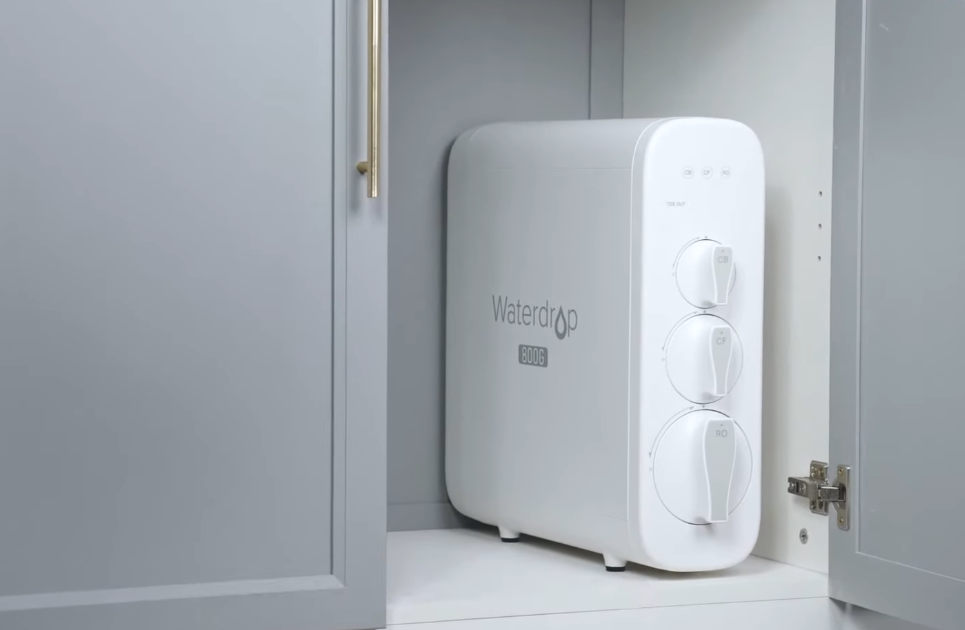
If you’re considering either of these under-sink systems, you’ll want to make sure they will fit in your kitchen and that you can meet their installation requirements. Both models have a tankless design that takes up much less space than traditional RO systems, but there are still some space and connection requirements to keep in mind.
Under-Sink Cabinet Space Requirements
The G3P600 and G3P800 have the same physical footprint at roughly 18.11 inches long, 5.67 inches wide, and 17.73 inches tall.
You’ll want a spot with a nearby power outlet, enough slack for the tubing to route cleanly, and clear access so you can swap filters without fighting the plumbing. Leaving a bit of breathing room around the sides also helps with airflow and makes maintenance easier.
It’s very important to note that both models require an electrical outlet to operate. Waterdrop lists a power adapter as part of the included kit for the G3P600, and an outlet is required for operation. The G3P800 additionally needs power for its UV stage. Plan your installation location with outlet access in mind for either model.
Most homeowners with basic plumbing know-how can install either system in under an hour using Waterdrop’s included installation guide. If your under-sink setup is unusually complex, professional installation typically runs $150–$200.
Choosing the Right Waterdrop System for Your Home
The right choice between the Waterdrop G3P600 and G3P800 depends on your unique household needs and preferences.
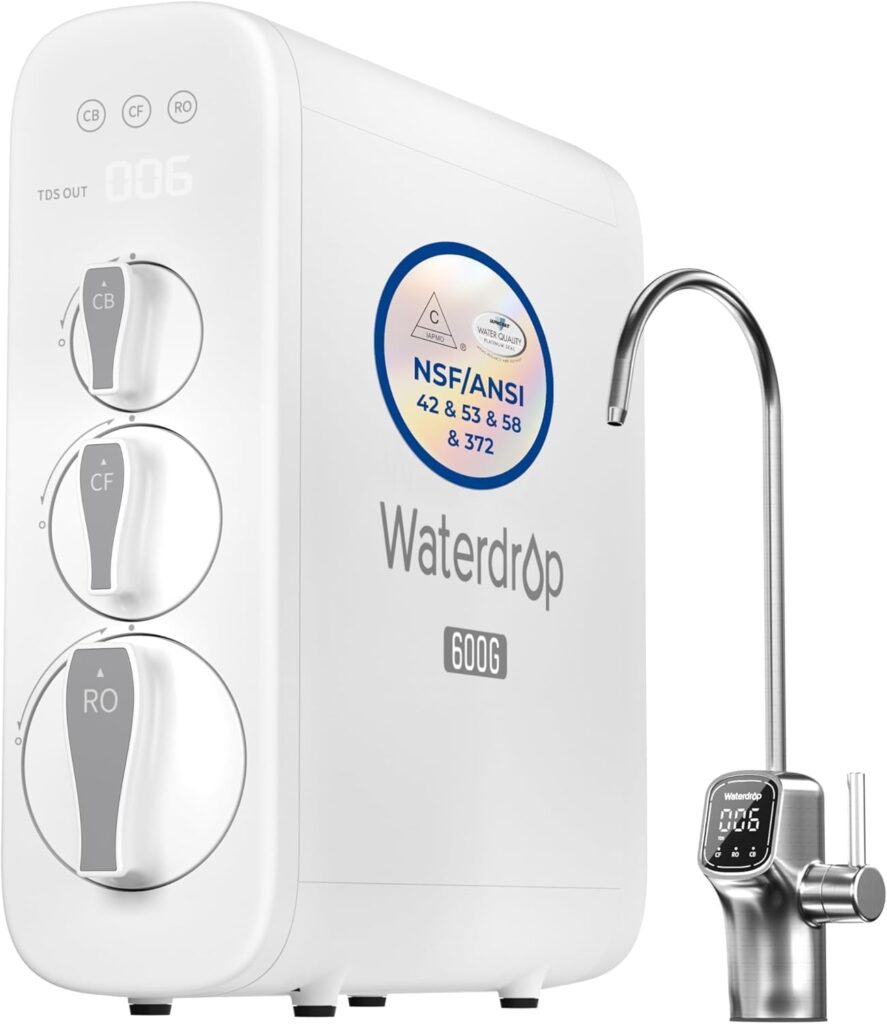
The G3P600 Can Be a Great Fit If…
Your household has 1-3 people with moderate daily water use. You are mainly focused on chemical contaminants like lead, fluoride, PFAS, chlorine, and arsenic, rather than microbiological risks. You want the same core filtration and TDS monitoring without paying extra for UV. And you would rather keep the upfront cost lower while still getting solid, certified filtration.
One thing to keep in mind is that the G3P600 is not a weaker system. It’s a strong RO option for most homes on treated municipal water. The difference comes down to added features and targeted protection, not overall water quality.
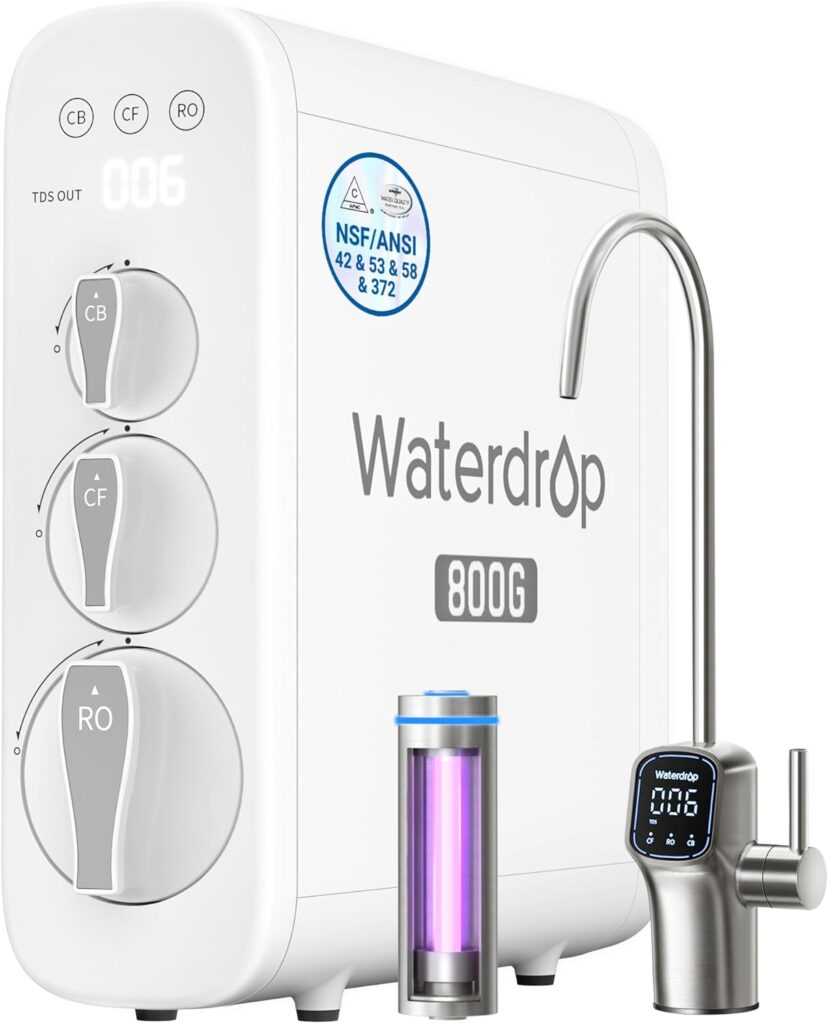
The G3P800 Can Be a Great Fit If…
Your household has 4 or more people, you fill large containers often, or you just want the faster flow rate. You also want UV sterilization for extra coverage against microorganisms, whether that is because someone in the home is immunocompromised, you use well water, or you simply want an extra layer. And the improved wastewater ratio is important to you for conservation.
Waterdrop G3P600 vs G3P800: FAQs
Does Waterdrop G3P800 have remineralization?
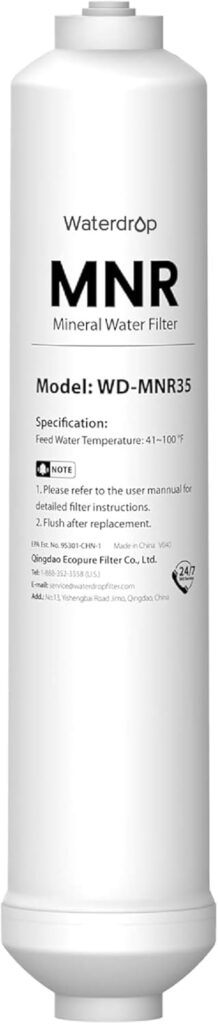
The Waterdrop G3P800 does not automatically include remineralization in every bundle. You can add remineralization separately by purchasing Waterdrop’s optional remineralization filter (model WD-MNR35) on Amazon. If you care about adding minerals back for taste, check the exact bundle name and the filter list in the box before buying.
What’s the lifespan of a Waterdrop G3P800 filter?
Waterdrop lists typical G3P800 filter life as CF about 6 months (or 550 gallons), CB about 12 months (or 1,100 gallons), and the RO membrane about 24 months (or 2,200 gallons). Your real timing can be shorter with heavy use, low water pressure, or dirtier source water. The faucet display is the best indicator because it tracks usage.
What is the lifespan of the Waterdrop G3P600 filter?
Waterdrop lists G3P600 filter life as CF about 6 months (or 500 gallons), CB about 12 months (or 1,100 gallons), and the RO membrane about 24 months (or 2,200 gallons). Those numbers assume typical conditions and can change with usage and source water quality. The faucet indicator is the most reliable replacement reminder.
Does Waterdrop G3P800 remove bacteria?
The Waterdrop G3P800 is marketed to reduce bacteria using its built-in sterilization stage (often described as up to 99.9% sterilization on product pages). This is an added layer on top of RO filtration for households that want extra protection from microorganisms. For exact wording and test conditions, rely on the model’s official documentation and performance sheet.
Can the Waterdrop G3P800 improve water taste?
The Waterdrop G3P800 can improve taste because it reduces chlorine, odors, and dissolved solids that commonly cause “tap water” flavor. Most people notice the biggest taste change if their water has chlorine, metallic notes, or strong odor. If you want a less “flat” RO taste, that’s where a remineralization version or add-on can help.
What is the disadvantage of reverse osmosis water?
Reverse osmosis water can taste “flat” because RO strips out a lot of dissolved minerals along with contaminants. RO systems also produce wastewater, meaning some water goes to the drain while making purified water. Some people prefer adding minerals back for taste, or using RO only for drinking and cooking.
Does waterdrop G3P600 remove minerals?
The Waterdrop G3P600 removes many dissolved minerals because reverse osmosis is designed to reduce total dissolved solids (TDS). That includes minerals like calcium and magnesium, along with unwanted dissolved contaminants. If you want minerals added back for taste, you need a remineralization stage/version rather than standard RO output.
Does waterdrop G3P600 remove microplastics?
A reverse osmosis system like the Waterdrop G3P600 should reduce microplastics because the RO membrane is a very fine physical barrier. The exact removal rate depends on particle size and test conditions, and Waterdrop doesn’t consistently publish a dedicated “microplastics” certification claim for this model.
Both systems offer strong, certified filtration for most homes. If you want to compare current prices side-by-side before deciding, check pricing on the G3P600 and the G3P800 on Amazon to see which fits your budget right now.