People look into tankless reverse osmosis systems for a few reasons. Maybe a water test showed PFAS or lead, maybe you’re trying to reduce contaminants like fluoride or nitrates, or maybe you just want filtered water without a bulky storage tank taking up space under the sink.
A tankless reverse osmosis system filters water on demand through an RO membrane, so it can save cabinet space and avoid the slow refill time that comes with a traditional RO storage tank. However, most tankless RO systems need electricity for the booster pump, use proprietary filters, and may have a brief first-draw TDS rise after sitting idle.
This guide compares five under-sink tankless reverse osmosis systems based on certification strength, flow rate, pure-to-drain ratio, remineralization, filter replacement, and everyday usability.
Top 5 Picks
Best Overall Tankless Reverse Osmosis System
Waterdrop G3P800
Best for households that want faster 800 GPD flow, smart faucet monitoring, and a more efficient 3:1 pure-to-drain ratio.
Check price on Amazon
Jump to review ↓
Best 600 GPD Tankless RO System
Waterdrop G3P600
Best for small to mid-sized households that want a compact 600 GPD tankless RO system with smart TDS monitoring.
Check price on Amazon
Jump to review ↓
Best Tankless RO System for Everyday Drinking Water
iSpring RO500AK-BN
Best for everyday drinking and cooking water, with alkaline remineralization, 500 GPD flow, and NSF/ANSI 58 certification for TDS.
Check price on Amazon
Jump to review ↓
Best Tankless RO System with Remineralization
Frizzlife PD600-TAM3
Best for buyers who want alkaline remineralized RO water and a 2:1 pure-to-drain ratio.
Check price on Amazon
Jump to review ↓
Best High-Flow APEC Tankless RO System
APEC ROCT-A1000 Tankless RO System
Best for buyers who want a high-flow APEC tankless RO system with 1000 GPD capacity, quick-change filters, and 2:1 efficiency.
Check price on Amazon
Jump to review ↓
Best Overall: Waterdrop G3P800
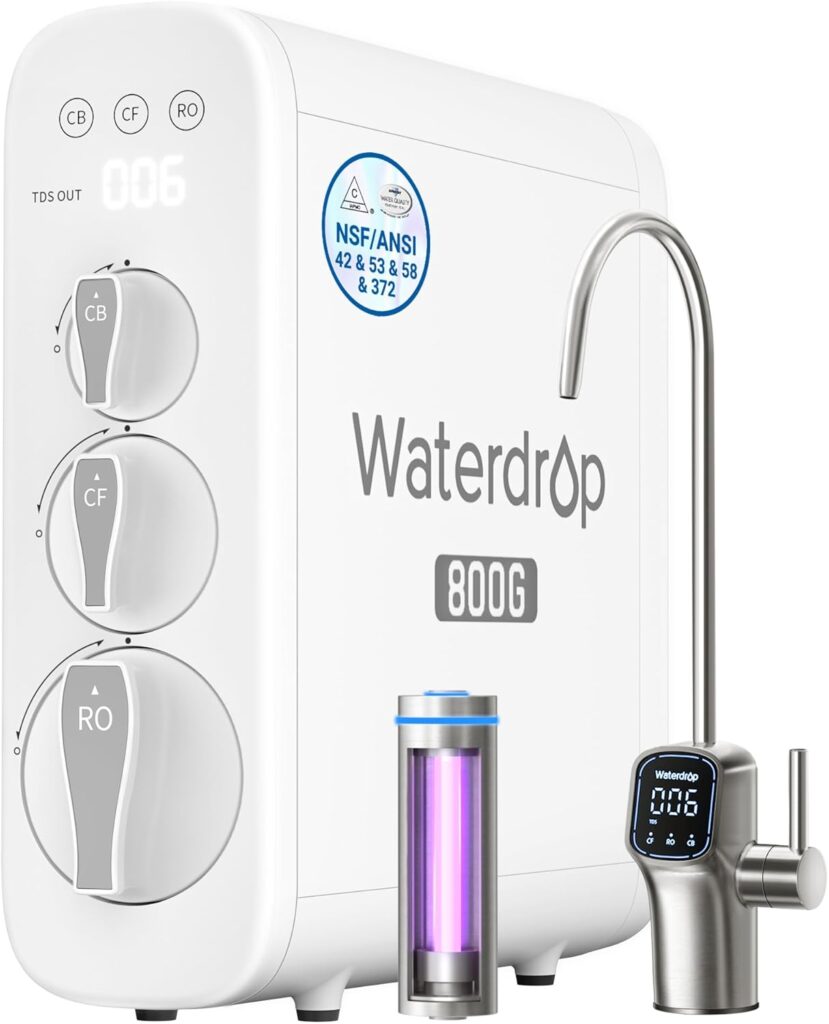
The Waterdrop G3P800 is the strongest overall pick if you want faster flow, better water efficiency, and a more feature-rich tankless RO system.
It produces up to 800 gallons per day, fills a 6 oz cup in about five seconds, and uses a 3:1 pure-to-drain ratio, which means it sends less water to the drain than many older RO systems. Waterdrop also states that the system is certified by IAPMO R&T to NSF/ANSI 42, 53, and 58 for the claims listed on its performance data sheet, and to NSF/ANSI 372 for lead-free materials.
It’s a good choice for families that use filtered water for drinking, coffee, cooking, pet bowls, and filling bottles throughout the day.
The higher flow rate can help if the system connects to a refrigerator line, but fridge compatibility still depends on your home’s water pressure, the tubing distance, and the refrigerator’s inlet requirements.
What Hits the Mark
- Certified by IAPMO R&T to NSF/ANSI 42, 53, and 58 for listed performance claims, plus NSF/ANSI 372 for lead-free materials.
- 800 GPD output and about a five-second cup fill make it one of the faster tankless RO systems in this roundup.
- 3:1 pure-to-drain ratio is more efficient than many 2:1 systems
- Smart faucet shows TDS readings and filter status, which helps you track performance without a separate meter.
What to Know First
- Requires a grounded electrical outlet under the sink; most installations will need one if the garbage disposal already uses the existing outlet
- Proprietary G3 cartridges, so you are dependent on Waterdrop’s supply chain for ongoing filter costs
- TDS creep on first draw after the system sits idle is a known quirk of tankless systems, including this one
Specs snapshot
| Filtration type | 10-stage tankless reverse osmosis |
| Certifications Listed | IAPMO R&T certified to NSF/ANSI 42, 53, 58 for listed claims and NSF/ANSI 372 for low lead |
| Capacity | 800 GPD |
| Pure-to-drain ratio | 3:1 |
| Fill time | About 5 seconds per 6 oz cup |
| Product Dimensions | 18.12″L x 5.67″W x 17.72″H |
Maintenance notes
Waterdrop’s G3 series uses multiple proprietary filters with different replacement intervals. The smart faucet helps track filter life, but it’s still worth checking replacement filter costs before buying because filter prices can change over time. See G3P800 filters on Amazon here.
Best 600 GPD Tankless RO System: Waterdrop G3P600
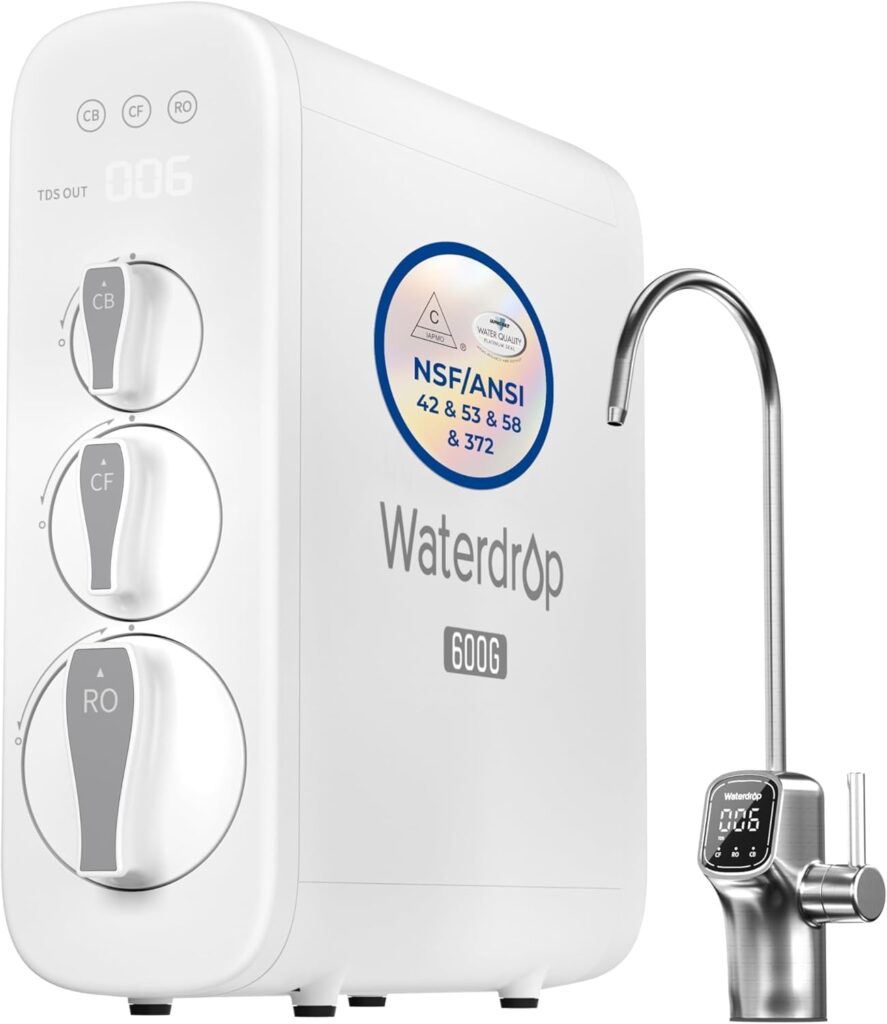
The Waterdrop G3P600 is a strong option if you like the Waterdrop G3 design but don’t need the higher output of the G3P800.
It produces up to 600 gallons per day, fills a cup in about eight seconds, and uses a 2:1 pure-to-drain ratio. That’s plenty for most homes using filtered water for drinking, coffee, cooking, and bottle filling.
What Hits the Mark
- 600 GPD flow is plenty for most households using RO water for drinking and cooking.
- Smart faucet displays TDS readings and filter life.
- 2:1 pure-to-drain ratio is more efficient than many older tank-based RO systems.
- Compact tankless design saves cabinet space compared with a traditional RO tank.
What to Know First
- Replacement filters are proprietary to the Waterdrop G3 series.
- Requires an electrical outlet under the sink
Specs snapshot
| Filtration type | 8-stage tankless reverse osmosis |
| Certifications Listed | NSF/ANSI 42, 58, and 372 listed by Waterdrop. Specific contaminant reduction claims are covered in the performance data sheet. |
| Capacity | 600 GPD |
| Pure-to-drain ratio | 2:1 |
| Fill time | About 8 seconds per cup |
| Product Dimensions | 18.12″L x 5.67″W x 17.72″H |
Maintenance notes
Waterdrop’s G3P600 uses separate filter cartridges with different replacement intervals. Filter life depends on source water quality and usage, so homes with higher sediment or TDS may need replacements sooner. See G3P600 filters on Amazon here.
If you’re deciding between the two Waterdrop models, see our full Waterdrop G3P600 vs G3P800 comparison before choosing.
Best Everyday Drinking Water: iSpring RO500AK-BN
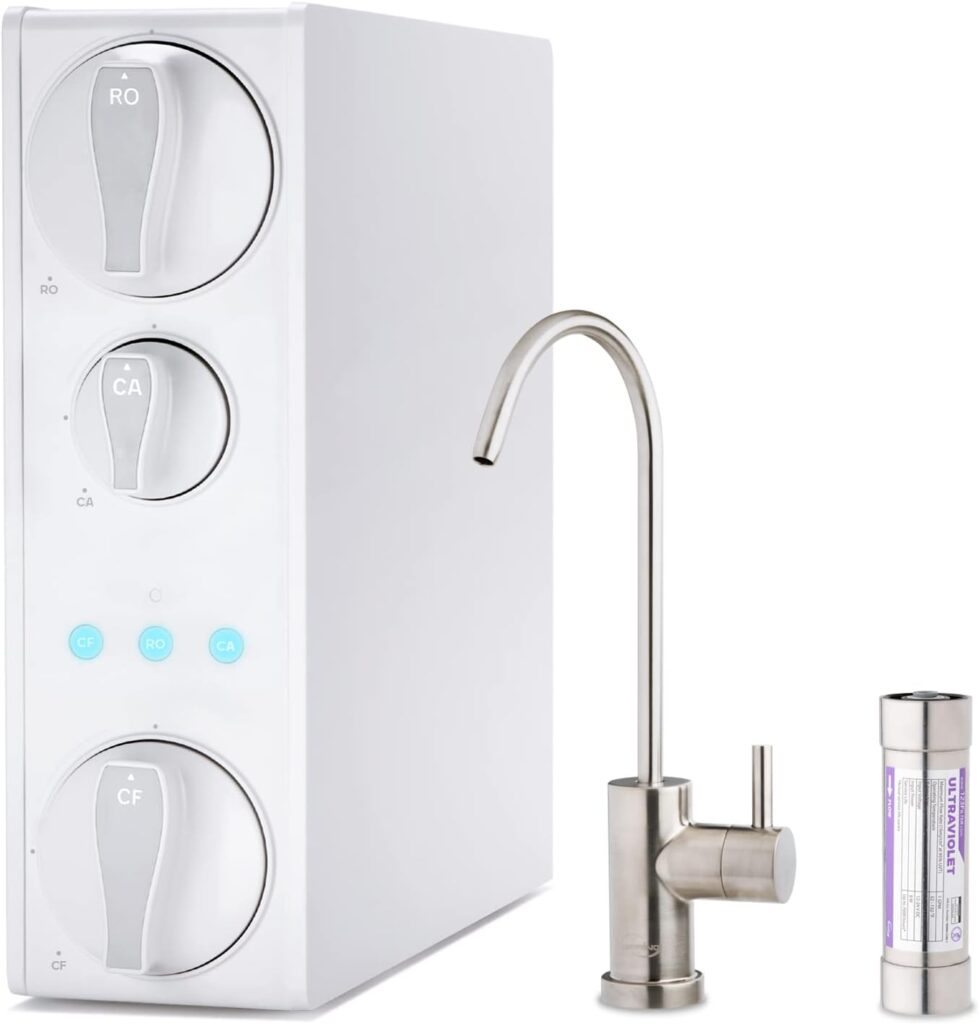
The iSpring RO500AK-BN is our top pick for everyday drinking and cooking water. It produces up to 500 GPD, uses a 2:1 pure-to-waste ratio, and adds an alkaline remineralization stage after the RO membrane.
It’s not the fastest tankless reverse osmosis system, but 500 GPD is enough for most homes using filtered water for glasses, coffee, tea, and cooking.
If you like iSpring but don’t need a powered tankless model, our iSpring RCC7 reverse osmosis review covers a more traditional tank-based option.
What Hits the Mark
- NSF/ANSI 58 certified for TDS reduction with a verifiable QR code that links to the official NSF report
- Alkaline remineralization stage included, adding calcium and magnesium for improved taste and balanced pH
- 2:1 pure-to-waste ratio helps reduce water waste compared with many traditional RO systems.
What to Know First
- 500 GPD is the lowest capacity on this list. If you want to connect a refrigerator line, the lower flow may be more limiting than the Waterdrop G3P800.
Specs snapshot
| Filtration type | Tankless RO with alkaline remineralization |
| Certifications Listed | NSF/ANSI 58 certified for TDS reduction |
| Capacity | 500 GPD (0.4 GPM flow rate) |
| Pure-to-drain ratio | 2:1 |
| Best use | Daily drinking and cooking water |
| Product Dimensions | 19″L x 8″W x 24″H |
Maintenance notes
The F7-RO500AK 2-year filter set covers all replacement cartridges for a full two-year cycle. Filter changes require no tools and no water shutoff. See F7-RO500AK filters on Amazon here.
Best Integrated Remineralization: Frizzlife PD600-TAM3
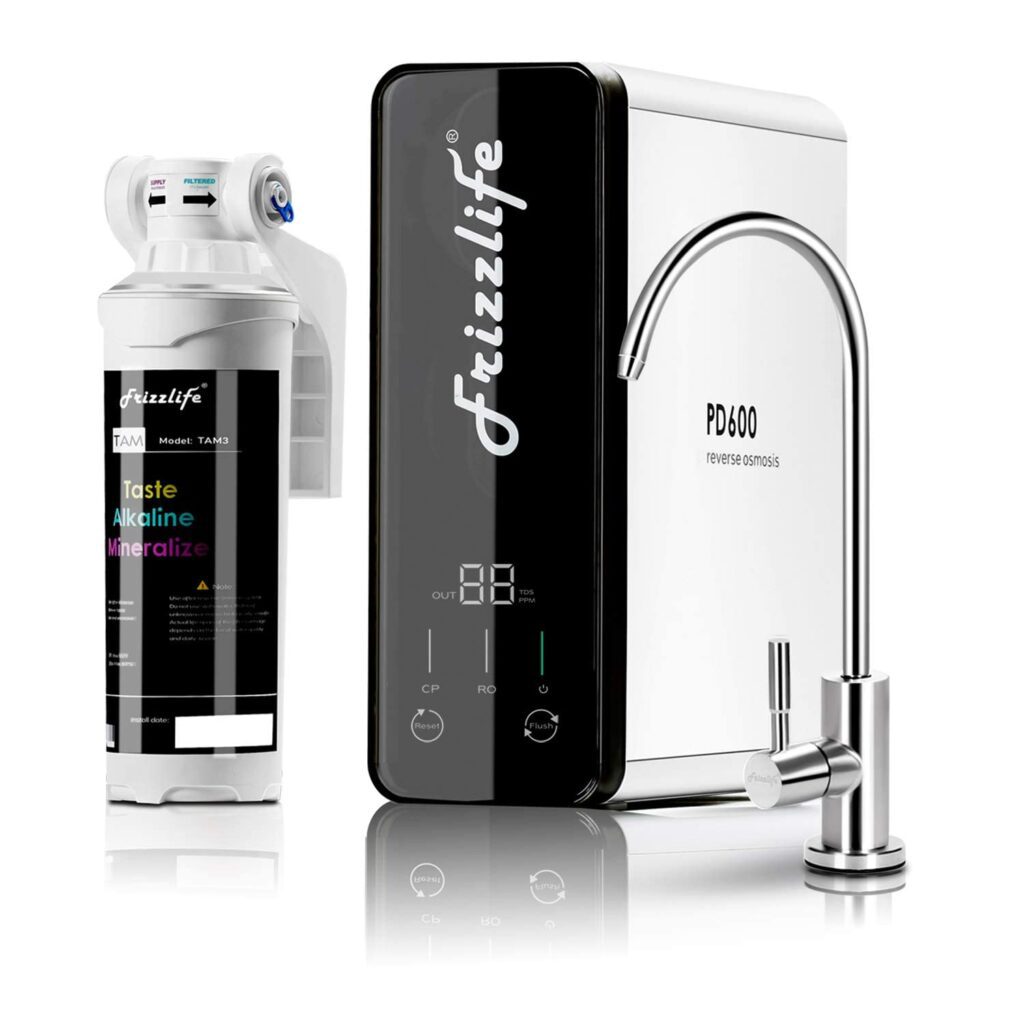
The Frizzlife PD600-TAM3 is a tankless reverse osmosis system with alkaline remineralization. Its TAM3 stage adds minerals back after RO filtration, which can improve the taste of finished water.
It’s rated for 600 GPD and uses a 2:1 pure-to-drain ratio. The compact 14.7″ x 5.3″ x 15.5″ design fits under many sinks, and the smart display shows real-time TDS and filter life.
What Hits the Mark
- Built-in TAM3 remineralization stage adds minerals back after RO filtration for better-tasting water.
- 600 GPD output is plenty for most households using filtered water for drinking, cooking, coffee, and bottle filling.
- Smart display shows TDS readings and filter life, so you are not guessing when cartridges need replacing.
- 2:1 pure-to-drain ratio is more efficient than many older RO systems.
- Compact tankless body saves cabinet space compared with a traditional RO tank.
What to Know First
- This is not the most water-efficient system in the roundup if you are comparing it against 3:1 models like the Waterdrop G3P800.
- Remineralization can raise TDS readings after the water passes through the TAM3 filter. That is expected because minerals are being added back.
- It needs electricity under the sink.
- Replacement filters are proprietary, so check ongoing filter costs before buying.
Specs snapshot
| Filtration type | Tankless reverse osmosis with alkaline remineralization |
| Certifications Listed | Listing references NSF/ANSI 58, 53, 42, and 372 standards; Frizzlife says it has been tested under NSF/ANSI 42, 53, and 58 for listed reduction claims. |
| Capacity | 600 GPD |
| Pure-to-drain ratio | 2:1 |
| Remineralization | Yes, TAM3 alkaline mineral stage |
| Fill Time | Approx.10 seconds |
| Product Dimensions | 14.7″ L x 5.3″ W x 15.5″ H |
Maintenance notes
The Frizzlife PD600-TAM3 uses three main filter stages: the CP filter, the RO membrane, and the TAM3 alkaline remineralization filter. Actual replacement timing depends on your water quality and usage, so homes with high TDS, sediment, or heavy daily use may need replacements sooner. See PD600-TAM3 filters on Amazon here.
Best for High-Flow: APEC ROCT-A1000 Tankless RO System
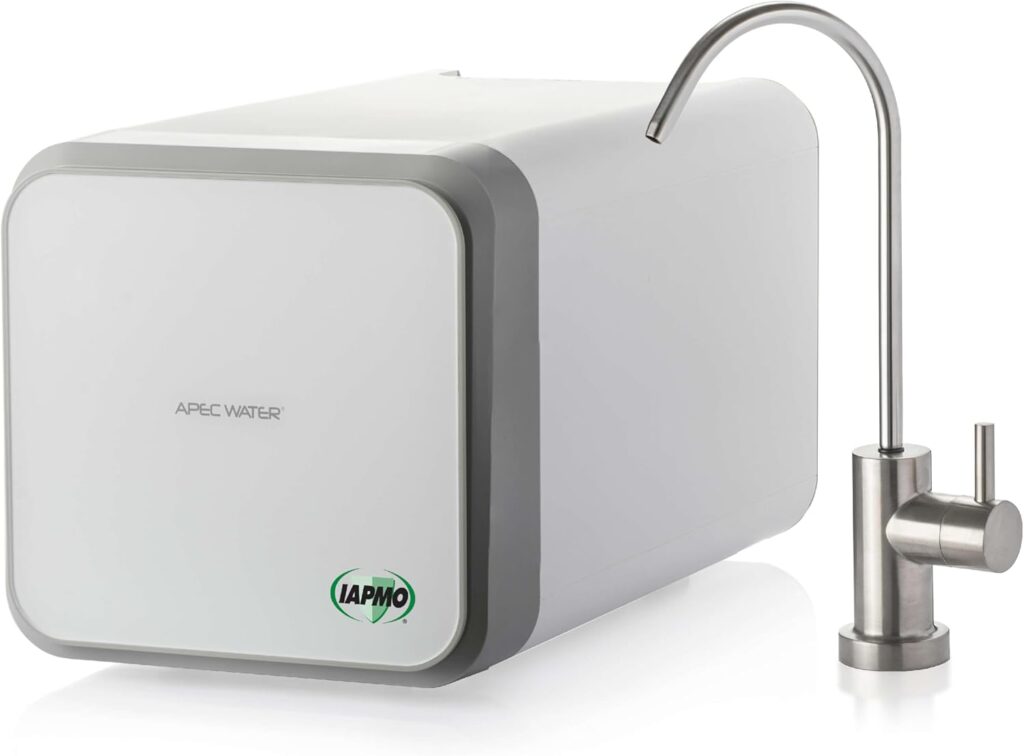
The APEC ROCT-A1000 is a tankless reverse osmosis system built for homes that need fast filtered water without a storage tank. It produces up to 1000 gallons per day, has a 2:1 pure-to-drain ratio, and can fill a 16 oz cup in under six seconds.
The RO system uses 3-stage reverse osmosis filtration and is listed with NSF 372 and NSF 58 certifications. According to the listing, it’s been third-party tested for reduction of TDS, lead, arsenic, radium, chlorine, chromium, PFAS, and PFOS.
The ROCT-A1000’s standout feature is its front-facing quick-twist filter design, which makes replacements easier than many traditional under-sink RO systems.
Its compact 18″ x 10″ x 10″ tankless design fits under many sinks, but you’ll still need enough cabinet space and a nearby outlet.
What Hits the Mark
- 1000 GPD capacity gives it the highest rated output in this roundup.
- 2:1 pure-to-drain ratio is solid for a high-flow tankless RO system.
- Listed with NSF 372 and NSF 58 certification.
- Front-facing quick-twist filters should make maintenance easier than traditional canister-style filter changes.
- Compact tankless body saves under-sink space by removing the storage tank.
What to Know First
- Requires an electrical outlet under the sink like all powered tankless systems
- It does not include alkaline remineralization, so buyers who prefer mineralized RO water may prefer iSpring or Frizzlife.
Specs snapshot
| Filtration type | 3-stage tankless reverse osmosis |
| Certifications Listed | NSF 372 and NSF 58 |
| Capacity | 1000 GPD |
| Pure-to-drain ratio | 2:1 |
| Fill speed | 16 oz cup in under 6 seconds |
| Dimensions | 18″ L x 10″ W x 10″ H |
| Weight | 18.9 lb |
| Best for | Buyers who want a high-flow APEC tankless RO system with quick-change filters |
Maintenance notes
The ROCT-A1000 uses front-facing quick-twist filters, so replacements should be easier than older under-sink RO systems with separate filter housings. APEC also provides installation and filter replacement videos, which is helpful if you plan to install or maintain the system yourself. Because the filters are model-specific, check the current replacement filter cost before buying.
How to Choose the Best Tankless Reverse Osmosis System
Start with Certification, Not Features
For reverse osmosis systems, NSF/ANSI 58 is the main standard to look for because it applies to RO filtration. NSF/ANSI 53 covers health-related contaminant reduction claims, while NSF/ANSI 42 covers taste, odor, and chlorine reduction.
NSF/ANSI 372 is different. It covers low-lead plumbing materials, not contaminant reduction. A system can meet NSF/ANSI 372 without being certified to reduce lead in drinking water.
For PFAS, NSF points to products certified to NSF/ANSI 53 or NSF/ANSI 58 with a specific PFAS reduction claim. Always check the performance data sheet for the exact reverse osmosis system, since certification claims vary by model.
Match GPD to Your Water Usage
GPD stands for gallons per day. It tells you how much water the system can produce under test conditions, not how much your household will actually drink. Most families do not need hundreds of gallons of RO water per day, but higher GPD can still matter because it usually gives you a faster faucet stream, shorter cup fill times, and better performance during back-to-back use.
For most households, a 500 to 600 GPD tankless reverse osmosis system is enough for drinking water and cooking.
The Waterdrop G3P800’s higher flow is a good choice if you fill large bottles, cook often, or plan to connect the RO system to a refrigerator line.
Plan for the Electrical Outlet
Most tankless reverse osmosis systems need power for the booster pump, smart faucet, UV stage, or filter-life display. Before buying, check whether you already have a grounded outlet under the sink. If the only outlet is used by a garbage disposal, you may need an electrician to add another one.
Pure-to-Drain Ratio and Water Bills
Pure-to-drain ratio tells you how much filtered water the system produces compared with wastewater. A 3:1 ratio means three cups of filtered water for every one cup sent to the drain. A 2:1 ratio means two cups filtered for every one cup sent to the drain.
Among these picks, the Waterdrop G3P800 has the strongest blend of high flow and efficiency at 3:1.
Remineralization: What it Does and What it Costs
Reverse osmosis reduces dissolved minerals along with many unwanted contaminants. That’s one reason some people find plain RO water a little flat. A remineralization stage adds minerals back after the RO membrane, which can improve taste and slightly raise TDS readings.
Choose iSpring or Frizzlife if you know you want remineralized water. Choose Waterdrop G3P800 or G3P600 if you care more about flow, smart monitoring, and certification strength.
If you rent, have limited under-sink space, or don’t want to drill a faucet hole, a countertop RO system may be the easier route. Our guide to the best countertop reverse osmosis systems with remineralization covers no-plumbing options that still add minerals back after filtration.
Tankless vs Tank-Based Reverse Osmosis Systems
| Option | Best for | Tradeoffs |
| Tankless RO | Tight cabinets, faster cup fills, and households that want filtered water on demand | Requires electricity, uses proprietary filters, may produce pump noise, and can have brief first-draw TDS creep |
| Tank-based RO | Homes that want stored filtered water or do not have an under-sink outlet | Takes up more cabinet space, can be slower to refill after heavy use, and may waste more water depending on the system |
| Countertop RO | Renters, apartments, or anyone who cannot drill a faucet hole | Takes up counter space, has smaller capacity, and some models still require electricity |
Ice Maker and Refrigerator Line Compatibility
This is one of the most overlooked issues with tankless reverse osmosis systems. A refrigerator ice maker draws small, repeated amounts of water through a valve that needs steady pressure. Tankless RO systems filter water in real time, so flow and pressure can vary depending on the system, tubing distance, refrigerator requirements, and your home’s incoming water pressure.
If you plan to connect a tankless RO system to a refrigerator water dispenser or ice maker, check the manufacturer’s refrigerator-line guidance before buying. Some refrigerators require around 40 PSI at the inlet to run the ice maker and dispenser properly, and RO systems can reduce outlet pressure compared with your home’s incoming water pressure.
For ice production, that can mean slower fills, smaller ice cubes, hollow cubes, or reduced dispenser flow if the system cannot maintain enough pressure. A higher-flow tankless RO system, such as an 800 GPD or 1000 GPD model, may help, but it does not guarantee compatibility with every refrigerator.
If ice quality is one of the reasons you’re upgrading your water system, you may also want to compare a dedicated countertop ice maker instead of relying only on your refrigerator line. See our guide to the best self-cleaning countertop ice makers for options that are easier to place on a counter, bar cart, RV counter, or a small kitchen.
What Contaminants Does a Tankless RO System Reduce?
Reverse osmosis can reduce many dissolved contaminants by pushing water through a very tight membrane. The EPA lists reverse osmosis and nanofiltration as effective treatment options for PFAS. NSF also says devices certified to NSF/ANSI 53 or NSF/ANSI 58 can help reduce PFAS exposure when the product includes a PFAS reduction claim.
For lead, fluoride, nitrates, TDS, and PFAS, check the performance data sheet for the exact system. Don’t rely on broad claims like “removes up to 99%”. Certification claims are model-specific. A standard listed on the box doesn’t mean every contaminant has been independently tested for that product.
If fluoride and chlorine are your main concerns, our guide to the best water filters for fluoride and chlorine compares other filter types worth considering before you decide on an under-sink RO system.
Tankless RO Filter Replacement Costs and What to Expect
Filter replacement is the main ongoing cost of owning any tankless RO system. These systems usually use proprietary cartridges, which means you cannot swap in generic 10-inch RO filters.
Before choosing a model, check three things: the cost of a one-year filter pack, the cost of the RO membrane, and whether replacement filters are easy to buy from Amazon or the brand’s own site.
For most tankless RO systems, carbon and pre-filter stages are replaced more often than the RO membrane. Actual timing depends on your water quality, usage, and sediment load. If your tap water has high TDS or visible sediment, filters may need changing sooner than the brand’s maximum estimate.
Conclusion
The best tankless reverse osmosis system is the one that matches your water quality, sink space, and daily water use.
Certification is one of the easiest ways to narrow the list because it shows which claims have been checked against recognized standards. Just make sure the certification applies to the exact model and contaminant claim you care about.
Before you buy, check the outlet access under your sink, filter replacement costs, and noise from the booster pump. Most tankless RO systems use brand-specific filters, so long-term maintenance matters just as much as the upfront price.
FAQ About Tankless Reverse Osmosis Systems
What is the best tankless reverse osmosis system for most households?
For most households, the Waterdrop G3P800 is the strongest overall pick in this lineup. It produces up to 800 GPD, has a smart faucet display, and uses a 3:1 pure-to-drain ratio.
The G3P800 is listed as certified by IAPMO R&T to NSF/ANSI 42, 53, and 58 for the claims listed on its performance data sheet, plus NSF/ANSI 372 for low lead.
The Waterdrop G3P600 is a good alternative if you want a smaller 600 GPD system. The iSpring RO500AK-BN is also worth considering if you want alkaline remineralization and NSF/ANSI 58 certification for TDS reduction.
Does a tankless reverse osmosis system remove PFAS?
A tankless reverse osmosis system can reduce PFAS when it uses an RO membrane and has product-specific PFAS reduction claims.
The EPA lists reverse osmosis as a treatment option for PFAS in drinking water, and NSF recommends checking certified systems instead of relying on broad marketing claims. For any tankless RO system, check the performance data sheet for PFOA, PFOS, or PFAS reduction claims.
Can a tankless reverse osmosis system remove fluoride?
Yes, reverse osmosis membranes can reduce fluoride, but the exact reduction rate depends on the specific system and its performance data sheet. Waterdrop lists fluoride among the reduced substances for both the G3P600 and G3P800, but if fluoride reduction is your main reason for buying, check the model’s current performance data sheet for the tested reduction percentage before purchasing.
Do all tankless RO systems require electricity?
Most tankless RO systems require electricity because they use a booster pump to push water through the membrane on demand. Many also power a smart faucet, filter-life display, UV stage, or automatic flushing feature. If your under-sink outlet is already used by a garbage disposal, plan for that before buying. During a power outage, a powered tankless RO system may not dispense filtered water normally.
What is TDS creep in a tankless reverse osmosis system?
TDS creep is a temporary rise in TDS readings after an RO system sits unused. It happens when a small amount of dissolved solids migrates across the membrane while the system is idle. With a remineralization stage, the first-draw TDS may read even higher because minerals are being added back after filtration. Running the faucet briefly before filling a glass can help clear that first draw.
Tankless reverse osmosis vs tank-based RO for a small kitchen which is better?
For a small kitchen, a tankless reverse osmosis system is usually better for saving cabinet space because there is no pressurized storage tank. The tradeoff is that tankless systems usually need electricity, use proprietary filters, and may make pump noise during use. A compact tank-based RO system may be simpler if you do not have an under-sink outlet or want stored filtered water available during a power outage.
How often do I need to replace filters in a tankless RO system?
Most tankless RO systems use multiple filters with different replacement schedules. Pre-filters and carbon stages are commonly replaced every 6 to 12 months, while RO membranes often last longer, depending on the model, water quality, and household use. Higher sediment, high TDS, or heavy daily use can shorten filter life. Many tankless systems include smart faucets, LED reminders, or filter-life indicators to help you know when replacements are due.
What certifications should a tankless reverse osmosis system have?
For RO systems, NSF/ANSI 58 is the key certification to look for because it applies to reverse osmosis drinking water treatment systems. NSF/ANSI 42 covers aesthetic claims such as chlorine, taste, and odor. NSF/ANSI 53 covers health-related contaminant reduction claims. NSF/ANSI 372 relates to low-lead materials, not contaminant reduction performance. Certification from NSF, IAPMO R&T, or another recognized certifier is stronger than a brand simply saying a system was “tested to” a standard. Always check the exact model and the listed contaminant claims, because certification does not automatically cover every contaminant you care about.