After a long day on trail, pumping water for the whole group is the last thing anyone wants to do at camp. A gravity water filter system solves that: fill a bag, hang it from a branch, and come back to treated water ready for cooking and drinking. No pumping, no squeezing, no standing at the creek.
The five backpacking water filters below cover a wide range of trip types. Some are complete two-bag kits engineered for group camp use. One is a squeeze filter that doubles as a gravity setup with gear many hikers already own. One is a full gravity purifier that removes viruses, which the others do not.
The right pick depends on group size, typical water source conditions, and how much weight you are prepared to carry into the backcountry.
Quick Picks
Best Overall
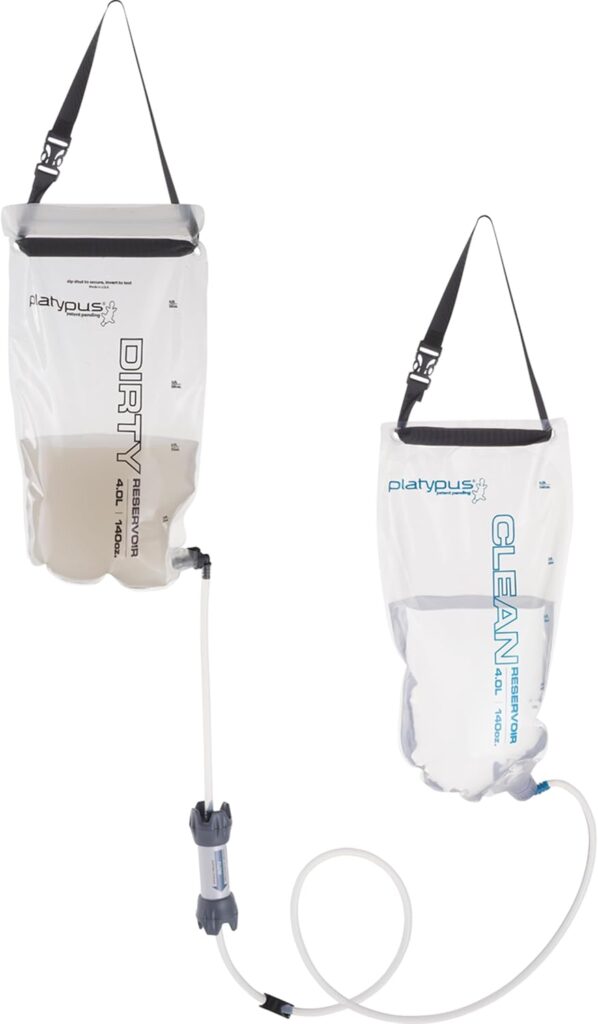
Platypus GravityWorks 4LHands-free group filtration with a proven dual-bag design. Roughly 1.75 L/min keeps a crew of four supplied in about ten minutes with no pumping.
↓ Jump to review-
 Best UltralightKatadyn BeFree Gravity 3L
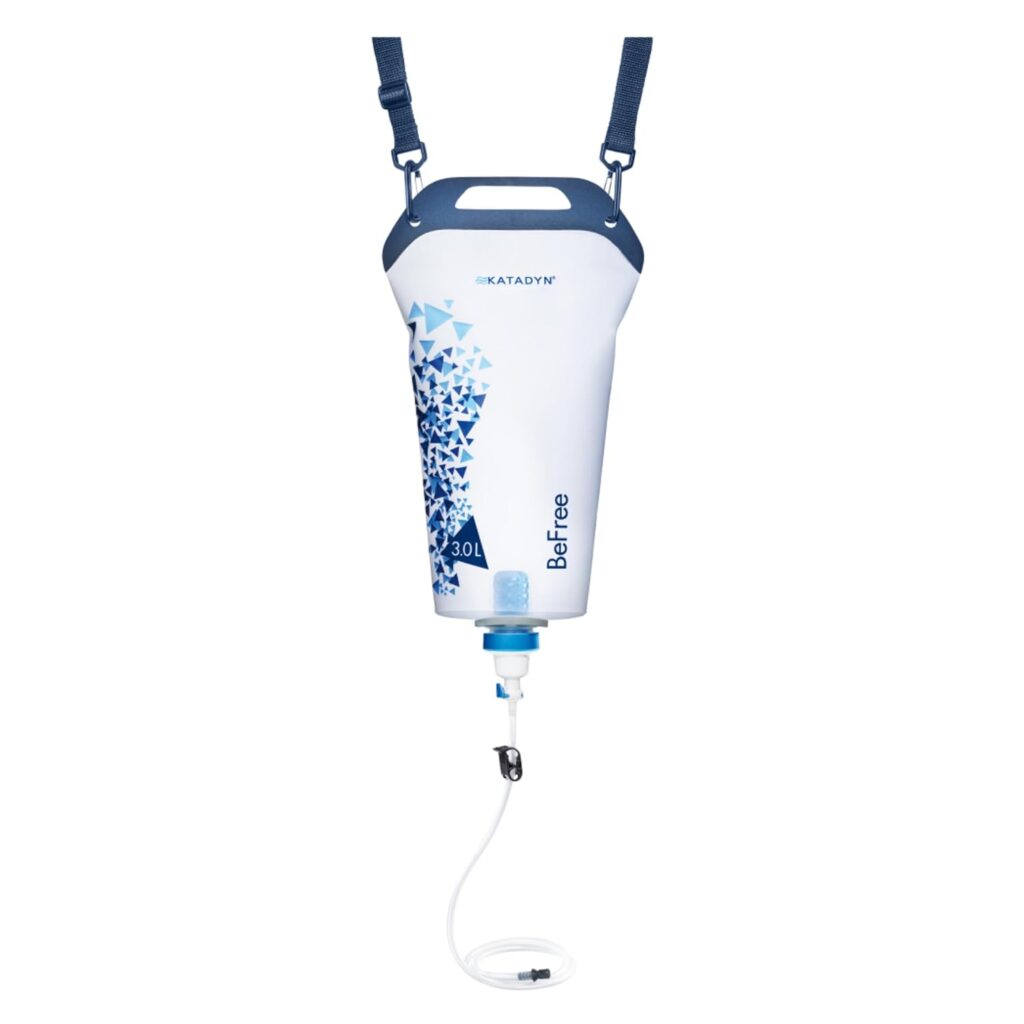
Solo hikers and duos who count grams. Fast flow at under 90 seconds per liter with clear water.
↓ Jump to review -
 Best Versatile SetupSawyer Squeeze in Gravity Mode
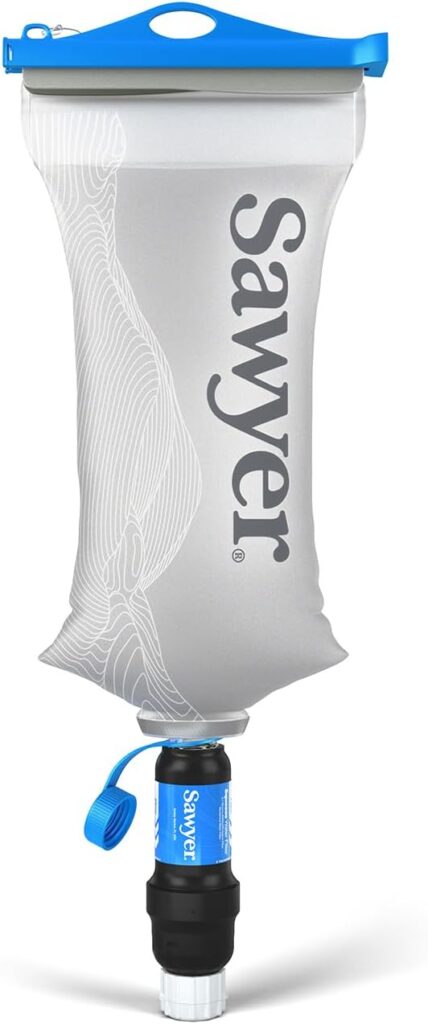
One filter that squeezes, runs inline, or hangs as gravity. Works with Smartwater and CNOC bags you may already own.
↓ Jump to review -
 Best for Virus ProtectionMSR Guardian Gravity
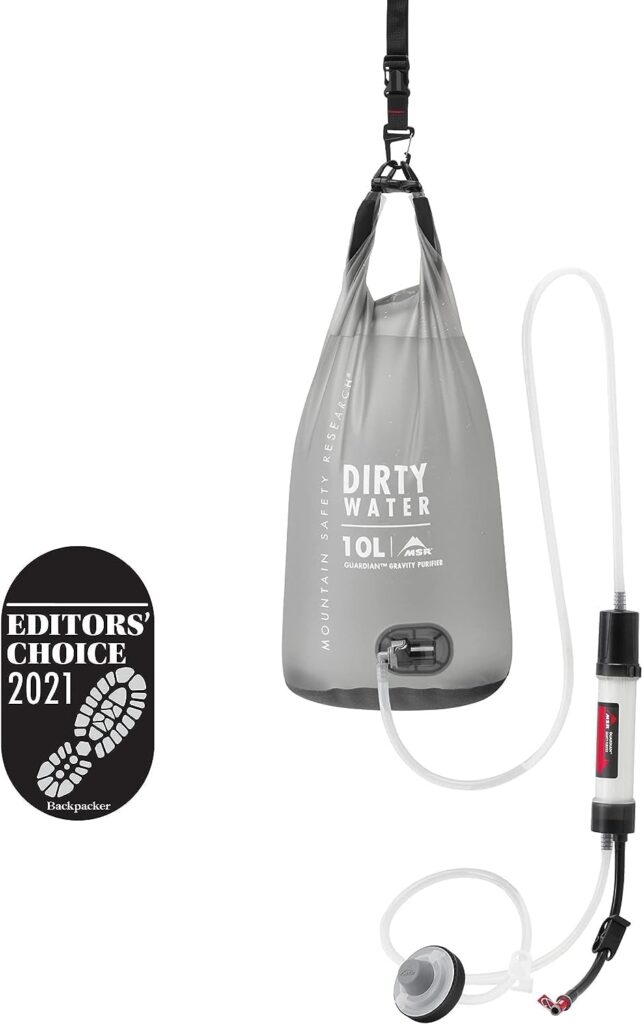
The only gravity system in this list that removes viruses alongside bacteria and protozoa. Built for international travel and high-risk sources.
↓ Jump to review -
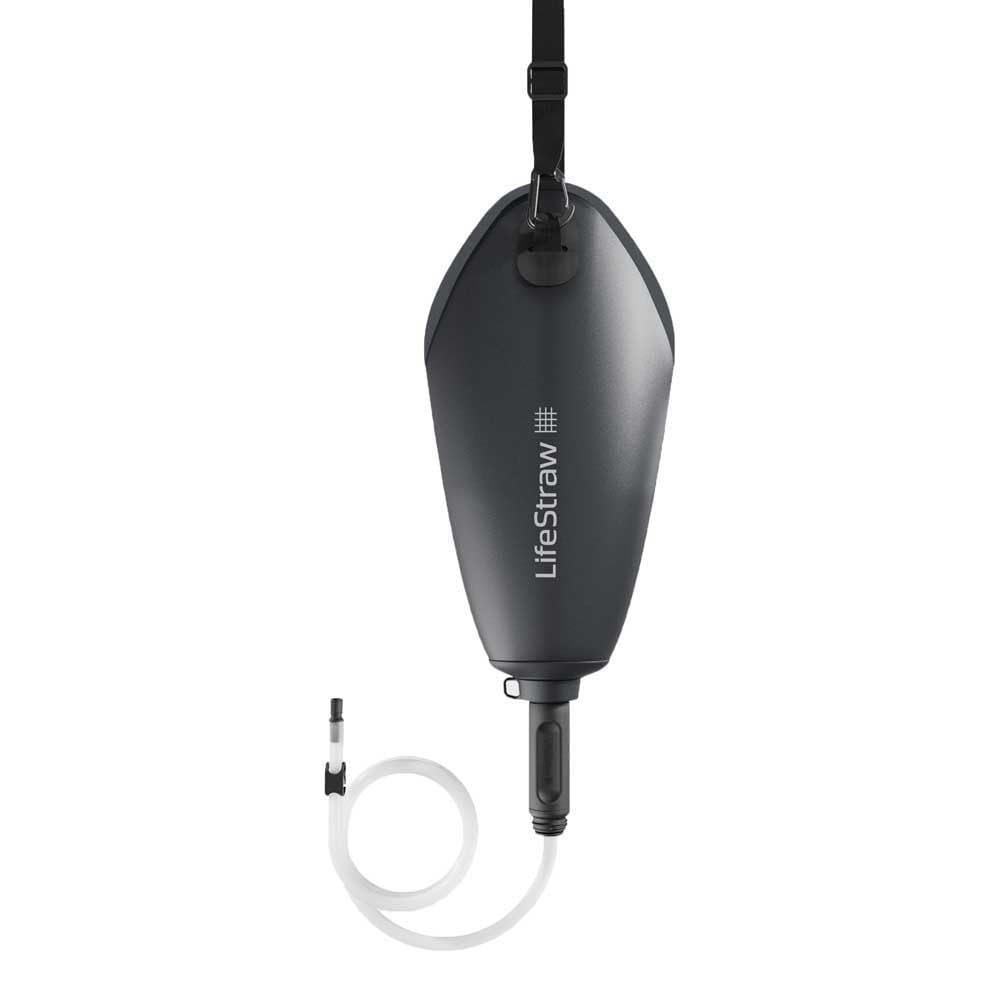 Best for Alpine WaterLifeStraw Peak Gravity 3L
Lightweight and compact with a long 2,000 L filter life. Best suited to clear water rather than silty or murky sources.
↓ Jump to review
Best Overall: Platypus GravityWorks 4L
For groups of three or four, the GravityWorks is a strong choice when you want a backpacking water filter you can hang at camp and leave to do the work on its own.
Hang the dirty bag from a branch, clip the clean bag below it, and the 0.2-micron hollow fiber element moves up to 1.75 L/min without any effort from you. Platypus says every microfilter is individually tested to meet EPA and NSF guidelines for bacteria and protozoa removal, and the color-coded dual-bag design makes it impossible to mix up the dirty and clean sides.
It’s the heaviest gravity filter in this list at 11.5 oz. For a group splitting weight across packs that is not a problem, but for a solo hiker it’s a harder call. The filter element is rated to 1,500 L, shorter than the LifeStraw Peak and Sawyer Squeeze, so budget for a replacement cartridge after a couple of heavy-use seasons.
Pros
- Up to 1.75 L/min through a 0.2-micron hollow fiber element; four people can have 4L ready in roughly ten minutes
- Color-coded dual-bag system keeps dirty and clean water separated at every step
- Every microfilter is individually tested to meet EPA and NSF guidelines before leaving the factory
- Backflushes quickly in the field to help restore flow
- Clean bag doubles as a camp shower reservoir with compatible accessories
Cons
- 11.5 oz system weight; best split across a group rather than carried solo
- 1,500 L filter lifespan is shorter than the LifeStraw Peak (2,000 L) and Sawyer Squeeze (1,000,000 gal)
- Flow drops with silty or turbid water; backflush more frequently when source quality is poor
Specs Snapshot
- Filtration type: Gravity filter
- Filter media: Hollow fiber
- Pore size: 0.2 microns
- Removes: 99.9999% of bacteria, 99.9% of protozoa
- Bag capacity: 4L dirty + 4L clean (8L total system)
- Flow rate: Up to 1.75 L/min
- System weight: 11.5 oz (326 g)
- Filter lifespan: 1,500 L (approx. 396 gal)
- Bottle compatibility: Not a standard 28 mm bottle-thread system; uses Platypus’ bag-and-hose
- Field cleanable: Yes — backflush in approx. 4 seconds
- Certification: Tested to EPA and NSF guidelines per Platypus
Maintenance: Backflush after trips or whenever flow slows. Protect the filter from freezing after use, since a frozen hollow-fiber element can be permanently damaged.
Best Ultralight: Katadyn BeFree Gravity 3L
For solo hikers or pairs who want backcountry water handled at camp without adding a heavy dedicated system to their kit, the BeFree Gravity 3L is worth a serious look. At 192 g, or about 6.8 oz complete, it’s one of the lightest full gravity filter systems in this list. Its 0.1-micron EZ-Clean Membrane pushes water at up to 2 L/min with a clear source, the fastest flow rate of any system here, and the collapsible 3L Hydrapak SoftFlask compresses nearly flat when empty.
The catch is the opening. The BeFree uses a 43 mm wide-mouth HydraPak reservoir, not a standard 28 mm bottle thread. You can fill bottles with the hose, but it’s not a direct screw-on match for Smartwater-style bottles. If you already run Hydrapak flasks that is not an issue, but it rules out pairing with gear many backpackers already carry.
Pros
- 192 g, or about 6.8 oz complete, making it one of the lightest full gravity filter systems in this list
- Up to 2 L/min with clear water, the fastest flow rate in this roundup
- 0.1-micron pore size is finer than the 0.2-micron filters used in the GravityWorks and LifeStraw Peak
- EZ-Clean Membrane cleans with a quick shake or swish, with no syringe or backflushing tool required
- Collapsible flask packs down nearly flat when empty
Cons
- Uses a 43 mm wide-mouth HydraPak reservoir instead of a standard 28 mm bottle thread, so it will not screw directly onto Smartwater-style bottles
- 1,000 L filter lifespan is the shortest in this roundup
- Replacement elements can be harder to find in stores and may cost close to a new kit
Specs Snapshot
- Filtration type: Gravity filter
- Filter media: Hollow fiber (EZ-Clean Membrane)
- Pore size: 0.1 microns
- Removes: 99.9999% of bacteria, 99.9% of protozoa cysts
- Bag capacity: 3L collapsible Hydrapak SoftFlask
- Flow rate: Up to 2 L/min
- System weight: 192 g (approx. 6.8 oz)
- Filter lifespan: 1,000 L (approx. 264 gal)
- Thread compatibility: 43 mm wide-mouth HydraPak reservoir; not compatible with standard 28 mm bottle threads
- Field cleanable: Yes — shake or swish in water, no syringe
- Standards: Meets U.S. EPA microbiological water purifier standards for bacteria and protozoan cyst reduction
Maintenance: Shake or swish the element in clean water after use to help clear sediment from the membrane. No backflushing tool required.
Best Versatile Setup: Sawyer Squeeze
Most thru-hikers and long-distance backpackers already carry a Sawyer Squeeze as a squeeze or inline hydration filter. Depending on the kit version, it can also be adapted for gravity use at camp.
Thread it onto a Smartwater bottle or a 28 mm CNOC Vecto, hang it up, and let it drain while you set up camp. The Sawyer Squeeze uses a 0.1-micron absolute hollow fiber membrane, weighs 3 oz, and is backed by a lifetime limited warranty.
Pros
- One filter works as a squeeze filter, inline hydration filter, and gravity-compatible setup depending on the trip
- 0.1-micron absolute filtration with 99.99999% bacteria removal and 99.9999% protozoa removal
- 28 mm threading connects directly to Smartwater bottles and 28 mm CNOC Vecto bags
- Filter weighs 3 oz (85 g)
- Backflushable and reusable
Cons
- Gravity flow is not rated here and is generally slower than purpose-built dual-bag gravity systems
Specs snapshot
- Filtration type: Squeeze / inline / gravity-compatible filter
- Filter media: Hollow fiber membrane
- Pore size: 0.1 micron absolute
- Removes: 99.99999% of bacteria and 99.9999% of protozoa
- Filter weight: 3 oz (85 g)
- Filter lifespan: Up to 100,000 gallons
- Thread compatibility: Standard 28 mm threads
- Field cleanable: Yes — backflush with the included plunger
- Testing: Individually performance tested by Sawyer; bacteria/protozoa claims cite independent lab testing
Maintenance: Backflush with the included plunger after every use and before storage. On nights below freezing, store the filter element inside your sleeping bag and blow out as much residual water as possible before temperatures drop.
Best for Virus Protection: MSR Guardian Gravity
Every other system in this list is a backpacking water filter that removes bacteria and protozoa but allows viruses through.
For international travel, filtering water near heavily used backcountry campsites, or anyone who wants full biological coverage without relying on chemical backup, the MSR Guardian Gravity is the only gravity water purifier in this list built for that job.
Its 0.02-micron advanced hollow fiber element removes viruses at a 99.99% rate alongside bacteria (99.9999%), protozoa (99.9%), sediment, and microplastics. A second activated carbon stage helps reduce chemicals, unpleasant tastes, and odors. MSR says the Guardian Gravity meets NSF protocol P248, a military-grade testing standard for microbiological purifiers.
However, there are tradeoffs. At 18.7 oz it’s the heaviest system in this list by a wide margin. Flow rate is 0.5 L/min, or 1L in 2 minutes at an optimal hang height of 6 feet, roughly one quarter the speed of the BeFree Gravity.
For a group at a North American trailhead campsite with clear water, that level of protection is more than most trips require. For international travel, expedition use, or any source where viral contamination risk is real, no other gravity filter system here comes close.
Pros
- 0.02-micron pore size physically removes viruses, bacteria, protozoa, sediment, and microplastics in a single pass
- Meets NSF protocol P248, a military-grade testing standard for microbiological purifiers
- Two-stage design: hollow fiber purifier plus activated carbon for taste and odor reduction
- 10L reservoir covers a full group day of drinking, cooking, and hygiene needs
- Purge hose self-cleans the system; no backflushing required
- Built-in cartridge replacement indicator removes the guesswork on when to swap the element
- Made in the USA
Cons
- 18.7 oz is significantly heavier than every other system in this list
- 0.5 L/min flow rate requires patience and a hang height of at least 6 feet for rated output
- Higher price than every other pick here; virus coverage is unnecessary for most domestic backcountry trips
Specs snapshot
- Filtration type: Gravity purifier (2-stage)
- Filter media: Advanced hollow fiber + activated carbon
- Pore size: 0.02 microns
- Removes: 99.99% of viruses, 99.9999% of bacteria, 99.9% of protozoa, sediment, microplastics
- Bag capacity: 10L reservoir
- Flow rate: 0.5 L/min (1L in 2 min at optimal 6 ft hang height)
- System weight: 18.7 oz (530 g)
- Filter lifespan: 3,000+ L
- Thread compatibility: Universal bottle adapter included
- Field cleanable: Yes — open purge hose, no backflushing needed
- Cartridge indicator: Yes
- Certification: NSF protocol P248; meets US EPA Guide Standard
- Country of origin: Made in the USA
Maintenance: Open the purge valve to flush the system and release trapped air, which can reduce flow if left unchecked. No syringe or backflush step is needed. Do not allow the cartridge to freeze. For storage, keep the cartridge assembled and wet inside rather than drying it out.
Best for Alpine Water: LifeStraw Peak Gravity 3L
For clear mountain streams and above-treeline trips, the LifeStraw Peak Gravity 3L is a great fit for solo hikers and pairs who want less weight than the GravityWorks and a longer filter life than the BeFree.
At 8.1 oz complete, the 0.2-micron membrane microfilter averaged 1L per 30 to 34 seconds in independent field testing with clear water, and the filter is rated for 2,000 L, the longest lifespan in this list. LifeStraw redesigned the Peak Series membrane and added a custom backwash accessory to improve performance against sand and silt over the long haul.
In silty or turbid water, flow can slow and filling the bag from shallow or slow-moving sources can be awkward. In clear alpine water, the low weight and 2,000 L filter life makes this system more ideal.
Pros
- Approx. 1L per 30 to 34 seconds with clear water in independent field testing
- 2,000 L (500 gal) filter lifespan, the longest in this roundup
- Lightweight system that is notably lighter than the GravityWorks and MSR Guardian
- Meets US EPA and NSF P231 drinking water standards for bacteria and parasite removal
- Filter is interchangeable across the Peak Series ecosystem and can also be used with a water bottle
- Filter is designed to stop flowing at end of life, making replacement timing straightforward
Cons
- Flow drops with silty or turbid water
- Filling can be awkward in shallow or slow-moving sources
- Does not remove viruses
Specs snapshot
- Filtration type: Gravity filter
- Filter media: Hollow fiber membrane microfilter
- Pore size: 0.2 microns
- Removes: 99.999999% of bacteria, 99.999% of parasites, 99.999% of microplastics, silt, sand, and cloudiness
- Bag capacity: 3L
- Flow rate: Approx. 1L per 30 to 34 seconds in independent field testing with clear water
- System weight: 8.1 oz (228 g)
- Filter lifespan: 2,000 L (500 gal)
- Compatibility: Designed for the Peak Series ecosystem and can also be used with a water bottle
- Field cleanable: Yes — custom backwash accessory included
- Certification: Meets US EPA and NSF P231 drinking water standards for bacteria and parasite removal
Maintenance: Backwash when flow slows and follow LifeStraw’s saline-solution instructions for long-term storage. Avoid freezing the filter.
How to Choose the Right Gravity Water Filter for Backpacking
Group Size and Bag Capacity
A 3L bag filled two or three times is usually enough to cover drinking water and simple camp cooking for one or two people on a typical backcountry day. Once you get into a group of three or four, a 4L to 6L gravity filter system becomes more practical because it cuts down on repeated trips to the water source.
The MSR Guardian Gravity sits in a different category with its 10L reservoir, making it better suited to larger groups or long basecamp-style days. For groups of five or more, two smaller systems running side by side are often more efficient than waiting for one large bag to filter multiple rounds.
Gravity Filter vs. Gravity Purifier: Do You Need Virus Protection?
Four of the five systems here are standard filters, not purifiers. In backpacking water filters with pore sizes around 0.1 to 0.2 microns, that level of filtration is designed to remove bacteria and protozoa such as Giardia and Cryptosporidium, but not viruses.
For most backcountry trips in the US and Canada, that is usually enough because viral contamination is not the main concern in remote wilderness water sources. The equation changes for international travel, water near heavily used areas, or places with unreliable sanitation.
In those situations, the MSR Guardian Gravity offers virus protection the others do not, while a lighter backup option is to use a standard hollow fiber filter and follow it with chlorine dioxide tablets.
Gravity Water Filter System Comparison
| System | Best for | Main tradeoffs |
| Platypus GravityWorks 4L | Groups of 3 to 4 wanting a turnkey two-bag system | Heaviest pick; shorter filter lifespan than some |
| Katadyn BeFree Gravity 3L | Solo and duo hikers wanting the fastest flow at low weight | Hydrapak opening limits bag compatibility; shortest filter lifespan |
| Sawyer Squeeze (gravity mode) | Hikers who already carry a Squeeze and want gravity at camp | Slower gravity flow; OEM pouches are fragile |
| MSR Guardian Gravity | International travel or high-risk water sources needing virus removal | Heaviest and slowest; high cost |
| LifeStraw Peak Gravity 3L | Solo and duo hikers in clear alpine conditions | Flow drops more with turbid water; narrow bag opening |
Flow Rate and Water Source Clarity
Manufacturer flow rates are based on clear water and ideal setup conditions, so actual performance in the field is usually slower. Silty lakes, cloudy streams, and sediment-heavy water all reduce flow and lead to more frequent cleaning.
In those conditions, filters that are easy to backflush or maintain in the field tend to be less frustrating to use than lighter systems that perform best with clear water. Letting dirty water settle for a few minutes before filling the gravity bag can also help by reducing sediment load and slowing down clogging.
Thread Size and the Bags You Already Carry
The 28 mm thread is the most common standard for backpacking water bottles and many hydration setups. The Sawyer Squeeze uses that standard, so it connects easily with gear many hikers already carry. The LifeStraw Peak 3L is built to work within the Peak Series system, but it is still worth checking the exact connector style before buying if you plan to pair it with a specific bag or bottle.
The Katadyn BeFree uses a wide-mouth Hydrapak-style opening instead of a standard 28 mm thread, so you may need to buy compatible bags if you do not already use Hydrapak flasks.
Filter Lifespan and Replacement Cost
The Sawyer Squeeze stands apart here with a lifetime limited warranty and a claimed lifespan of up to 100,000 gallons. In normal backpacking use, most hikers are unlikely to replace it.
The LifeStraw Peak is rated to 2,000 liters and the MSR Guardian Gravity to 3,000+ liters, both giving them longer replacement intervals than the Platypus GravityWorks at 1,500 liters. The Katadyn BeFree has the shortest lifespan in this group at 1,000 liters, so it is worth checking replacement cartridge pricing before you buy.
What Backpacking Gravity Filters Remove from Backcountry Water
Hollow fiber gravity filters work by physically blocking contaminants that are larger than the pore size. In the 0.1 to 0.2 micron range, that includes bacteria and protozoa such as Giardia, Cryptosporidium, E. coli, and Salmonella.
Viruses are much smaller and pass through standard hollow fiber filters. The MSR Guardian Gravity, with its 0.02 micron purifier element, is the only system here designed to stop them. For most wilderness trips in North America, virus protection is not usually the main concern. It becomes more important for international travel or water sources near dense human activity.
Tea-colored filtered water is another common point of confusion. When water still looks brown after filtration, the color usually comes from tannins, which are dissolved organic compounds released by decaying vegetation. Hollow fiber filters do not remove tannins, so the color can remain even when the water is microbiologically safe. The activated carbon stage in the MSR Guardian can improve taste and odor, but it will not reliably remove that brown tint.
None of these systems are comprehensive solutions for chemical contamination, heavy metals, or pesticides. The MSR Guardian Gravity includes activated carbon to reduce some chemicals, tastes, and odors, but if chemical pollution is a real concern, a standard backpacking gravity filter or purifier is not enough on its own.
Gravity Filter vs Squeeze Filter for Backpacking: Which Is Better?
Both systems use hollow fiber membranes and target the same kinds of biological contaminants. The real difference is how they fit into your day on trail.
A squeeze filter gives you water right away by forcing it through the membrane with pressure from a bag or bottle. It’s quick and practical for drinking on the move, but filling several bottles or a cook pot takes more effort. Sawyer’s Squeeze is a good example because it can be used as a squeeze filter, inline with a hydration pack, or adapted for gravity use.
A gravity filter works the other way: fill the reservoir, hang it up, and let gravity do the job. It’s usually less hands-on once set up, which makes it useful around camp when you need several liters for drinking or cooking.
For solo hiking, a squeeze filter is often the simpler tool. For camp use, cooking, or any trip where you need several liters at once, a gravity setup is often easier.
Backpacking Gravity Filter Maintenance and Replacement Costs
Cleaning the filter when flow slows is one of the best ways to keep a hollow-fiber system working well. The Sawyer Squeeze uses a cleaning plunger, the LifeStraw Peak uses a custom backwash accessory, the BeFree uses a shake-or-swish cleaning method, and the MSR Guardian Gravity uses a purge hose and valve instead of backflushing.
Freeze damage is a real concern with hollow-fiber filters after they have been used. On freezing nights, keep the filter element warm and get as much water out of it as you can before bed. MSR specifically warns not to freeze the Guardian Gravity cartridge.
Replacement intervals vary quite a bit. The Sawyer Squeeze is rated up to 100,000 gallons, the LifeStraw Peak to 2,000 liters, the Platypus GravityWorks to 1,500 liters, the Katadyn BeFree to 1,000 liters, and the MSR Guardian Gravity to 3,000+ liters. Before buying, it is worth checking the price and availability of replacement cartridges for the exact system you want.
FAQ about Gravity Water Filters for Backpacking
What is the best gravity water filter for backpacking?
The best gravity water filter for backpacking depends on trip style, group size, and water conditions. Look for a system with enough capacity for your group, a reliable flow rate, low packed weight, easy cleaning, and the right level of protection for the places you hike. For most backcountry trips, a filter that removes bacteria and protozoa is enough, while virus protection is more relevant for international travel or heavily contaminated water sources.
Gravity filter vs squeeze filter: which is better for backpacking?
A squeeze filter is usually better for fast, on-the-move drinking because it gives you water immediately. A gravity filter is better at camp because it works hands-free and is more convenient when you need to treat several liters at once. Many hikers use a squeeze filter for solo trips and a gravity system for groups or basecamp-style stops.
Do backpacking gravity water filters remove viruses?
Most backpacking gravity water filters do not remove viruses. Standard hollow-fiber filters like the Platypus GravityWorks and Katadyn BeFree are designed for bacteria and protozoa, while the MSR Guardian Gravity uses a 0.02-micron purifier element rated to remove viruses as well.
How fast do backpacking gravity water filters work?
Backpacking gravity filter speed varies by model and water quality. In this group, the Katadyn BeFree Gravity 3L is rated up to 2 L/min, the Platypus GravityWorks up to 1.75 L/min, and the MSR Guardian Gravity 0.5 L/min; the LifeStraw Peak 3L has tested around 1 liter per 30 to 34 seconds in independent field testing with clear water.
How long do gravity water filter cartridges last for backpacking?
Cartridge life varies a lot by model. The Katadyn BeFree Gravity is rated to 1,000 liters, the Platypus GravityWorks to 1,500 liters, the LifeStraw Peak 3L to 2,000 liters, and the MSR Guardian Gravity to 3,000 liters or more; actual lifespan depends heavily on water quality and maintenance.
Can a backpacking gravity filter handle murky or silty water?
Yes, but flow rate usually slows and cleaning becomes more frequent. Pre-settling silty water in a separate container before filtering can reduce clogging and help hollow-fiber filters last longer, especially in glacial, muddy, or sediment-heavy sources.
Can gravity water filters freeze on backpacking trips?
Yes. If a hollow-fiber filter freezes after it has been used, it should be treated as unreliable because ice can damage the fibers internally without obvious visible signs. On freezing nights, keep the filter element in a pocket or sleeping bag and drain out as much water as possible before bed.
Conclusion
The best gravity water filter for backpacking depends on how many people you need to supply and how much weight you are willing to carry. For groups of three to four, larger-capacity systems with a dependable two-bag design and strong flow rate are usually the best fit because they can produce several liters at camp with very little effort.
For solo hikers and pairs, a lighter gravity filter often makes more sense, especially if fast flow and low packed weight is more important than maximum capacity. In most cases, a backpacking gravity water filter is a smart choice for camp use because it replaces pumping with a hands-free setup that lets you treat water while you cook, set up shelter, or relax.