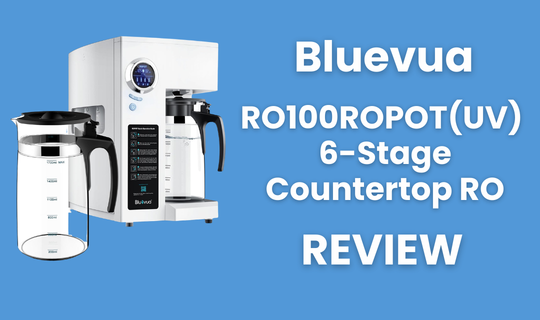
Bluevua RO100ROPOT(UV) Review
The Bluevua RO100ROPOT(UV) is a plug-in countertop reverse osmosis system with UV sterilization, remineralization, and a glass carafe. It performs well in published third-party testing and offers a thoughtful feature set, though the filtration rate is slower than some rivals and a few specs are worth understanding before you buy.
Best for
- Renters who want RO filtration without plumbing
- Buyers avoiding plastic storage containers
- Small households wanting UV and remineralization
Skip if
- Water conservation is your top priority
- You need faster output for heavy daily use
- You want the most thoroughly documented fluoride reduction available
What Is the Bluevua RO100ROPOT(UV)?
| Specification | Detail |
|---|---|
| Brand | Bluevua |
| Model | RO100ROPOT(UV) |
| Filtration Method | Reverse Osmosis |
| Filtration Stages | 6 (PP, CTO, RO, PCF, UV, Remineralization) |
| RO Membrane Pore Size | 0.0001 μm |
| Carafe Material | High Borosilicate Glass |
| Carafe Capacity | 60 oz |
| Filtration Rate | 0.06 GPM |
| Water Efficiency | 2:1 pure-to-waste ratio |
| Certifications | WQA NSF/ANSI/CAN 372, SGS tested |
The Bluevua RO100ROPOT(UV) is a plug-and-play countertop reverse osmosis water filter that combines six-stage purification, UV sterilization, remineralization, and a high borosilicate glass carafe into a single unit that requires no plumbing and no installation.
Simply fill the top reservoir from your tap, plug the unit in, and purified, mineral-balanced water collects in the glass carafe below.
Published third-party testing from BOS Water and Water Filter Guru confirmed strong contaminant reduction across a wide range of pollutants. The system holds WQA NSF/ANSI/CAN 372 certification, which confirms that all components in contact with your water meet lead-free material standards, and has been independently tested by SGS, a globally recognized testing organization.
The borosilicate glass carafe is a big plus over many countertop RO competitors that use plastic storage, and the built-in UV stage adds a layer of biological protection that standard RO filtration alone cannot provide.
Water efficiency runs at a 2:1 pure-to-waste ratio, which compares well against most traditional under-sink systems, though it falls behind the AquaTru Classic on that specific metric.
Check the current price and availability of the Bluevua RO100ROPOT-UV on Amazon →
How the Bluevua RO100ROPOT(UV) 6-Stage Filtration System Works
Understanding what each stage does, and why the order matters, can help you decide whether an RO system is the right investment for your household. In the Bluevua RO100ROPOT(UV), each stage is arranged to protect the one that follows it.
Stage 1: PP Sediment Filter
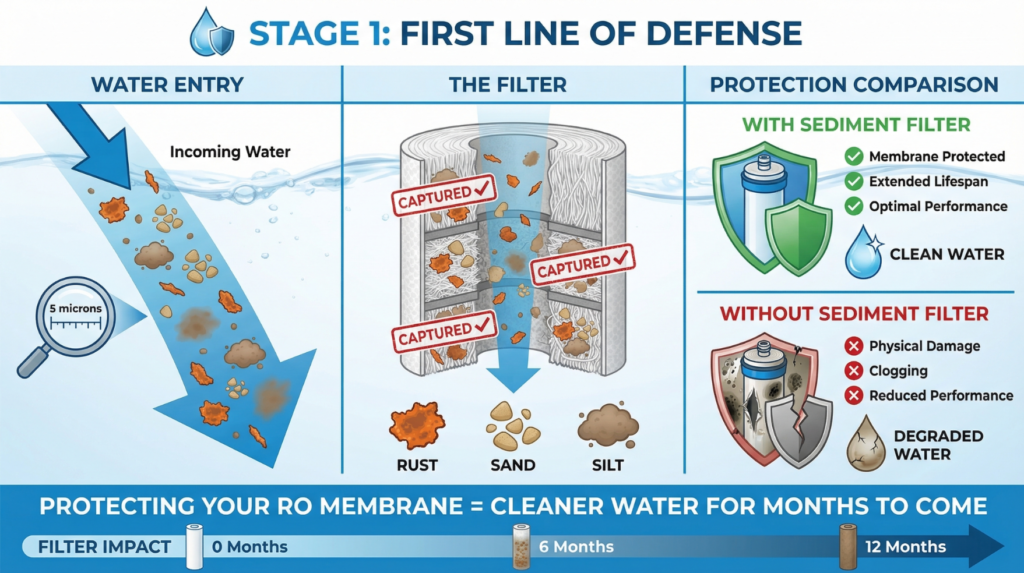
Water enters through a polypropylene filter that captures particles down to 5 microns, including rust flakes, sand, silt, and sediment.
Its primary job is to protect the RO membrane from physical damage, since particles that reach the membrane can tear or clog the surface over time.
Catching them here first helps the membrane perform consistently for longer.
Stage 2: CTO Carbon Block Filter
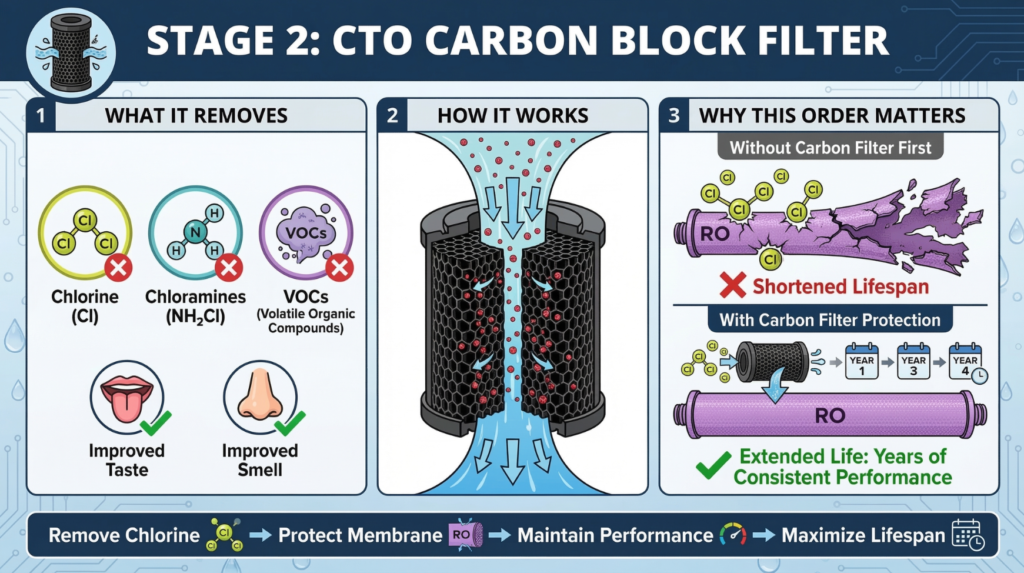
This stage removes chlorine, chloramines, and volatile organic compounds, improving both taste and smell.
There is also a more practical reason it comes before the membrane: chlorine degrades the polymer structure of the RO membrane, so removing it first helps extend membrane life and keeps performance stable over the months and years of use.
Stage 3: RO Membrane (0.0001 Microns)
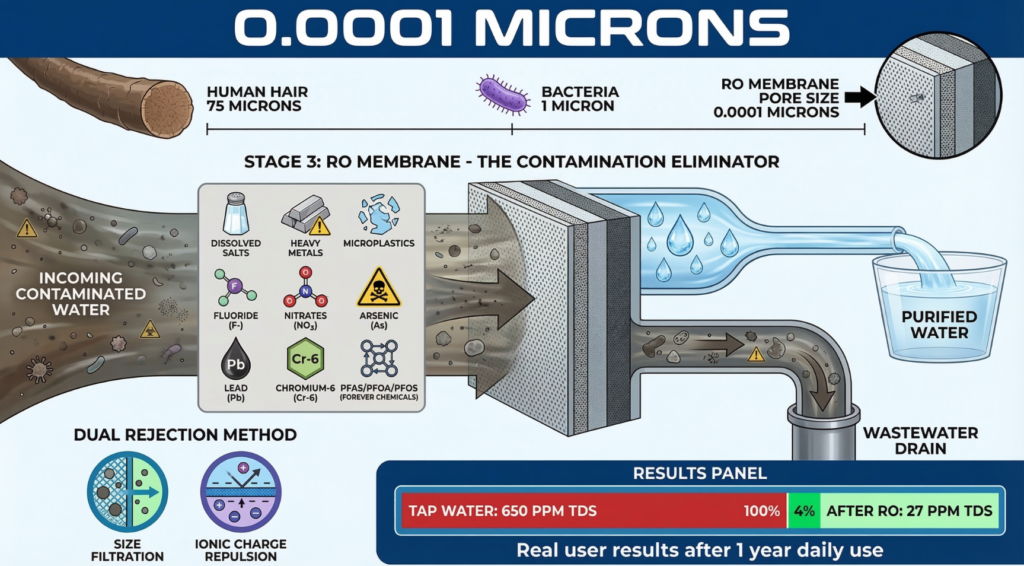
This is where most of the contaminant reduction happens.
At 0.0001 microns, the membrane blocks dissolved salts, heavy metals, microplastics, fluoride, nitrates, arsenic, lead, chromium-6, and PFAS compounds including PFOA and PFOS.
It rejects contaminants based on both molecular size and ionic charge. Anything that doesn’t pass through is flushed away as wastewater.
Stage 4: Post Carbon Filter (PCF)
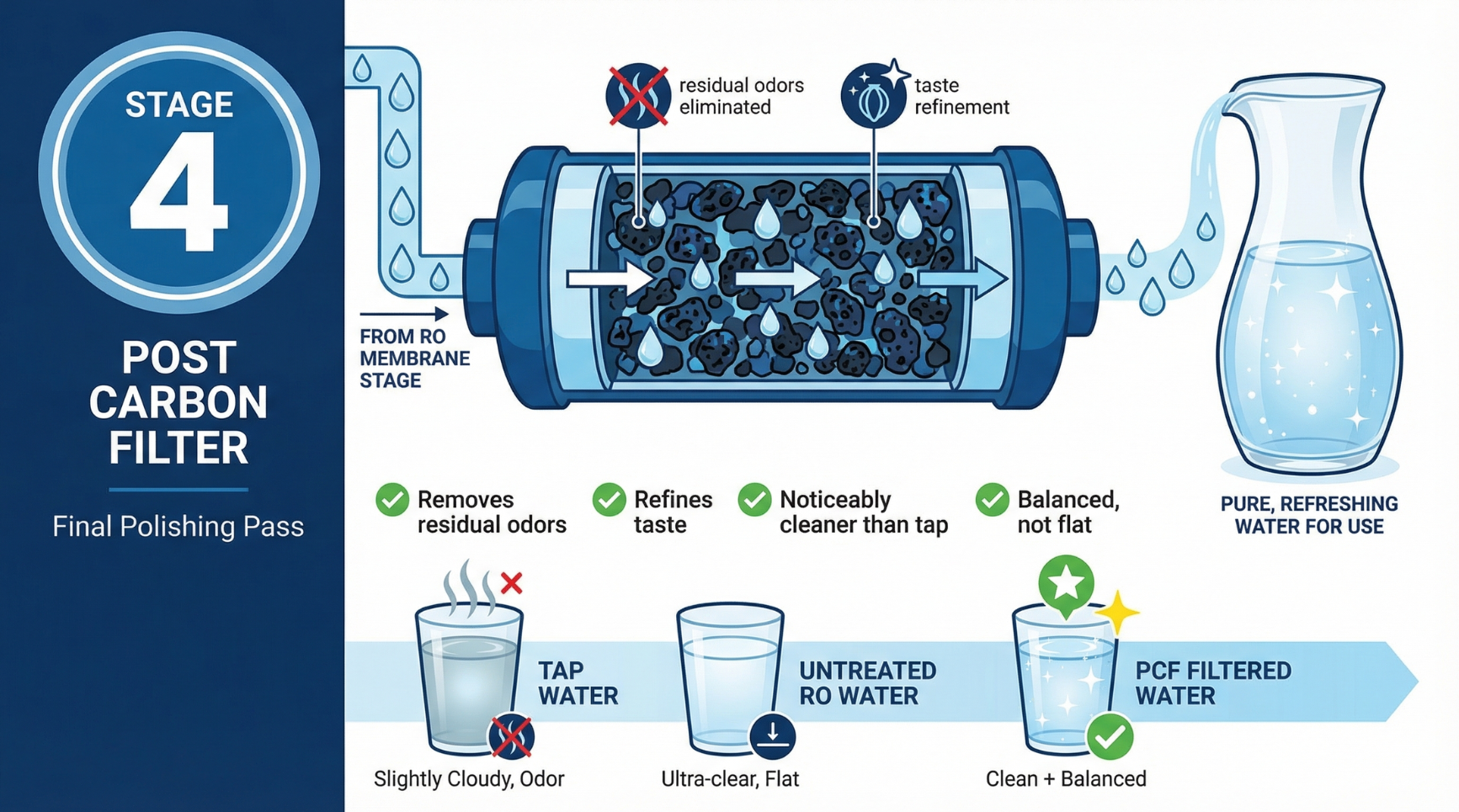
After the membrane, a polishing pass removes any residual odor and refines the taste of the filtered water before it reaches the carafe.
The result is noticeably cleaner and more neutral than tap water, without the flat quality that untreated RO water can sometimes have.
Stage 5: UV Sterilization
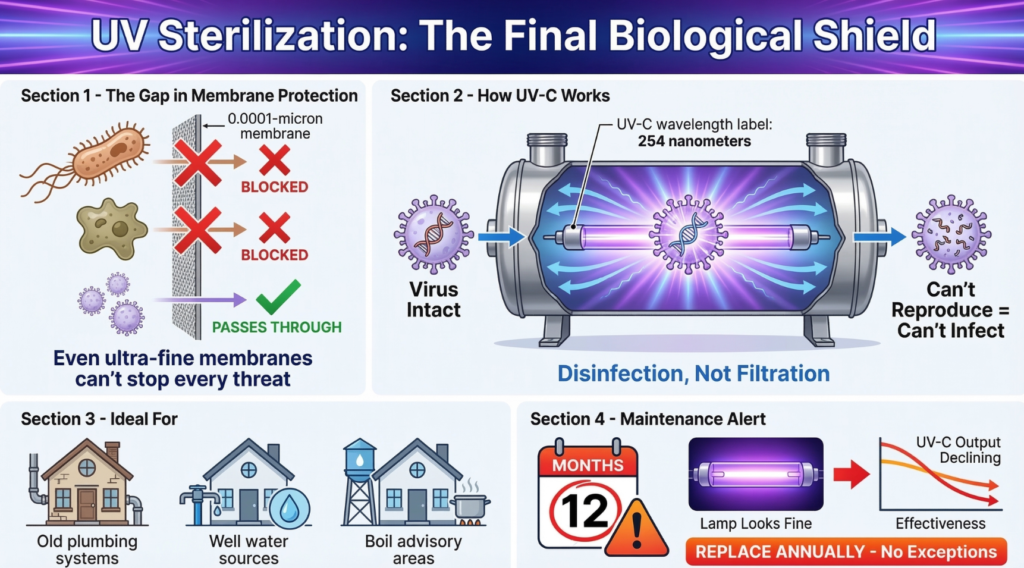
The UV stage adds a disinfection layer alongside RO filtration rather than replacing it.
It’s designed to address biological threats that physical filtration alone may not fully capture, and Bluevua has published microbiological test results for the ROPOT platform covering total coliforms and MS2 bacteriophage.
This stage adds the most value in homes with older plumbing infrastructure, households on well water , or areas that periodically issue boil water advisories.
It is worth noting that the UV component in this unit uses UV LED technology. Bluevua’s published materials indicate a prolonged LED lifespan, though it is worth checking the current manual for your specific model to confirm maintenance requirements.
Stage 6: Remineralization
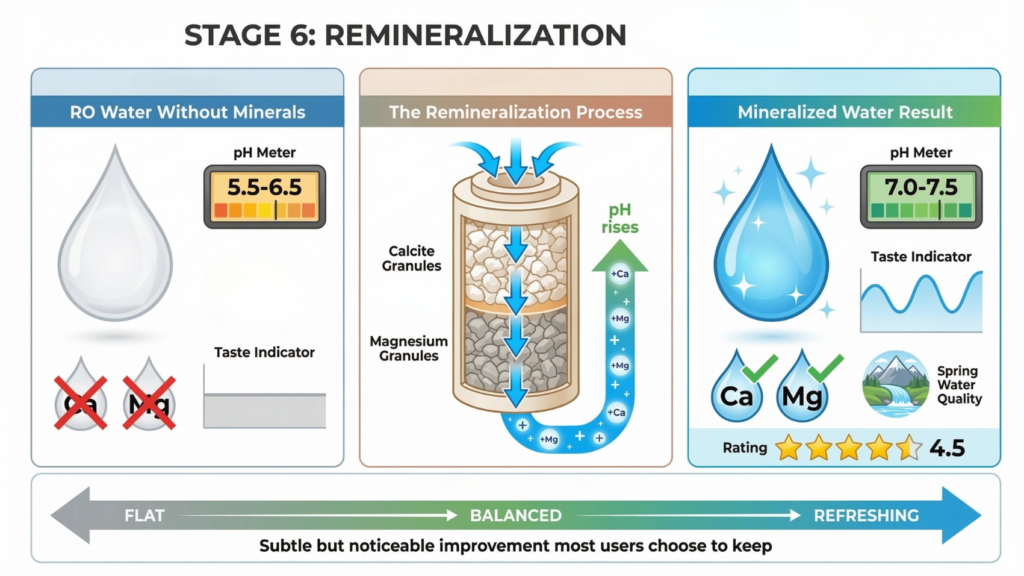
Water coming straight off the RO membrane is mildly acidic and stripped of its natural mineral content.
The remineralization stage uses calcite and magnesium to restore trace calcium and magnesium, raise the pH slightly, and produce water that tastes closer to quality spring water than to something processed.
It is a noticeable improvement, and it’s the reason many people choose to keep this stage active rather than skipping it.
Bluevua RO100ROPOT(UV) Borosilicate Glass Carafe, No Plastic Storage Tank
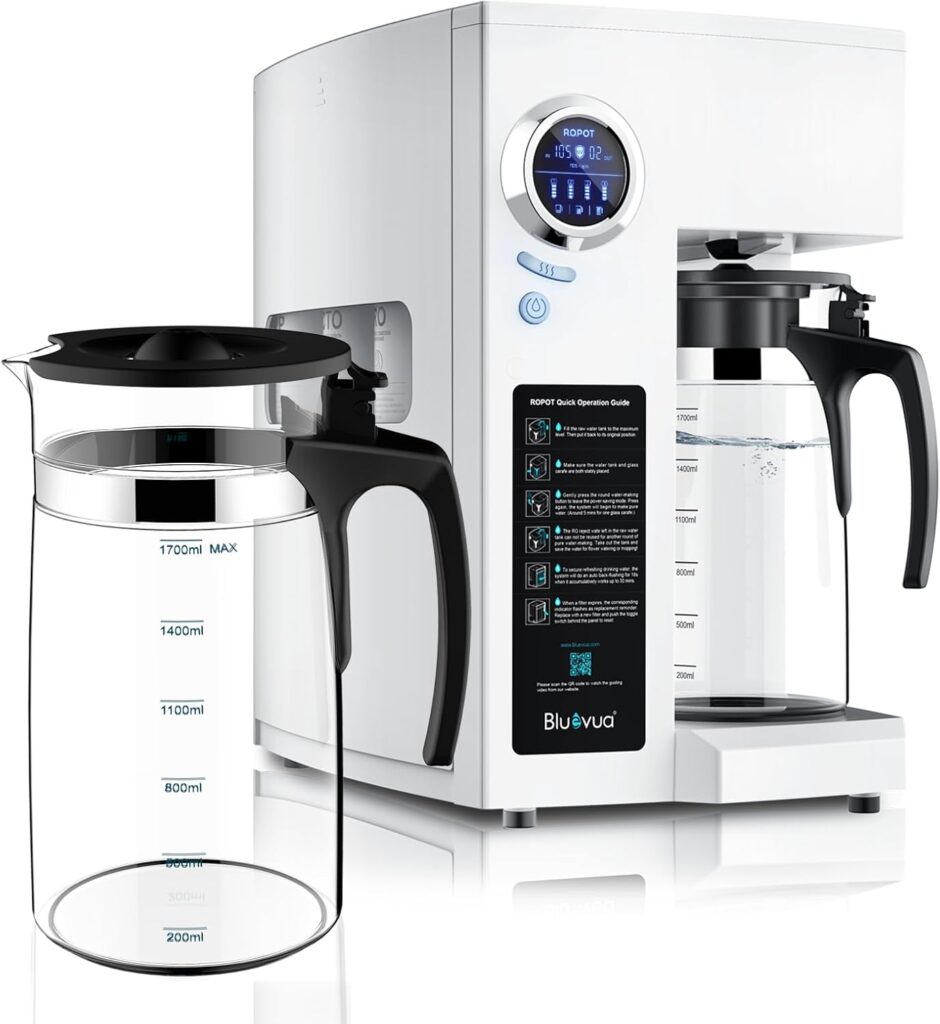
Most countertop RO systems store filtered water in plastic, but the ROPOT(UV) uses a borosilicate glass carafe instead. Borosilicate glass handles temperature changes well, stays chemically stable, and does not leach into the water regardless of how long it sits.
Bluevua’s own messaging describes the glass-first design as keeping purified water away from plastic tanks, which is a meaningful practical differentiator at this price point and not something you commonly see in countertop RO systems.
For people who are filtering heavy metals and contaminants out of their tap water, the idea of storing that water in a plastic container can feel counterproductive. The glass carafe addresses that concern directly.
What Contaminants Does the Bluevua RO100ROPOT(UV) Remove?
Published third-party testing from BOS Water and Water Filter Guru confirmed reliable performance across a wide range of common household contaminants.
Chlorine is addressed in the CTO stage before water reaches the membrane. Lead, arsenic, and heavy metals showed strong reduction results consistent with a 0.0001-micron membrane. PFOA and PFOS, which are now subject to tightening EPA limits, were meaningfully reduced in Bluevua’s published SGS reports.
Fluoride results are worth looking at more closely, because different testing sources report different figures.
Bluevua’s published SGS startup test reports 98.57% fluoride reduction, while WaterFilterGuru’s later hands-on testing found approximately 83%. That gap likely reflects differences in test conditions, water source, and where in the filter’s life cycle the test was conducted, which is common across RO products. Because of that variation, fluoride performance for this model is harder to pin down with a single number than it would be for a system with standardized certified performance data on file.
For most households on standard municipal water supplies, either figure still represents a meaningful reduction. For parents of young children or anyone with specific guidance to minimize fluoride intake, it may be worth factoring in that the documented range is wider here than it would be for a system with a formal certified performance specification for fluoride.
| System | Fluoride Reduction |
|---|---|
| Bluevua RO100ROPOT(UV) | ~83% to 98.57% across published tests |
| AquaTru Classic (NSF/ANSI 58 certified) | ~93–95% |
| Typical NSF-certified under-sink RO | ~90–96% |
Certifications: What the Bluevua RO100ROPOT(UV) Is Covered Under
| Certification | Bluevua RO100ROPOT(UV) | AquaTru Classic |
|---|---|---|
| WQA NSF/ANSI/CAN 372 (Lead-Free) | Yes | Yes |
| SGS Independent Testing | Yes | Not listed |
| NSF/ANSI 58 Performance Certification | No | Yes (83+ contaminants) |
The ROPOT-UV holds WQA NSF/ANSI/CAN 372 certification, which confirms that every component contacting your water meets lead-free material standards. It has also been independently tested by SGS, a globally recognized testing organization, which gives the manufacturer’s published reduction data more credibility than self-reported figures alone.
One thing worth noting: Bluevua’s published materials reference NSF/ANSI 58 at the brand level, while the WQA Gold Seal certificate on its reports page lists the RO100ROPOT(UV) under NSF/ANSI/CAN 372.
Other models in the lineup, including the ROPOT-Lite and ROPOT-Lite(UV), are listed under NSF/ANSI 58 on that same certificate. If certification documentation is important to your purchasing decision, it is worth reviewing Bluevua’s current reports page directly or contacting them to confirm the current status for this specific model.
For most homeowners, the WQA 372 certification and SGS testing data provide a reasonable basis for confidence in material safety and published performance. For immunocompromised individuals, infants, or households dealing with serious source water contamination, reviewing the full certification picture before purchasing is a sensible step.
Bluevua RO100ROPOT(UV): Setup, Installation, and Ease of Use
Getting started with the Bluevua ROPOT-UV is about as low-effort as a water filtration system can get. Place the unit on your counter, fill the top reservoir from your tap, and plug it in. No water line connections, no drilling, no tools required. Most people are up and running in under ten minutes.
Day-to-day use settles into a comfortable rhythm fairly quickly. Many owners describe it as something they stop thinking about after the first week or so. Fill the reservoir, go about your morning, and the water is ready when you need it. Some people run two full carafes daily, keeping one chilling in the refrigerator and one on the unit itself, which works well for staying ahead of demand without much effort.
The LCD display adds a layer of transparency that many people find genuinely reassuring. It shows real-time TDS readings for both your incoming tap water and the filtered output at the same time, so you can see exactly what the system is doing. If the gap between those two numbers starts to narrow over time, that can be a useful signal that the membrane may be ready for attention.
The display also tracks filter life individually by stage and sends alerts when something is due for replacement, which takes the guesswork out of maintenance.
One feature that stands out for a countertop unit at this price point is the automatic self-cleaning and backflushing cycle. It runs on its own without any manual input, clearing buildup from the membrane surface to help maintain consistent output quality over time. That kind of functionality is more commonly found in higher-end under-sink systems, so having it built in here is a genuine long-term ownership benefit.
At 0.06 GPM, a full 60-ounce carafe takes around eight minutes to fill, which is rarely a problem for one or two people. If your household goes through a higher daily volume of water, it helps to keep the reservoir topped up consistently rather than waiting until you run out.
Bluevua RO100ROPOT(UV) Filter Replacement Schedule and True Cost of Ownership
| Filter Stage | Estimated Lifespan | Replacement Frequency |
|---|---|---|
| PP Sediment Filter | 12 months | Once per year |
| CTO Carbon Block Filter | 12 months | Once per year |
| RO Membrane | 12 – 24 months | About every 1–2 years |
| Post Carbon Filter | 12 months | Once per year |
The RO membrane is the most durable component in the system and also the most important one to monitor over time. With average daily use, it can last anywhere from one to two years depending on your source water quality, which makes it one of the more manageable long-term costs in the system.
That said, six filter stages do mean six replacement schedules to keep track of. The LCD display handles most of that for you by tracking each stage individually and alerting you when something is due, so it rarely requires much active attention on your part.
When you factor in the cost per gallon over time, the ongoing expense works out to considerably less than buying bottled water regularly. For many people, the bigger draw is simply not having to purchase single-use plastic anymore.
Bluevua RO100ROPOT(UV) Water Waste Ratio: Is a 2:1 Pure-to-Waste Ratio Good Enough?
The ROPOT-UV operates at a 2:1 pure-to-drain ratio, producing two gallons of purified water for every one gallon sent to waste. That compares favorably to many traditional under-sink reverse osmosis systems, which commonly run at 4:1 or worse, so for most everyday households it holds up well on efficiency.
That said, if water conservation is a significant factor in your decision, it is worth knowing that the AquaTru Classic achieves a 4:1 ratio in favor of purified output, meaning four gallons filtered for every one gallon wasted. For anyone in a drought-prone area or with strong eco-conscious priorities around water use, that gap is worth weighing alongside everything else the two systems offer.
Bluevua RO100ROPOT(UV) vs. AquaTru Classic: Which Countertop RO System Is Right for You?
| Feature | Bluevua RO100ROPOT(UV) | AquaTru Classic |
|---|---|---|
| Best For | Plastic-free storage, UV protection, remineralized taste | Certified performance, fluoride removal, water conservation |
| WQA NSF/ANSI/CAN 372 | Yes | Yes |
| SGS Independent Testing | Yes | Not listed |
| NSF/ANSI 58 Certification | See certification section | Yes (84 contaminants) |
| UV Sterilization | Yes | No |
| Remineralization | Yes | Not included at base price |
| Carafe Material | Borosilicate Glass | Plastic |
| Pure-to-Waste Ratio | 2:1 | 4:1 (more efficient) |
| Fluoride Reduction | ~83–98% (range across published tests) | ~93.5% (certified performance sheet) |
These two systems are built around genuinely different priorities, so the better fit really comes down to what matters most to you.
The AquaTru Classic may be the stronger choice if you want the most thoroughly documented and standardized performance data available, or if fluoride reduction and water conservation are at the top of your list. Its certified performance sheet lists 93.5% average fluoride reduction under NSF/ANSI 58 testing, and the 4:1 efficiency ratio is a real advantage for water-conscious households.
The Bluevua ROPOT-UV can be a better fit if you want to avoid plastic storage entirely, since the borosilicate glass carafe is something you rarely see at this price point. It also has UV sterilization built in, which adds a layer of biological protection that a standard four-stage system simply does not offer.
For anyone concerned about both chemical and biological contaminants, that combined approach covers more ground without needing to buy add-ons. The remineralization stage also means the water tastes good right out of the box, which is not always the case with basic RO filtration alone.
Compare the Bluevua RO100ROPOT(UV) and AquaTru Classic on Amazon →
What It’s Actually Like to Use the Bluevua RO100ROPOT(UV) Every Day
For most people, the first thing they notice after switching to the ROPOT(UV) has nothing to do with TDS numbers or filtration stages.
You stop buying cases of bottled water. You stop running out of water at 10pm and making a mental note to add it to tomorrow’s grocery list. You stop wondering whether the last filter change was six months ago or eight.
The glass carafe changes how the whole system feels. Filling a glass pitcher of water and putting it in the refrigerator is a noticeably different experience than drawing from a plastic reservoir. It’s a small thing, but small things tend to determine whether people actually keep using a product long-term or eventually migrate back to old habits.
The real-time TDS display adds something useful as well. After a few days you start noticing the gap between your tap reading and your filtered output, and many users find that feedback genuinely satisfying. It also serves a practical purpose: if that gap starts closing over time, it’s a reliable signal that the membrane may need attention before the filter alert kicks in.
Once the system is up and running, it largely takes care of itself. The filters track their own service life and let you know when something is due, the self-cleaning cycle runs automatically, and the water is simply there when you need it.
For people who want clean drinking water without a lot of ongoing effort or guesswork, that kind of low-maintenance experience is exactly what they were looking for.
Bluevua RO100ROPOT(UV) Drawbacks and Limitations
A few things to factor in before purchasing:
- It’s slower than an under-sink system. At 0.06 GPM, filling the carafe takes around 8 minutes. That’s fine for one or two people. For a household of four or more with high daily water consumption, the pace can become a bottleneck during busy windows.
- Fluoride reduction results vary across published testing sources. Bluevua’s published SGS report shows 98.57% fluoride reduction, while WaterFilterGuru’s hands-on testing recorded about 83%. That variation may reflect differences in source water, test setup, or filter condition at the time of testing. If fluoride removal is a top priority, it’s worth comparing this model with a system that has a formally certified fluoride reduction figure on file.
- The certification picture requires a closer look. The unit holds WQA NSF/ANSI/CAN 372 certification for lead-free materials and has been independently tested by SGS, both of which provide a reasonable basis for confidence. However, as noted in the certification section above, it is worth reviewing Bluevua’s current reports page if formal performance certification for this specific model is important to your decision.
- Water efficiency trails the AquaTru. The 2:1 ratio is a genuine improvement over most traditional under-sink systems, but the AquaTru Classic produces four gallons of purified water per gallon of waste.
- Six stages means six replacement schedules. The LCD display handles most of the tracking for you, but it is worth calculating the annual filter cost before purchasing rather than after.
Bluevua RO100ROPOT(UV) Review: My Verdict and Final Recommendation
For most renters and apartment dwellers comparing these two, I’d start with the Bluevua ROPOT(UV) specifically for the glass carafe and the UV sterilization stage.
If you’ve already decided to filter your water to reduce plastic and microplastic exposure, storing the filtered water in plastic immediately afterward is a real contradiction. The glass carafe eliminates that.
The UV stage adds a layer of biological protection that a standard four-stage system simply does not have, which is worth considering for anyone on well water, in an area with aging infrastructure, or somewhere that sees seasonal boil water advisories.
The honest caveat is on fluoride documentation. The published test results range fairly widely depending on the source, and if consistently documented fluoride reduction is the primary reason you are looking at RO, particularly for young children, the AquaTru Classic offers a more clearly defined performance specification for that specific contaminant.
For everyone else, the six-stage filtration, glass storage, UV protection, and mineral-balanced output make this one of the more complete countertop RO options available without any plumbing required.
See the exact model and check today’s pricing on Amazon →
Bluevua ROPOT-Lite(UV): The Compact Variant Worth Knowing About
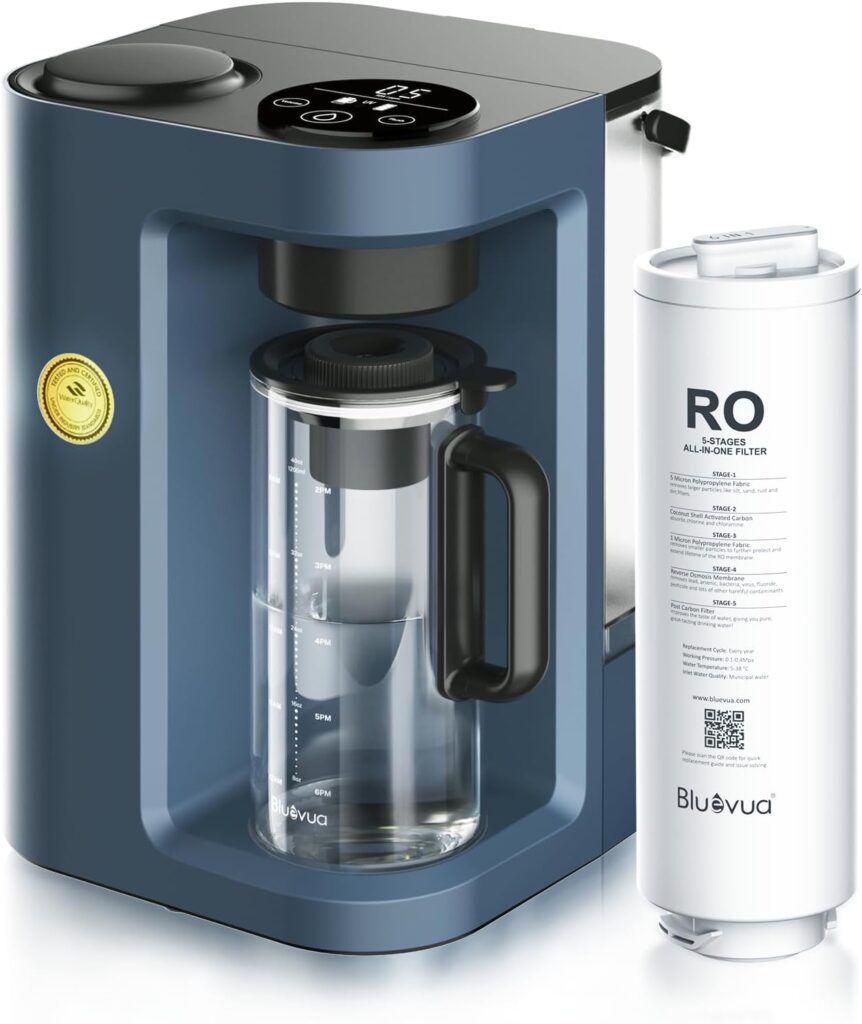
If you’re comparing options within the Bluevua lineup, the RO100ROPOT-Lite(UV) is worth a quick look alongside this model.
It’s the more compact countertop version, built around the same core approach of plug-in reverse osmosis, UV sterilization, remineralization, and a high borosilicate glass carafe, but designed with a smaller footprint that can be a better fit for tighter kitchens or one to two-person households.
The Lite(UV) runs a 7-stage filtration process covering PP sediment, CTO carbon block, RO membrane, post carbon, UV, and remineralization. It is available in Blue, White, UV-Blue, and UV-White colors and comes with the glass carafe, mineral filter, infuser, and cleaning tools included. According to the manufacturer, it operates at a 3:1 pure-to-drain ratio, which is worth comparing directly when you are weighing water efficiency across models.
One thing to keep in mind is that the Lite(UV) is sized for lighter daily use. If you are a larger household or need higher daily volume, the standard model may serve you better. But for someone who wants the core benefits of RO filtration, UV protection, and glass storage in a more space-efficient package, the Lite(UV) is a natural option to consider alongside this one.
Frequently Asked Questions
Is There Any Plumbing or Installation Needed for the Bluevua ROPOT?
There’s no need for any plumbing or installation. The Bluevua RO100ROPOT(UV) is a fully self-contained countertop unit that works by manually filling a top reservoir with tap water. All you need to do is place it on your countertop, plug it into a standard electrical outlet, and it’s ready to filter. There are no water line connections, no drilling, and no tools needed at any point.
How Often Should You Replace the Filters?
The frequency at which the filters should be replaced depends on the stage. The PP sediment filter usually needs to be replaced every 3 to 6 months, while the CTO carbon block filter lasts about 6 months. The RO membrane is the component that lasts the longest, from 12 to 24 months, depending on the quality of the source water and the volume of use. The post carbon filter, UV lamp, and remineralization filter each need to be taken care of once a year. The system’s LCD display keeps track of the life of each stage’s filter and lets you know when it’s time to replace it, so you don’t have to guess when to do the maintenance.
Can I Put the Bluevua ROPOT’s Glass Carafe in the Dishwasher?
According to Bluevua’s current support content, both the water tank and the glass carafe can be cleaned in the dishwasher, and the product copy also describes the carafe as top-rack dishwasher-safe. Even so, keeping the carafe rinsed regularly is a good habit. A carafe that sits without rinsing can accumulate mineral deposits or biofilm over time, particularly in hard water areas.
How Does the Bluevua ROPOT Use UV Sterilization?
The ROPOT-UV includes a UV sterilization stage that adds a disinfection layer alongside RO filtration rather than replacing it. UV sterilization works by disrupting the genetic material of microorganisms so they cannot reproduce, and an organism that cannot reproduce cannot cause infection.
It is a disinfection method, not a filtration method, which means it works in tandem with the RO membrane rather than as a substitute for it. Together, the two stages address a wider range of potential water safety concerns than either technology covers on its own.
Bluevua has published microbiological test results for the ROPOT platform covering total coliforms and MS2 bacteriophage. The UV component in this unit uses LED technology, which Bluevua describes as having a prolonged lifespan. For specific wavelength and maintenance details, the current product manual is the most reliable reference.